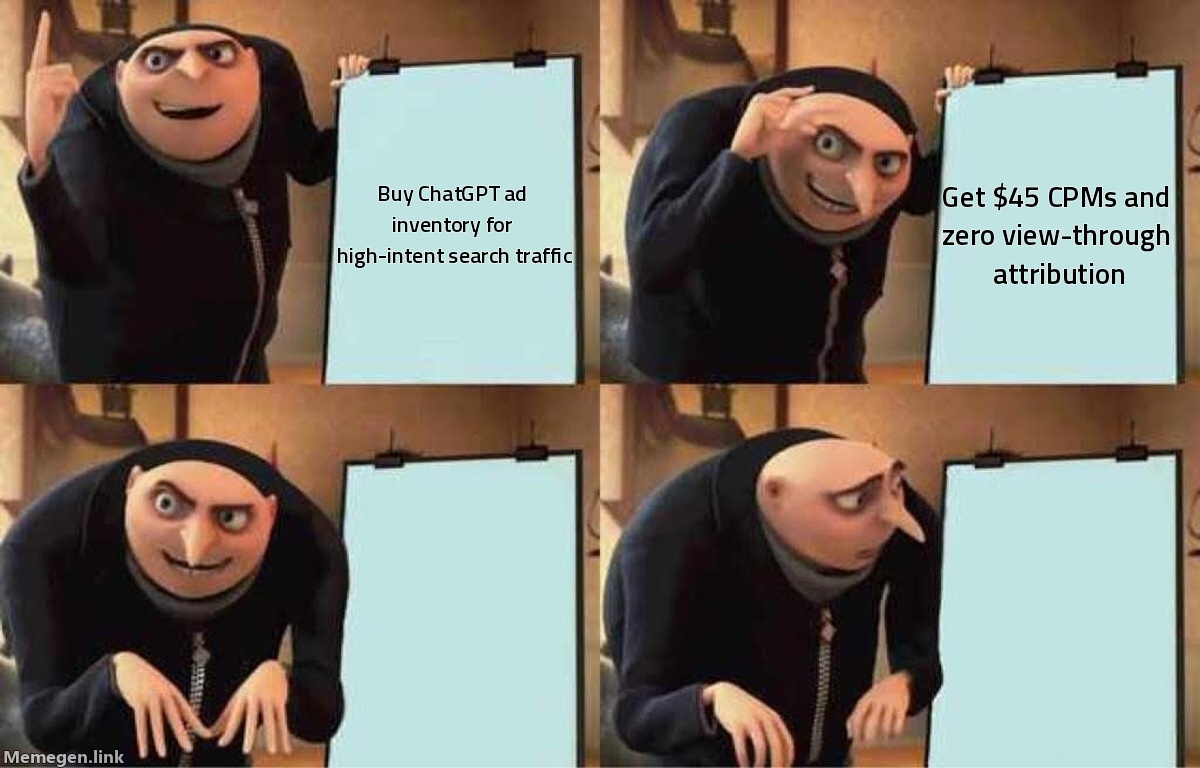
Testing ads in ChatGPT reveals an uncomfortable reality: conversational ad inventory is currently priced like premium broadcast media while delivering the measurement precision of 2012 mobile display network banners. In early commercial test campaigns across e-commerce, B2B SaaS, and high-ticket service verticals, CPMs averaged between $38 and $58, with click-through rates hovering around 0.65% to 1.10% and blended cost-per-click numbers landing between $4.10 and $7.80.
If your media mix assumes conversational AI searches behave identically to Google Search intent, your margin is about to take a hit. Marketers rushing to secure first-mover advantage in generative AI chat interfaces are discovering that prompt-level targeting lacks the commercial precision of standard search queries, while the platform's reporting ecosystem provides almost zero post-click visibility. Testing ads in ChatGPT requires a completely different bidding framework, distinct creative architecture, and realistic unit economics.
The Economics of Testing Ads in ChatGPT: $40 CPMs and Sparse Click Volume
The core tension in conversational advertising comes down to supply, auction density, and real estate. Unlike a Google Search Engine Results Page (SERP) that fits four sponsored text units above the fold alongside shopping carousels and local packs, ChatGPT displays a single sponsored citation or contextual card embedded directly within the generated answer.
That exclusivity sounds premium on a pitch deck. In practice, it drives CPMs into high-bracket territory without delivering the expected click volume.
In multi-vertical testing, the unit economics shake out across three distinct tiers:
- B2B SaaS and Enterprise Technology: CPMs fluctuate between $48.00 and $62.00. Average CPC sits at $6.85. The effective cost-per-lead (CPL) on un-gated demo requests runs 35% higher than targeted LinkedIn conversation ads, primarily due to low conversion intent inside conversational queries.
- Considered Consumer Purchases ($150+ AOV): CPMs stabilize near $34.00 to $42.00. Click-through rates average 0.95%, producing CPCs around $4.20. When offers require education—such as specialized supplements, home energy retrofits, or ergonomic hardware—on-page conversion rates reach 2.8%, making the channel marginally profitable on a first-touch basis.
- Low-Ticket Impulse E-Commerce (<$50 AOV): CPMs remain fixed at the network floor of ~$30.00. Because users inside ChatGPT are actively solving problems rather than passively browsing lifestyle imagery, conversion rates bottom out below 0.8%, producing customer acquisition costs (CAC) that exceed customer lifetime value on the first transaction.
The inventory is not cheap. When you buy traditional search, you pay strictly for the click. In ChatGPT's current auction mechanics, you are effectively buying contextual impression density where only a fraction of users ever interact with hyperlinked citations or product widgets.
Targeting Realities: Why Prompt Intent Is Not Search Intent
The most frequent mistake media buyers make is pasting their standard high-intent Google Search keyword list into conversational AI targeting profiles. Prompt intent and search intent represent two fundamentally different consumer behaviors.
When a user searches Google for "best enterprise CRM software," they expect a list of vendors, review aggregators, and pricing tables. They are in evaluation mode and ready to click through to landing pages.
When a user asks ChatGPT, "Compare the data governance features of HubSpot and Salesforce for a Series B fintech company," they want the answer synthesized directly inside the chat interface. They do not want to leave the platform. When sponsored recommendations appear underneath that synthesized answer, they function more like contextual display ads than transactional search ads.
We have already observed that organic AI citations deliver high conversion efficiency—as documented when Shopify reported AI-referred orders surged 13x with higher conversion rates than organic search. However, paid insertions interrupt the conversational flow rather than serving as the foundational source material of the model's response.
Furthermore, prompt drift degrades ad relevance within extended sessions. If a user starts a conversation asking about tax compliance software but branches into state filing deadlines three prompts later, keyword-level targeting often triggers ads based on initial session tokens rather than the active prompt context. You end up paying $5.00 a click for queries that have already moved past your value proposition.
Attribution Blind Spots and Conversion Bidding Mechanics
Measuring campaign efficacy in ChatGPT is currently an exercise in data reconciliation. The platform does not support third-party view-through attribution tags, does not pass granular query-level parameters via click identifiers, and strips referrer headers across several native desktop and mobile app wrappers.
While the rollout of programmatic bidding features—such as conversion bidding options for ChatGPT ads—allows accounts to optimize toward downstream events, the feedback loop to ad networks remains constrained by server-side tracking limitations.
The Tracking Breakdown
If you rely on standard client-side pixel tracking, expect a 25% to 40% discrepancy between ChatGPT reported clicks and your web analytics platform's tracked sessions. Because users frequently copy text, open links in external browsers, or interact across mobile app sandboxes, direct click-to-session resolution fails at a much higher rate than on Meta or Google properties.
To prevent budget leakage across unproven channels, run a Gromerce audit on your current paid search and social baseline. If your existing Google Search and Meta campaigns are not already optimized to maximum conversion value efficiency, reallocating spend into an opaque, high-CPM channel will only inflate your blended CAC.
Creative Formats That Fail vs. Formats That Work
Standard search ad copy—composed of transactional headlines like "Buy Now - 20% Off Official Site"—delivers sub-0.4% CTRs in conversational interfaces. The user is reading a paragraph of analytical text; a screaming discount banner creates instant ad blindness.
Winning ad units adopt contextual citation styling:
- Problem-Solving Assets: Direct links to interactive calculators, benchmark reports, or un-gated comparison tools convert 3x better than product category pages.
- Single-Item Solution Cards: For e-commerce, pointing directly to a single SKU that directly addresses the prompt's technical requirement outperforms multi-product catalog feeds.
- Educational Anchor Text: Copy that frames the click as the logical deep-dive resource (e.g., "Review the complete implementation framework here") maintains the analytical tone of the AI response.
What to Do This Week Before Spending Budget on ChatGPT
Do not allocate more than 5% of your experimental media budget to conversational AI placements until the platform introduces query-level reporting and verified conversion pass-back protocols. If you are preparing to run tests, execute this four-step checklist:
- Establish Organic Referral Baselines First: Filter your web analytics for
chatgpt.comandopenai.comreferral sources. If your organic conversion rate from conversational AI traffic is below your site-wide average, paid conversational ads will not perform. Fix your landing page continuity first. - Mandate Deep-Funnel First-Party Tracking: Construct rigid UTM parameters utilizing custom parameters for campaign IDs and contextual placement groups. Rely entirely on server-side Conversions API (CAPI) or backend order webhooks to measure true acquisition costs, ignoring the in-platform conversion metrics.
- Restrict Tests to High-Consideration Offers: Turn off testing for products priced under $100. Restrict ad sets to high-LTV B2B services, complex software, or specialized physical goods where a $6.00 CPC can be absorbed by gross margins exceeding $200.
- Set Hard Impression Capping and Daily Spend Limits: Because conversational inventory can spike unpredictably based on trending AI prompt topics, enforce strict daily budget caps to prevent the auction algorithm from burning weekly allocations during sudden traffic surges.
Sources:
- PPC Hero: We Tested Ads in ChatGPT: Here's What the Channel Actually Does