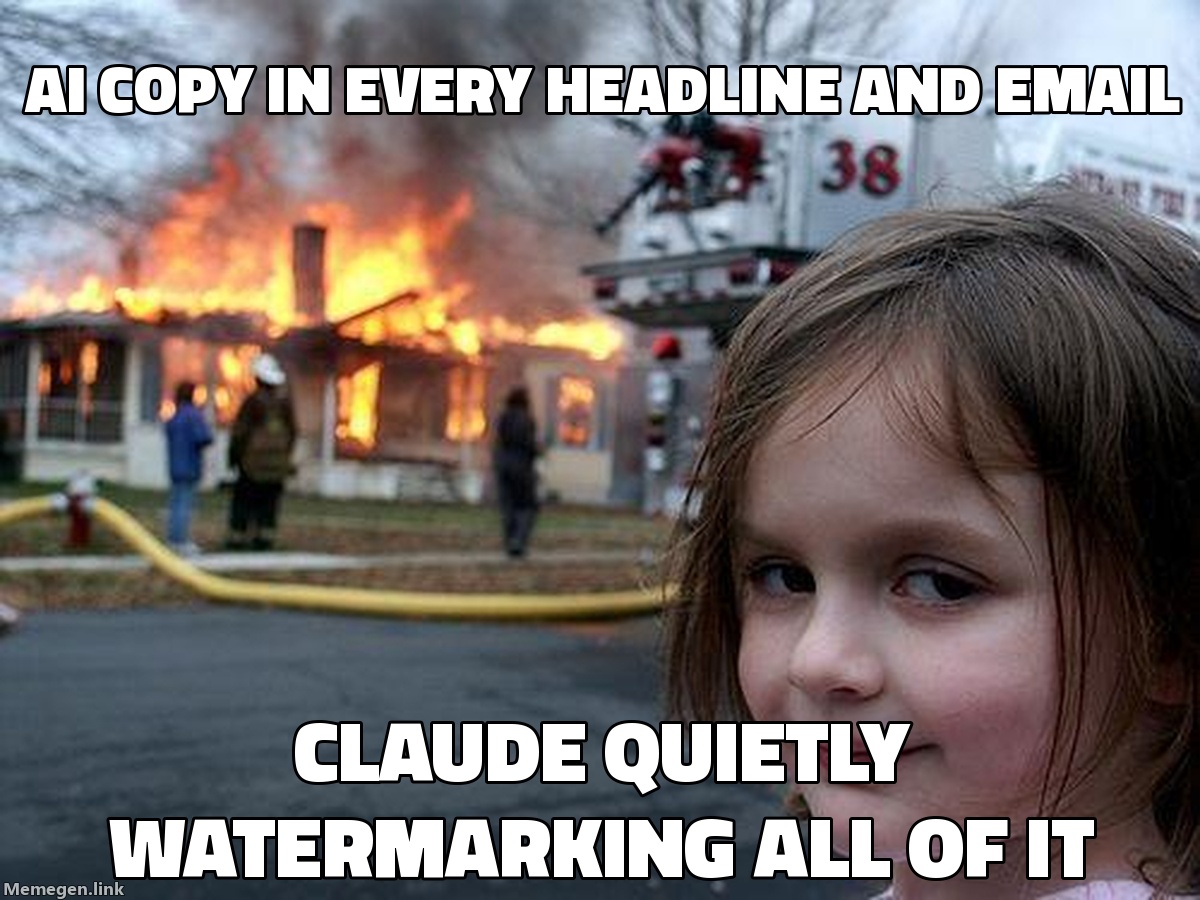
Anthropic announced on August 11 that Claude now embeds invisible watermarks in every piece of text it generates. Not a label. Not a disclosure badge. A statistical pattern woven directly into word choices during generation — undetectable to human readers, but readable by anyone with Anthropic's decoding key.
Google's Gemini has been doing this with SynthID for some time already. ChatGPT doesn't currently watermark text.
The watermark follows copy wherever it goes. Paste a Claude-generated ad headline into your Google Ads RSA fields. Export a Gemini-written product description to your Shopify catalog. Drop an AI-generated email subject line into your ESP. The statistical pattern embedded in the original text travels with it through every copy-paste.
How the watermark works
The mechanism, described by Anthropic in their August announcement and reported by TechCrunch, changes the source of randomness Claude uses when choosing between token options that wouldn't alter a sentence's meaning. At any point where Claude could pick one of several equally valid words or phrasings, the watermark influences that choice to encode a hidden pattern.
The result reads identically to unmarked text. The underlying signal does not.
Anthropic is applying it globally. They don't yet have the infrastructure to scope watermarking by geography, so Claude models launched on or after August 2 ship with it regardless of where the user is. Older Claude models are being updated over the coming months.
What this changes about AI copy
For the past few years, whether you used AI to generate ad headlines, email campaigns, or landing page copy was effectively invisible. No platform could reliably detect it. No regulator could verify it at scale.
That's changing in two phases.
Phase one is already active: the EU AI Act's Article 50 visible disclosure requirement came into force on August 2. If you're running AI-generated ad content in EU markets, you're legally required to label it. This applies to Claude output, Gemini output, and any content generated by AI tools deployed in commercial contexts reaching EU users.
Phase two comes December 2: the machine-readable watermarking grace period ends. After that date, organizations deploying AI content generation for EU-accessible audiences must be able to demonstrate their output is technically marked. Claude's invisible watermark and Gemini's SynthID both satisfy this requirement. ChatGPT's text at present does not — though OpenAI is under the same regulatory pressure and this gap is unlikely to hold.
The competitive gap in your toolchain
TechRadar's reporting noted real anxiety among marketers: that Claude's watermarks could make their AI usage detectable to platforms or clients before any enforcement mechanism requires disclosure. That reaction is understandable but premature. No ad platform has announced it's scanning for text watermarks in ad copy submissions. Google, Meta, and TikTok have not published watermark detection policies.
What's changed is the infrastructure. The watermark is now in the copy. Whether someone eventually reads it is a separate question from whether it exists.
As Inc. noted, "the era of secret AI use may be ending" — not because platforms are scanning for it today, but because the technical layer that makes content verifiable is now live. ChatGPT's current unmarked output is simultaneously lower compliance overhead right now and higher risk if OpenAI adds watermarking faster than you've built internal documentation around it.
Forbes covered the reaction when Anthropic made the announcement: some brands worried about being exposed before any policy required disclosure. That's the wrong way to read the timing. The visible disclosure requirement has been law in EU markets since August 2. The watermark is how auditors eventually verify compliance — it doesn't create a new obligation, it makes an existing one enforceable.
Four things to verify before December
Check which AI tools in your content workflow are generating publicly-facing text and whether they're currently watermarking output. Claude and Gemini are; most tools built on top of these models inherit that behavior. Tools built on ChatGPT do not yet.
Review whether you've applied visible AI labels to EU-market ad content since August 2. This is the currently enforced requirement, and it's separate from the watermarking question.
Document your AI content production workflow now. When watermark reading becomes standard practice — whether through platform policy, regulatory audit, or third-party verification — retroactive documentation is harder and less credible than contemporaneous records.
And audit your copy against any existing brand compliance or legal review requirements from before the EU AI Act. The Act adds a disclosure obligation on top of your existing compliance baseline, not in place of it.
If you want a read on how your tracking and attribution hold up before adding compliance infrastructure to the stack, the free audit at Gromerce gives you a useful baseline in a few minutes.
Sources: Anthropic, TechCrunch, Forbes, TechRadar, Inc., August 2026