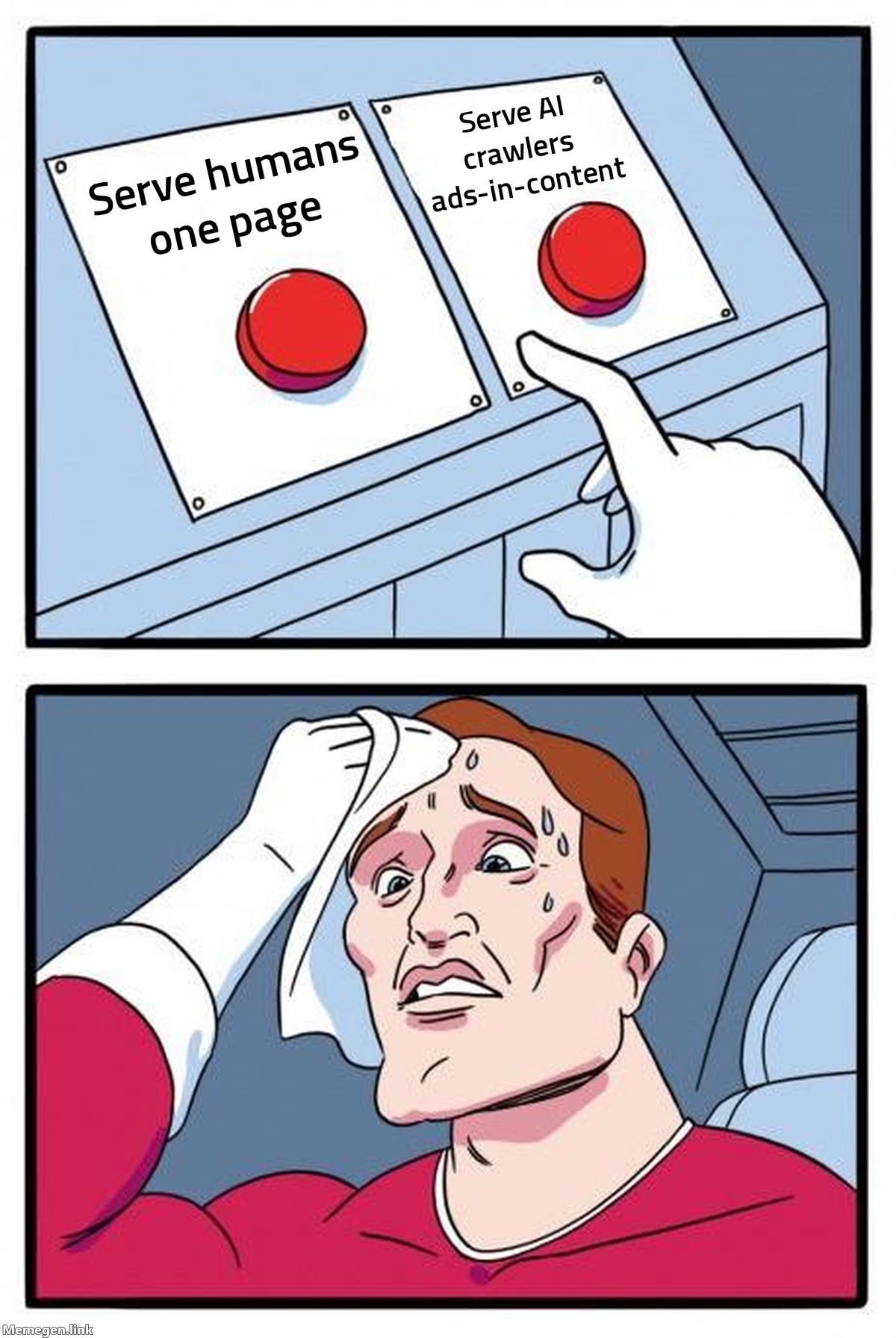
When ClaudeBot or PerplexityBot crawls Time magazine's Best Inventions of 2025 list, it doesn't see the same page you do. It gets a 42 KB markdown file — stripped of JavaScript, navigation, and images. And baked into that file is an Ally Bank FAQ block: "Who is Ally Bank?" "Can you deposit cash at Ally Bank?" Each question carries a tracking link tagged campaign="ally-2026-q3".
Human readers never see any of it.
How This Actually Works
Time converted all of its pages to markdown in June 2026. The reasoning: make the content easier for AI systems to read and increase the odds that Time articles appear in generative search answers. The ad format came next.
Working with ad-tech platform Mobian, Time now injects sponsored content into the markdown versions served to AI crawlers. Three bots specifically get the treatment: ClaudeBot, PerplexityBot, and OAI-SearchBot. The human-facing version — 1.2 MB of HTML — contains nothing of the kind.
The sponsored blocks are technically labeled "sponsored" inside the markdown. That's the extent of the disclosure. No reader who gets a ChatGPT or Perplexity answer influenced by this content will see any such label.
Google's bots are excluded. Google penalizes sites that show crawlers different content than humans — that's classic cloaking, which kills your organic ranking. The AI crawler category operates under different rules for now.
Why Ally Bank Is Writing Checks for This
The premise behind the buy is straightforward: AI systems generate answers from what they've crawled. If an AI has read a well-structured FAQ about Ally Bank, there's a higher chance it surfaces that information when someone asks "what's a good online bank?" The placement is essentially buying context into the AI's retrieval layer.
Whether that works is genuinely unverified. Neither Time nor Ally Bank has published citation data — there's no way to track when an AI answer was influenced by a sponsored FAQ block crawled months ago. The Project Management Institute is also running placements. Both are making a bet on a channel with no standard measurement yet.
Time's COO declined to share pricing. "Premium" was the only description offered.
The Disclosure Problem Nobody Has Solved
The FTC requires disclosed advertising. Time argues the "sponsored" label in the markdown satisfies that requirement.
It doesn't, practically speaking. Disclosure in a machine-readable file that no human reads isn't disclosure to the audience that matters. If an AI assistant cites a sponsored FAQ when someone asks a financial question, and neither the AI nor the publisher surfaces that commercial relationship, the user is being influenced by undisclosed advertising. The fact that the intermediary is a bot doesn't change the outcome for the person at the end of the conversation.
This is structurally where native advertising was before the FTC issued guidance in 2015 — technically disclosed, practically invisible. Expect similar regulatory pressure once the format gets wider adoption. Other publishers are already watching Time's experiment; several have reportedly begun building markdown infrastructure for the same purpose.
What You Can Actually Do Now
You can't buy this format today unless you're working directly with Time or another publisher running a similar program. There's no self-serve inventory, no standard IAB format, no measurement framework. It doesn't exist at scale yet.
But the underlying mechanic is already within reach. Your product pages, FAQ sections, and brand documentation are already being crawled by these bots. How that content is structured determines how AI systems represent your brand when users ask questions in your category.
Clean up your FAQ pages. Write in plain sentences, not bullet fragments. Answer the questions your customers actually ask — the same ones you've handled on sales calls and in support tickets. Use your brand name naturally in answers, not just in headings. Structure matters to machine readers the way keyword density once mattered to search algorithms.
Time just put a price tag on crawl-layer influence. The free version of it is still available, and most brands haven't optimized for it at all.