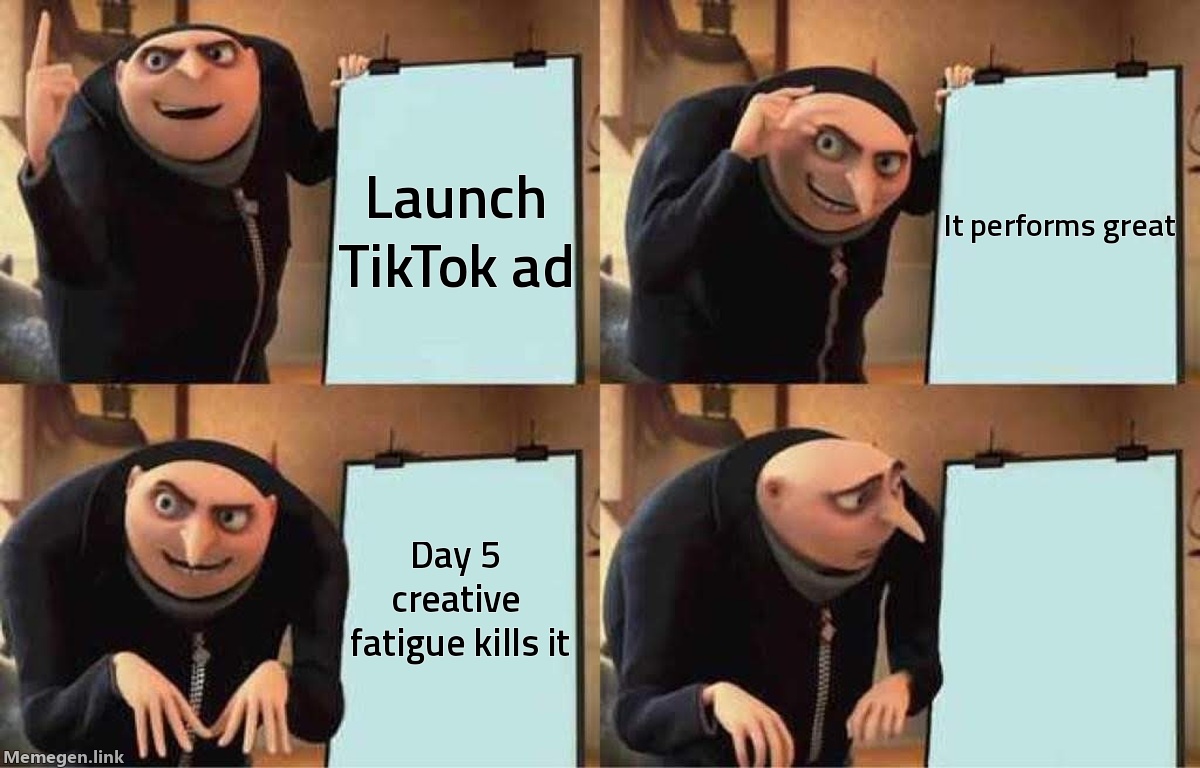
If you're running paid ads on TikTok, you've probably noticed that what works on Monday can be exhausted by Friday. This isn't your imagination — TikTok's creative fatigue cycle is genuinely faster than any other major ad platform, and misunderstanding it is one of the most expensive mistakes e-commerce advertisers make.
The Numbers Behind Creative Fatigue
On Meta, a strong creative typically has a useful life of 3–6 weeks before frequency-driven fatigue starts dragging down performance. On Google, search ads can run for months with minimal degradation.
On TikTok, the median lifespan of a top-performing ad creative is 3–7 days at moderate spend levels. At aggressive spend levels (over $2,000/day per creative), you may see saturation in 24–48 hours.
This isn't a bug — it's structural. TikTok's feed is built for novelty. Users are algorithmically trained to expect fresh content constantly. When the same ad appears repeatedly, it triggers a stronger negative signal than on platforms where ad repetition is more normalised.
Why Frequency Data Is Misleading on TikTok
On Meta, a frequency of 2.5–3.5 over 7 days is a reasonable saturation signal. On TikTok, the algorithm distributes impressions differently — you can have a low average frequency account-wide while specific audience segments are seeing the same creative 6–8 times.
The more reliable signal is view completion rate trend over time. A fresh creative on TikTok typically achieves 25–40% completion on the first 2 days. When that number drops below 15% and cost per result starts climbing, you're looking at creative fatigue — regardless of what your frequency metric says.
The Content Production System That Keeps Up
The brands consistently winning on TikTok Ads in 2026 aren't producing better individual creatives — they're producing more of them, faster. The operational model that works:
Weekly creative sprint (minimum 3 new concepts per week) Each concept should have a distinct hook — the first 3 seconds need to feel like different content. You can recycle offers, CTAs, and product footage, but the entry point must feel fresh.
Hook testing structure Run 5–7 hooks per week in a testing campaign at a low daily budget ($20–50 per creative). Identify which hooks achieve >25% 3-second view rate. Graduate winners to your main campaign. Kill losers within 48 hours.
UGC-first creative library Native-looking content consistently outperforms produced brand content on TikTok. Building a library of authentic UGC — product reviews, unboxings, before/after — gives you raw material that can be remixed into new hooks quickly.
Spark Ads for top organic posts If you have an organic TikTok presence, Spark Ads (boosting your own organic posts as paid ads) consistently show lower CPMs and higher engagement rates than standard in-feed ads. They reset the fatigue clock because they feel genuinely organic.
Campaign Structure for Creative Testing
The account structure that minimises the cost of creative fatigue:
- Testing Campaign — $50–100/day total, $20–30/ad set, one creative per ad set, 48-hour evaluation window
- Scaling Campaign — Top 3 performers from testing, broad audience, higher budget
- Retargeting Campaign — Video viewers (25%+) and website visitors, separate creative that assumes some product awareness
Separating testing from scaling prevents algorithm confusion and gives you clean data on what's actually working.
What the Audit Flags
When Gromerce audits a TikTok account, creative fatigue signals are part of the Creative & Testing pillar assessment. Accounts with fewer than 3 active creatives per campaign and no documented testing cadence score significantly lower — not because current performance is necessarily bad, but because the structural risk of a sudden performance cliff is high.
If you're running TikTok Ads and haven't run a recent audit, the diagnostic takes under 3 minutes.
Related articles: amazon-prime-video-dynamic-tv-creative-2026 · meta-andromeda-creative-first-2026 · tiktok-ad-free-subscription-uk-2026
Sources: TikTok for Business Advertising Guidelines, industry practitioner benchmarks, agency data Q1 2026