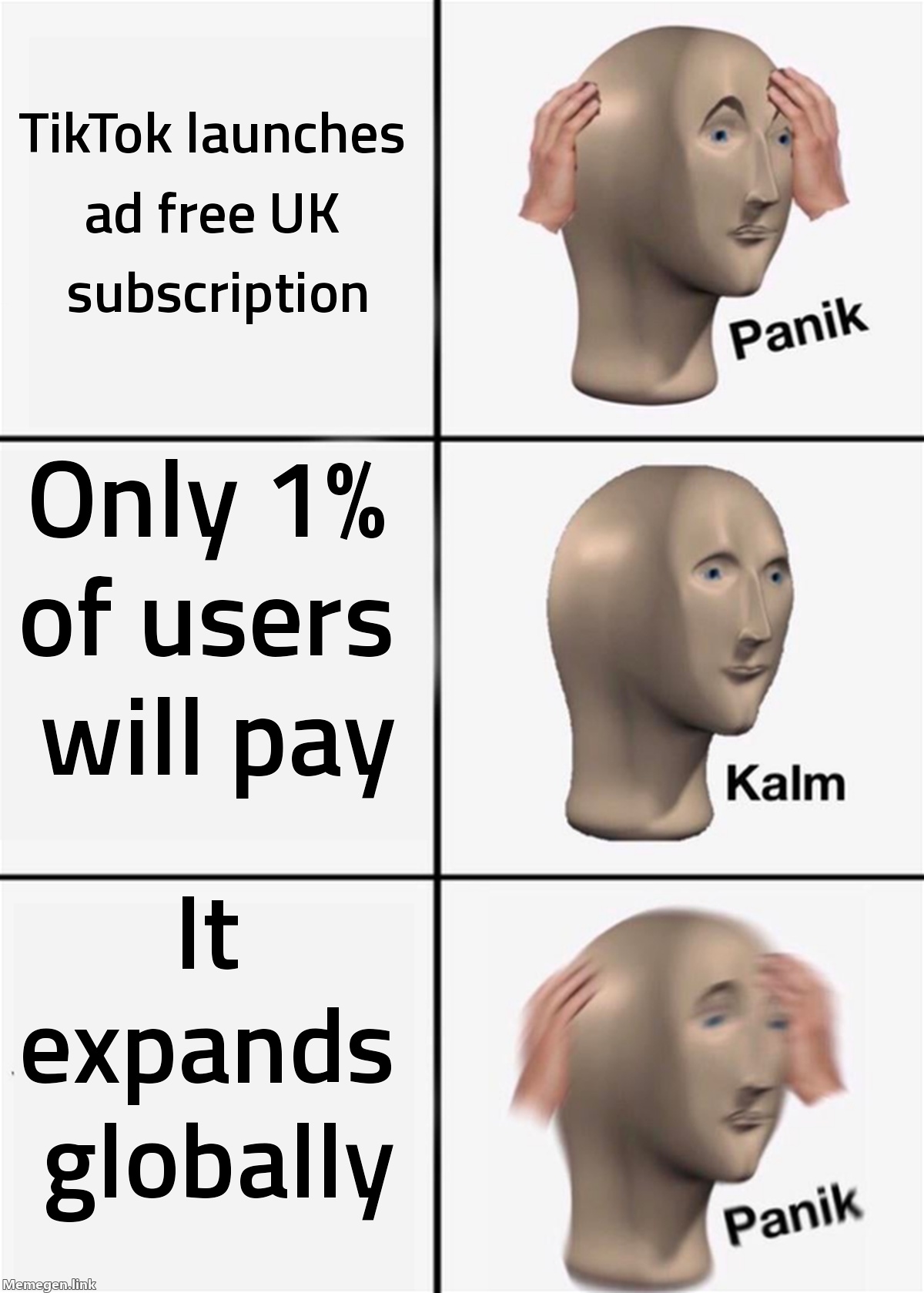
TikTok started notifying UK users on May 11 that they can now pay £3.99 a month to remove advertising from the app entirely. The offer is available to users 18 and over, rolling out over the coming months. Users have until November 11 to make their choice: stay on the free, ad-supported version or subscribe.
This is TikTok's first real ad-free tier in an English-speaking market. The platform tested a similar product briefly in 2023, but this is a full commercial rollout — not a test.
What the subscription removes (and what it doesn't)
Subscribers get clean feeds. No platform-served ads in the For You page, search results, or anywhere else TikTok injects promoted content from its ad auction.
What they still see: influencer posts, branded partnerships, and creator-produced sponsored content. That distinction matters. Paid posts by creators are treated as organic content by TikTok's algorithm — the subscription only removes what TikTok sells directly through Ads Manager.
The data side is the bigger issue for advertisers. Subscribers' information won't be used for personalized ad targeting. For a platform whose entire optimization model runs on behavioral signals, that's a meaningful exclusion, not a footnote.
The user who pays £3.99 to skip ads
This is the question your account strategy actually needs to answer — and there's no clean data yet.
On Meta's EU ad-free tier and YouTube Premium, the pattern has been consistent: the segment that pays to avoid ads is small in absolute terms but skews toward higher income, higher purchase intent, and more privacy-conscious behavior. Not TikTok's largest demographic. But not irrelevant to most e-commerce advertisers either.
On TikTok specifically, the platform's UK base skews younger. The 18–24 bracket is unlikely to pay £3.99 to remove ads from a free service. But if the 28–45 demographic — the group with real purchasing power for most DTC categories — disproportionately opts out, the audience composition shift affects your campaigns even if your raw reach numbers don't change immediately.
You won't see it in your reach metrics first. You'll see it in conversion rates and CPM trends if you're watching.
What this changes for your TikTok account right now
In Q2 2026, very little changes for most advertisers. Adoption will be slow. TikTok's ad inventory in the UK is not about to meaningfully contract.
Four things are worth tracking as the subscription scales up:
UK CPMs may trend upward through late 2026. As premium users leave the addressable pool, the same advertiser demand chases a slightly smaller audience. Price pressure follows inventory pressure.
Your Spark Ads and retargeting audiences will be built on a self-selected sample. Behavioral signals feeding TikTok's optimization come from users who haven't opted out — which means your algorithmic targeting is increasingly biased toward users who tolerate ads rather than users who convert.
Creator partnerships become the only TikTok placement that reaches subscribers. Branded content posted by creators appears in subscribed users' feeds like any other post. If you're not already running creator whitelisting or Spark Ads from owned content, this is a reason to start.
Watch frequency and creative fatigue in your UK campaigns. A smaller addressable pool with consistent ad spend means remaining users see your creative more often. The fatigue cycle shortens.
The pattern every paid media manager needs to understand
TikTok isn't doing something new. YouTube Premium has existed for years. Meta launched an ad-free subscription in the EU and UK in late 2023, driven by GDPR consent requirements. X offers ad-free tiers with its paid subscriptions. Now TikTok.
Every major platform is bifurcating: free users fund the ad business, paying users fund the subscription revenue. Platforms win either way. Advertisers don't — the premium users who opted out were often the most valuable segment of the addressable audience.
This is a structural trend, not a one-off policy change. The addressable universe on any platform will shrink gradually over time as more users find the subscription price worth paying. It adds to the same long-run fragmentation happening across streaming, connected TV, newsletters, and podcasts.
The platforms will reframe this as audience quality improvement — fewer disengaged users, higher intent among those remaining. That argument has some validity. But it's also convenient.
What to do with this
No major account restructuring is needed right now for UK advertisers. But the right move is to establish a baseline: pull your UK CPMs, conversion rates, and audience quality metrics this week and track them monthly through Q4 2026.
If your TikTok UK spend is significant, it's also worth testing creator-led formats now — before subscription adoption changes the calculus. The brands that already have creator pipelines won't scramble when organic placement becomes more important than paid placement.
A free audit at gromerce.com/audit can show you where your current TikTok setup is exposed and whether your creative, targeting, and placement mix is calibrated for where this platform is heading.
Ad-free subscriptions don't kill your TikTok campaigns — they quietly narrow the audience you can reach, and the thinning starts before the data tells you it did.
Related articles: tiktok-ads-creative-fatigue-2025 · tiktok-out-of-phone-dooh-2026 · tiktok-search-hubs-world-2026
Sources: TikTok Newsroom, TechCrunch, Social Media Today, MediaPost, May 2026