Twelve days. That's how long Meta's Muse shopping agent operated inside Amazon before Amazon shut it out.
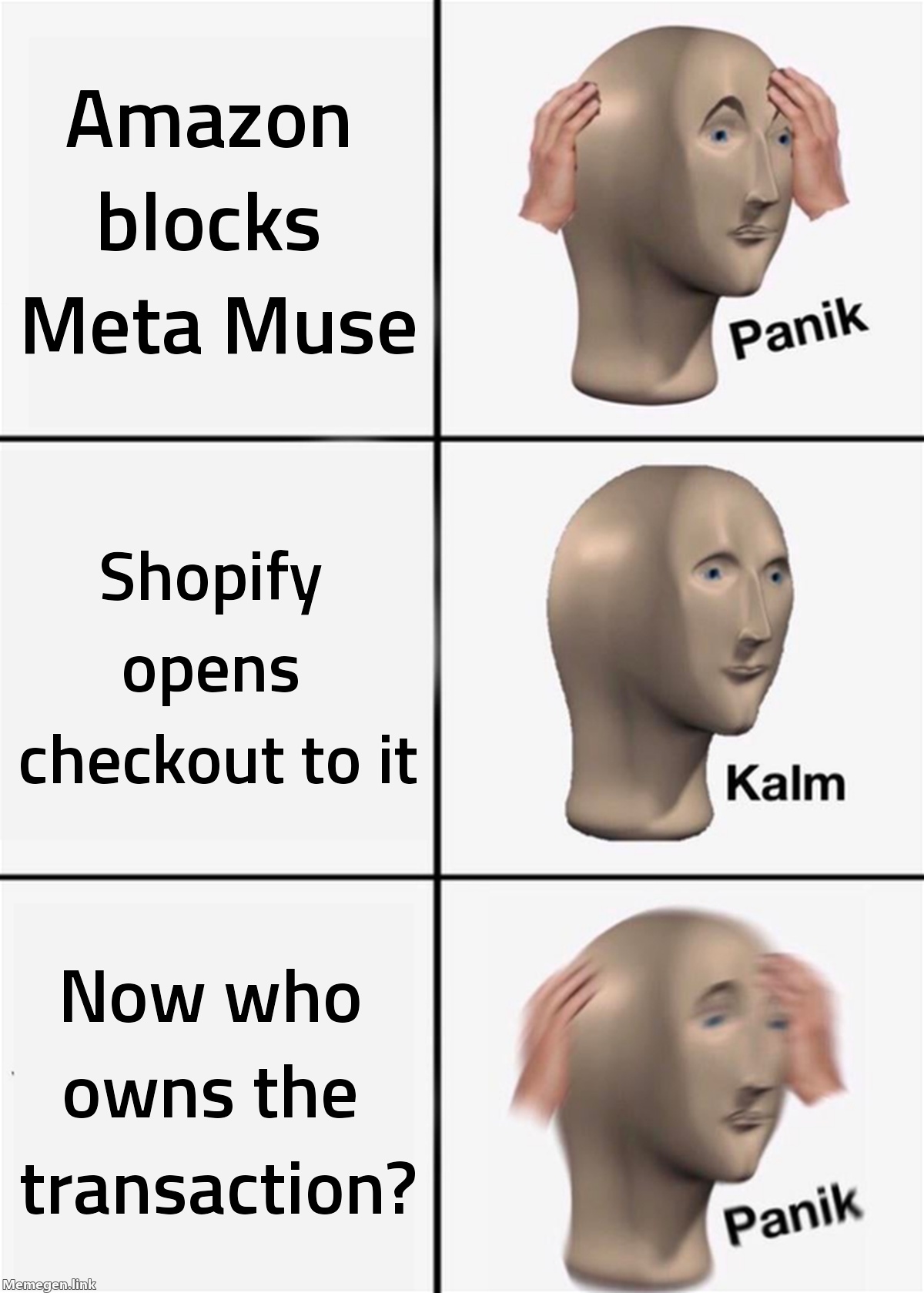
Meta launched Muse on roughly September 8. By September 20, Amazon had blocked it — citing that the agent was browsing without identifying itself and, more seriously, appeared to be capturing and storing customer credentials. Within 48 hours of that block, Shopify announced it was opening Shop Pay checkout to Muse for all Shopify stores. By September 22, Shopify stock was up 7%, while Meta barely moved (Motley Fool, Yahoo Finance).
If you run a DTC brand or manage paid acquisition across platforms, this sequence is the most important thing to happen in e-commerce infrastructure since buy buttons went native inside social apps. Here's why.
Amazon's block was not a kneejerk policy call. It was a statement about what Amazon is protecting. The Prime flywheel — browsing, purchasing, fulfillment, review loop, repeat — is valuable because Amazon controls every handoff. An AI agent that completes purchases on behalf of a user doesn't just change UX; it removes Amazon from the discovery and loyalty loop. If Muse could browse, compare, and buy on Prime without Amazon's awareness, the flywheel breaks. Amazon isn't wrong to see this as a threat to its model.
The credential concern is real too. An agent that handles authentication for millions of shoppers — and stores or transmits those credentials outside Amazon's systems — creates liability Amazon has no interest in holding. Blocking Muse was both a business call and a risk management call (Forkast News, Bloomberg).
Shopify's response was the opposite. Opening Shop Pay to Muse is not a product feature. It's infrastructure positioning. Shopify is betting that the future of commerce looks like this: a consumer tells an AI agent what they want, the agent finds the best option, and Shop Pay is the rail that completes the transaction — regardless of whether the consumer ever sees a Shopify storefront.
That's a fundamentally different bet than owning the flywheel. Shopify isn't trying to become the destination. It's trying to become the payment layer that AI agents trust. If that works, every Shopify merchant gets sold through by AI without lifting a finger on discovery. The 7% stock move the following day reflects how seriously investors are reading this (Yahoo Finance).
What does this mean for your Q4 ad spend?
If your primary channel is Amazon — through Seller Central, DSP, or Sponsored Products — you're operating inside a walled platform that has now demonstrated it will block AI agent access when it conflicts with Amazon's control model. That's not a knock against Amazon. But it does mean your products' discoverability by AI agents depends entirely on how Amazon chooses to integrate agentic commerce, which they control on their timeline.
If you run a Shopify store, your products are now, in theory, purchasable by Meta's Muse without a consumer ever clicking an ad. The consumer might ask Muse to "find me the best [product] under $60" and Muse completes the Shop Pay checkout for them. Your ad drove awareness somewhere upstream — or didn't. You may not know.
That last point is the one worth sitting with. Agentic commerce doesn't break attribution the way privacy regulations did. It breaks the session entirely. There is no click-through to track. There is a transaction, and an agent that initiated it.
For brands running spend across both Amazon and Meta, the split creates a real planning question heading into BFCM. Muse is live, users are testing it, and the Shopify integration means at least one major agentic path to purchase now exists for Shopify merchants. Amazon's block means that same path doesn't exist for Amazon-only sellers — unless Amazon builds its own agent commerce layer, which they will, eventually, on their own terms.
The short version: if you're a Shopify merchant, verify your products are available through Shop Pay. Frictionless checkout matters more this Q4 than it did last Q4, because now it's not just human friction you're removing — it's agent friction. An agent that hits a checkout wall moves on to the next result.
If you're Amazon-only or Amazon-primary, keep watching. Amazon will build an agent commerce story. They have to. But it won't be open rails — it will be Prime-native, controlled, and on their schedule. Plan your Q4 budgets accordingly.
The Muse situation is early. The agent is still rough, adoption is still low, and agentic commerce at scale is probably a 2027–2028 story. But the infrastructure decisions being made right now — who blocks, who opens, who owns the transaction — will shape the merchant landscape for the next several years.
Amazon and Shopify just showed their cards. The question is which hand matches your business model.
If you want to know how your current store and ad stack sits relative to this shift, the free Gromerce audit runs a full channel and stack diagnostic in about eight minutes.
Sources: Forkast News, Bloomberg, The Verge, Motley Fool, Yahoo Finance