Black Friday is nine weeks away. In September, three separate platform changes reduced how much control you have over where your money goes. None of them were announced loudly. All three are active in your accounts right now.
The timing matters. Q4 is when ad spend is highest, competition is steepest, and a misunderstood account setting costs real money. The cost of a poorly understood account is higher in November than in any other month, and these changes were all finalized in the six weeks before BFCM peak.
Google migrated your Search campaigns to AI Max without asking
Google's AI Max for Search campaigns — which expands keyword matching, enables URL expansion, and hands more creative decisions to the algorithm — moved from opt-in to mandatory throughout September. If your campaigns were eligible, Google began migrating them automatically. For many accounts, this happened without a notification most advertisers noticed.
Search Engine Journal reported on a 250-campaign study that found the median cost per acquisition increased 16% post-migration. That's not a universal result — accounts with strong conversion data and well-structured negative keyword lists saw smaller increases — but the direction is consistent with what happens when URL expansion is active: Google sends traffic to pages your campaign wasn't built around.
Two specific settings require review before October. First, check that brand exclusions are still in place. AI Max migrations have been known to reset or ignore brand-level exclusion lists. If a competitor campaign running on your brand terms was previously excluded, confirm that exclusion survived the migration. Second, check URL expansion settings. AI Max defaults to allowing Google to choose destination URLs beyond the ones you specified. If that's not what you want — and for most promotional campaigns, it isn't — the setting is in the campaign's AI Max configuration panel.
Meta removed placement exclusion checkboxes from ad sets
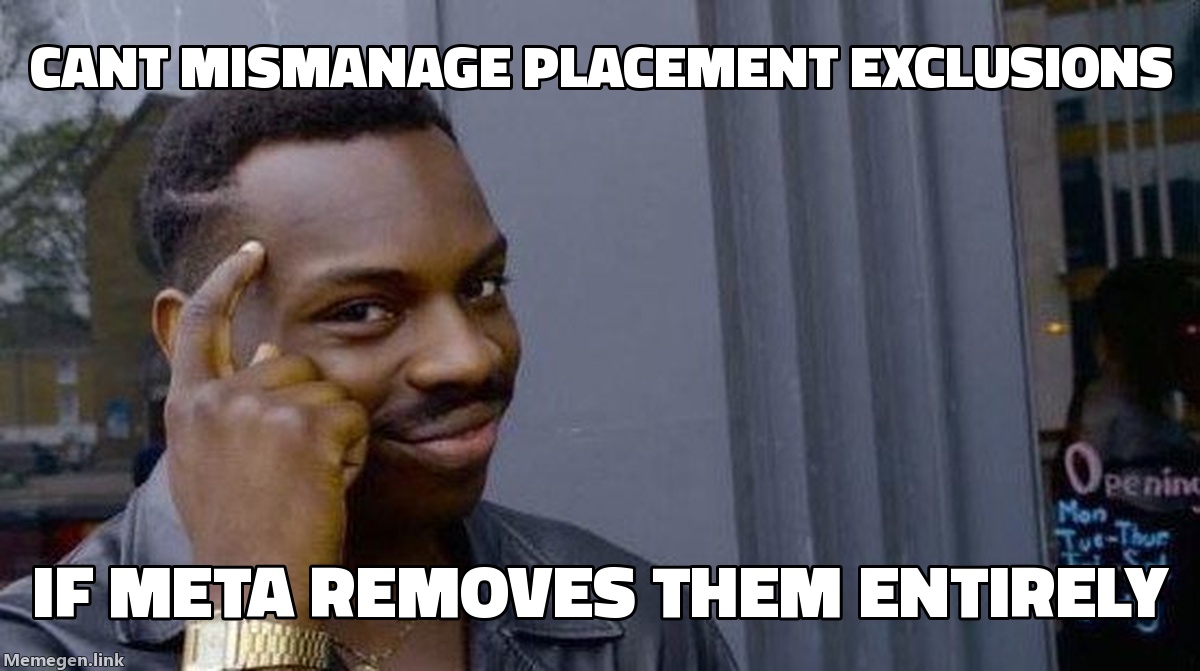
Around August 25, Meta removed the placement exclusion checkboxes from ad sets across most campaign types. The feature that let you uncheck Audience Network, specific Instagram surfaces, or Reels placements is gone.
The replacement mechanism is value rules: you can apply a bid reduction of up to 90% to placements you want to deprioritize. That's a meaningful difference. A 90% bid reduction still enters auctions — it just bids very low. You cannot zero out a placement the way an exclusion did.
For Q4 campaigns where placement mix matters — where your creative performs measurably better on feed than on Audience Network, or where you've historically excluded low-quality placements for brand reasons — the new system requires a shift in approach. The exclusion workflow is gone. The alternative is bid reduction with value rules, configured at the campaign level, and it requires a different understanding of where budget actually flows.
PMax reporting split on September 21
Yesterday, Google replaced the "Cross-network" Performance Max reporting row with up to seven channel-specific rows: Search, Display, YouTube, Discover, Gmail, Maps, and Shopping. If you track PMax performance in Looker Studio, Supermetrics, or any tool that filters on "Cross-network" as a network segment, those filters broke as of yesterday.
The data itself is still there. What changed is the schema. Historical data before June 1, 2025 still shows "Cross-network" as the segment value; data from yesterday forward uses the new channel-specific values. Reports that compare this month to prior periods will need updated filters or they'll show artificially low numbers for recent dates.
This is an operational fix, not a strategic one. But dashboards showing incorrect data during the Q4 ramp-up can produce wrong budget decisions fast. Check your PMax reports today.
What Q4 looks like with all three changes active
Klaviyo's 2026 BFCM planning research projects Meta CPMs will run 50–80% above their baseline during Black Friday week. That number reflects normal competitive pressure. It doesn't account for advertisers spending defensively because they've lost visibility into where their Meta budget is actually going.
The levers you still control are worth naming. On Google: smart bidding signals — first-party conversion data, customer match lists — still work and still influence AI Max behavior. Brand exclusions, once verified, hold. On Meta: value rules can approximate placement preferences if you build them deliberately and test them before November. Creative testing that runs now, with enough conversion volume to produce signal, will generate more reliable guidance than anything run the week before BFCM.
The platforms have moved toward automation for years. What's different heading into this Q4 is the pace: three material reductions to manual control in six weeks, all finalized just before peak season. The environment in November will be meaningfully different from what it was twelve months ago.
What to fix before October
These four items don't require rebuilding your account. They require checking settings that may have changed without your input.
Verify AI Max brand exclusions and URL expansion settings. Open each migrated Search campaign and confirm brand exclusions survived and URL expansion is set to your preference. This takes fifteen minutes per campaign.
Replace placement exclusions with value rules in Meta. For any ad set that previously excluded Audience Network or low-performing surfaces, build value rules with bid reductions in the 70–90% range. Monitor CPMs by placement breakdown after they run.
Update PMax dashboard filters. Replace "Cross-network" segment filters with the new channel-specific values. Add a date condition so historical pre-June-2025 data uses the old segment and post-September-21 data uses the new one.
Audit first-party signal inputs. With AI Max making more targeting decisions, the quality of your conversion signals matters more than it did on standard broad match. Confirm customer lists are refreshed, offline conversion imports are running, and enhanced conversions are firing correctly.
If you want to see exactly how these changes affect your current account setup, the free audit surfaces the gaps in about three minutes.
Sources: Search Engine Journal, Klaviyo, Google Ads Help, September 2026.