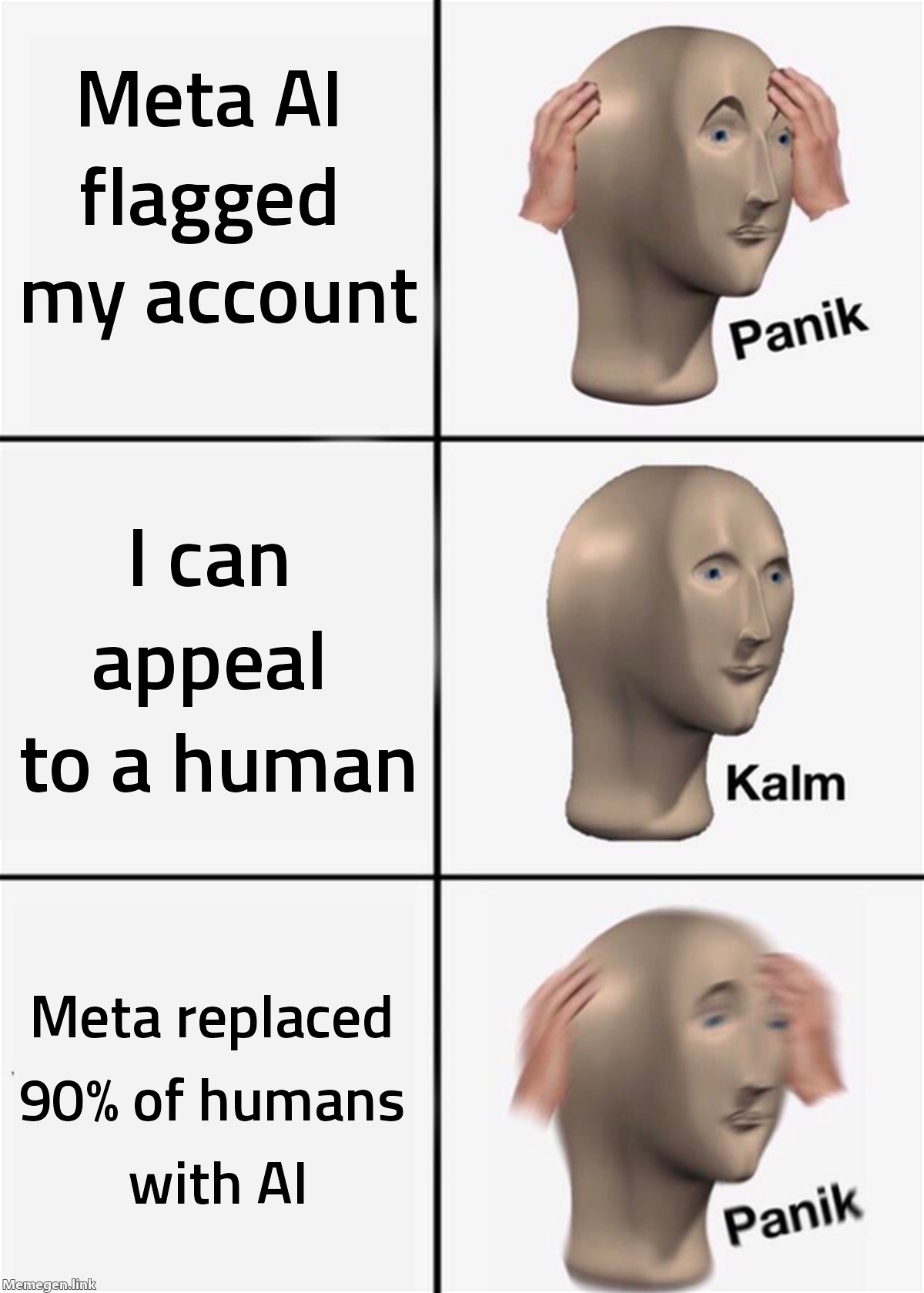
According to Social Media Today and eMarketer, Meta plans to use AI for 90% of its content and ad review by end of 2026, up from roughly 50% today. That is not a staffing update — it changes how your account gets flagged, how rejections get processed, and what happens when you try to push back.
What's actually changing in ad review
Right now, a rejected ad or a flagged account has a path to a human reviewer. Not always a fast one, not always reliable — but someone who reads context, weighs intent, and can override a call that was wrong.
That path is getting narrower. Meta hasn't specified what the remaining slice of human review covers. The likely interpretation is escalations for high-stakes decisions, regulatory disputes, or cases requiring cross-team handling. Routine rejections, account flags, and policy violation determinations are moving to automated systems.
The timeline is this year.
AI makes errors at scale, not one at a time
A human reviewer misreads one ad and rejects it. An AI system applies the same misread to every asset that fits the same pattern.
If you're running 30 ads with similar structure — same product category, same CTA style, similar creative format — and one trips a detection threshold, the system can batch-flag the rest before a human sees any of them. That is a different failure mode from a one-off bad decision, and it scales with however many similar assets you have in the account.
What triggers AI review systems isn't always obvious. Reports covering Meta's moderation infrastructure point to factors including aggressive budget scaling, new account creation patterns, landing pages that don't match ad copy, and historical associations with previously restricted accounts — all generating automated scrutiny even when current content is technically clean.
The appeal path is becoming unreliable
Experienced Meta advertisers have built a real skill around appeals — not just submitting a ticket, but knowing which contact path gets traction, what context to include, and how to frame a false positive in a way a human reviewer can actually act on.
That skill is losing most of its value. An AI review system doesn't process your explanation differently based on how well you wrote it. It weighs structured signals: account age, policy history, creative pattern data. If those signals don't favor you, a well-reasoned case doesn't change the outcome.
Meta's challenge workflows inside Business Manager will still exist. But the ceiling on what those workflows can accomplish gets lower when no human is reading the other end.
What to fix before the shift completes
The most practical response is to stop depending on arguments you make after the problem happens.
Pull your account's disapproval and restriction history for the last six months. Know which campaigns have historically triggered rejections, which creative formats caused friction, and whether any current ad sets sit on unresolved policy warnings you've been working around. An account carrying compliance debt into an AI-dominant review environment is more exposed than one with a clean slate.
Landing page alignment matters more now. Meta's systems flag intent gaps between what an ad promises and what the destination delivers. This has always been an enforcement signal — it will be enforced with more consistency at scale.
Keep new creative at controlled budgets for the first 48–72 hours. Scaling spend aggressively on untested assets before they've built any review history is a pattern automated systems treat as elevated risk.
If your account has had past restrictions that were resolved through human escalation but never fully closed on the policy side, close them now. Historical restriction data is precisely the kind of signal AI systems are built to weight against you.
Build compliance in. The appeal process was the safety net for when you didn't. That net is being replaced by a system that moves at algorithm speed.
If you want to see how your Meta account's policy health compares to what solid campaign performance actually requires, Gromerce's free audit gives you a clear picture in minutes.
AI review at 90% doesn't mean the system gets smarter about nuance — it means there's less room to argue past a wrong call.
Sources: Social Media Today, eMarketer, Search Engine Land, August 2026