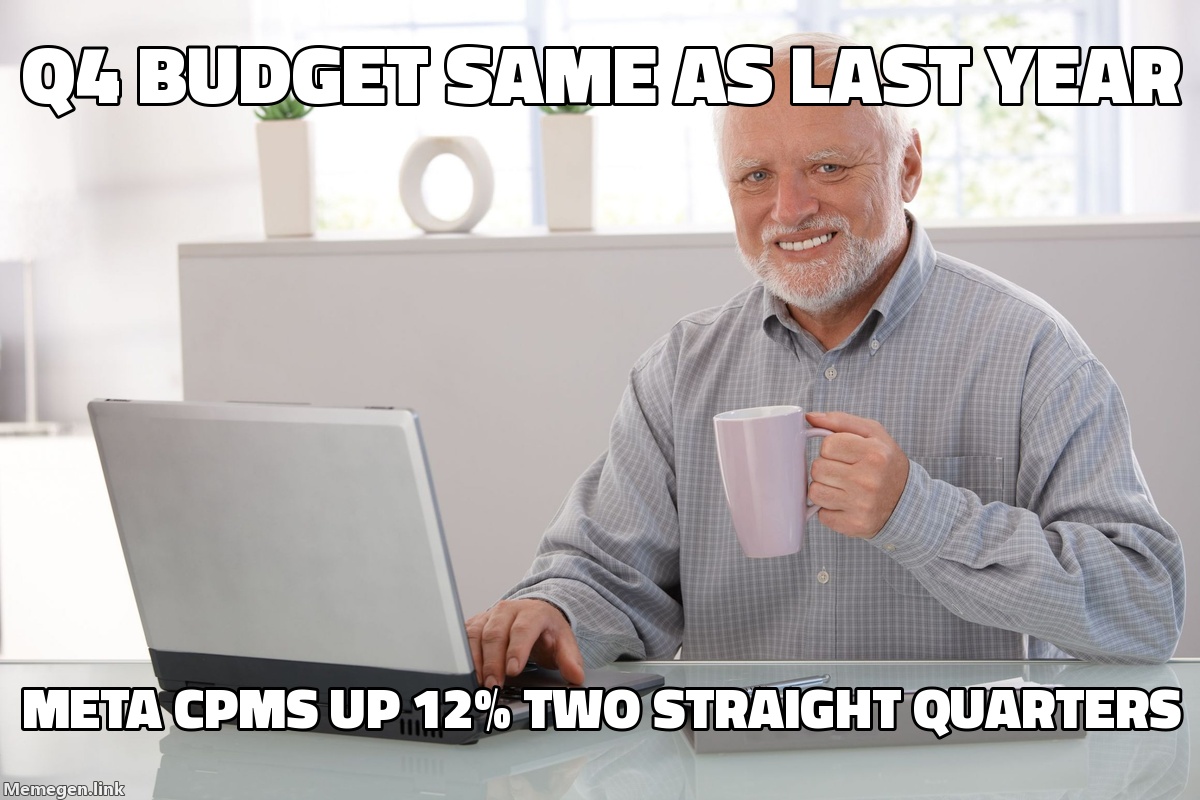
Most Q4 media plans are built on last year's numbers. That's the default: take what worked, hold the budget flat or add a modest buffer, and run it. This year, that approach produces a reach plan that's already short before Black Friday season opens.
Meta's own SEC filings show the average price per ad rose 12% year over year in Q1 2026 and again in Q2 2026 — the first two consecutive quarters at that level. According to a True North Social analysis published September 21, 2026, a flat Meta budget now buys roughly 10.7% fewer impressions than it did a year ago.
That gap exists in your account right now, independent of any Q4 competition.
Two consecutive quarters of 12% price growth
A single quarter of price inflation can be attributed to auction dynamics. Two straight quarters at 12% is a pricing baseline shift.
Meta's Form 10-Q for Q2 2026 reports average price per ad up 12% and impressions delivered up 14% year over year. The Q1 filing shows the same 12% price growth, with impressions up 19%. The read: Meta's platform is expanding (more total impressions sold), but the per-unit cost of attention is rising as advertiser demand outpaces inventory growth.
The concrete version: a brand spending $150,000 a month on Meta and buying 12.5 million impressions at a $12 CPM in mid-2025 would, at $13.44 CPM this year (12% higher), buy roughly 11.2 million impressions for the same spend. That's 1.3 million fewer impressions per month for an identical invoice — and the math works the same way whether you're spending $30K or $300K.
The Q4 plan that hasn't been updated
The problem with annual media planning is that it anchors to the previous year's clearing price. If your Q4 2026 budget was set in Q1 or approved based on 2025 performance data, it reflects a market that no longer exists.
This doesn't just affect brands with fixed annual budgets. Brands running Advantage+ campaigns may see delivery and reach decline without any visible change in account settings — Advantage+ adjusts bid pacing, but it cannot stretch $150K of spend into the impression volume that $167K would buy. If your Q4 ROAS or CPA targets were modeled against last year's reach, the numbers will behave differently than planned.
DTC brands with margin-sensitive acquisition goals are the ones most exposed. A specific CPA target implies a specific reach volume. If reach is structurally lower at the same spend level, hitting that target requires either more budget or revised expectations.
Seasonal premium arrives on top of this
Meta Q4 CPMs carry a significant seasonal increase above already-elevated Q3 levels. Meta's advertiser guidance for the holiday period has historically pointed to peak CPMs running 35–50% above Q1, with the Black Friday and pre-Christmas window reaching 50–80% above baseline.
That premium will land on top of a baseline that's already 12% higher than a year ago.
The practical result: the same dollar amount that funded a given number of peak-week impressions in Q4 2025 funds fewer in Q4 2026. If the budget model hasn't been updated, you've made an undisclosed reach cut without a deliberate decision to do so.
Two choices before October
There are two positions worth making explicitly, before the season starts rather than mid-campaign.
The first is increasing Q4 budget by roughly 12% to hold the same reach volume as last year. For a brand that spent $500K on Meta across Q4 2023–2025, that means approximately $560K to maintain equivalent impression count. If the business case requires holding the same reach, the budget needs to reflect the new price.
The second is keeping the budget flat and rebuilding the forecast to reflect 10.7% lower impression volume. That means revisiting frequency targets, funnel stage allocation, and expected CPA before October — not in the second week of November when you're already deep in the campaign. The worst outcome isn't choosing this option; it's defaulting into it without acknowledging the decision.
If you're unsure where your current Meta campaigns stand ahead of Q4, a free account review at Gromerce can show you the gap in three minutes.
Flat isn't neutral on Meta in 2026. It's a reach cut that nobody signed off on.
Sources: Meta Form 10-Q Q1 2026, Meta Form 10-Q Q2 2026, Agile Brand Guide, September 2026