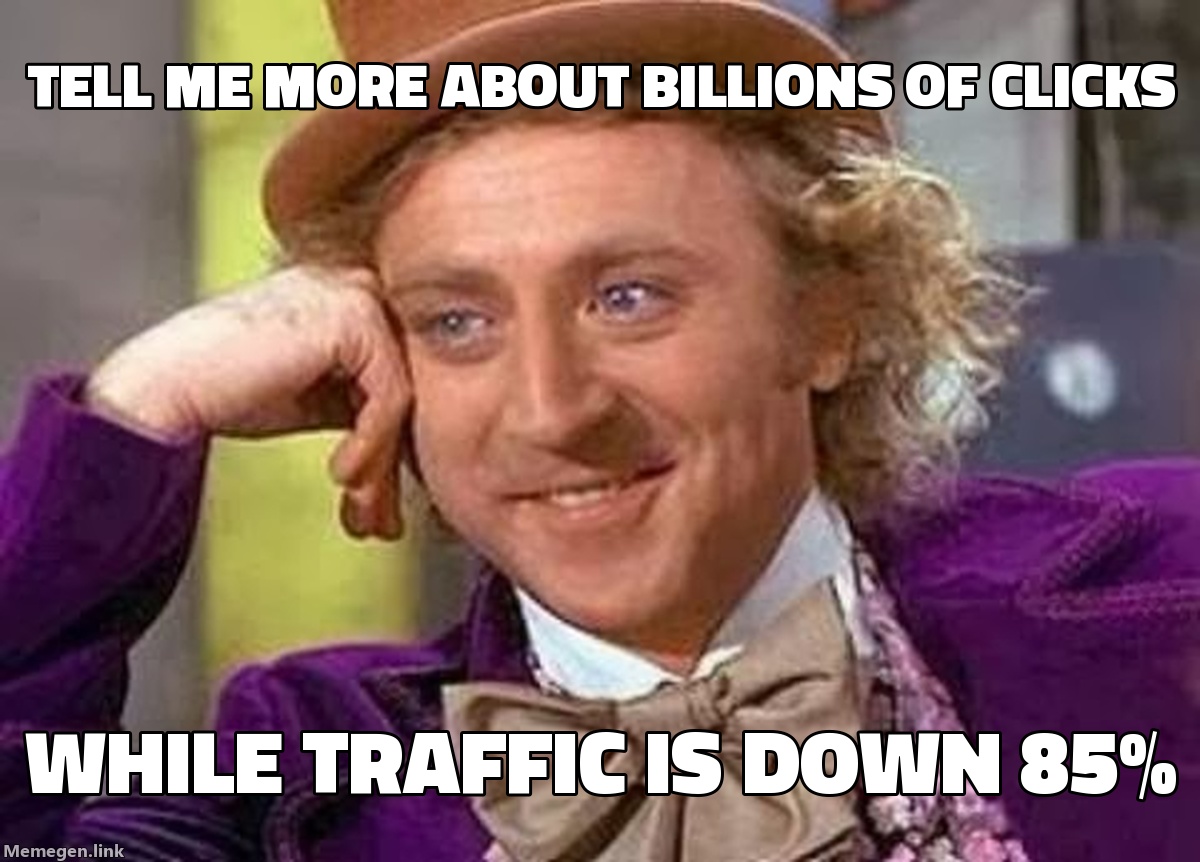
USA Today's national traffic fell by roughly half between June 2025 and June 2026, according to Semrush data. Business Insider dropped more than 85%. CNN was down 25%. Politico, 23%. The cause attributed across multiple reports: AI Overviews consuming publisher content and returning answers without sending users to the source.
This week, the situation went public. USA Today CEO Mike Reed said plainly: "It's time to take a stand and say enough is enough." Reuters, Politico, The Economist, and People Inc. are reported to be weighing whether to block Google's crawlers from their content. Reddit is reconsidering whether to renew the $60 million annual data licensing deal that allows Google to train AI models on its posts.
No major publisher has blocked Google's crawlers yet. But the conversation shifted from private deliberation to public statements in July — and that usually precedes action.
What Google actually said
Google SVP Nick Fox published a post on X on July 17 claiming that AI features in Search are now "sending billions of clicks to websites every week." Google followed with the statement that overall Search sends "billions of clicks to the web every day."
Publishers aren't disputing that Google sends clicks to the web in aggregate. They're disputing how those clicks are distributed — specifically whether publishers whose content trains Google's AI are getting a fair return in traffic.
Ahrefs data shows that when an AI Overview appears above organic results, click-through rates on the top organic listing drop by 58%. Sparktoro found that 68% of all US Google queries end without any click, in their 2026 zero-click study. The "billions of clicks" aggregate and the 58% CTR drop coexist without contradiction. A large index-wide number can be true at the same time a specific publisher loses half its traffic.
Why the SERP structure matters for paid search
Your paid ads run on the same search results page as organic results. That context shapes how users behave when they see your ad.
When Google's organic results are dense — quality results from authoritative publishers giving users the context to understand their options — users arrive at a SERP that's doing useful work. Ads appear alongside content. Users are in a research-and-discover state. The page earns attention before any ad demands it.
As organic results thin — because publishers reduce output, pull content, or block Google's crawlers — the SERP changes. Fewer informational results sit between your ad and the user. The page becomes more ad-forward and less information-rich.
That isn't automatically better for paid search. Higher ad visibility on a thinner page sounds like a win, but conversion rates track user intent quality. A user who arrived at a page that helped them understand their options converts differently than one who hit ads without that context first.
The CPC mechanism to watch
Publisher content withdrawals show up in ad performance before they become legible as ecosystem changes. The signal to track: CPC movement on informational keywords that currently compete with publisher content.
If a major publisher that ranks well on queries you advertise on pulls its content or blocks Google, organic competition on those queries decreases. When organic competition drops, advertiser concentration for the remaining paid slots tends to increase — even without new advertisers entering the auction. CPCs rise.
The second signal is conversion rate stability alongside impression share. Rising impression share with flat or declining conversion rates, on queries where users previously had strong organic context, suggests the SERP changed in a way that affected the quality of intent before the click.
These effects don't announce themselves as "publisher-related" in Google Ads reporting. They surface as auction dynamics.
Smart Bidding and index quality
Smart Bidding uses broad signals: device, time, audience membership, historical account data. It also relies, less visibly, on the richness of Google's index in the topic areas where your ads compete. Google's systems use indexed content to model query intent and match ads to relevant moments.
When authoritative publishers reduce or withdraw content from topic clusters you advertise in, the index for those clusters gets thinner. The degradation is gradual and distributed across queries — not a single event. But Smart Bidding campaigns in affected topic areas can see relevance matching drift over months as the underlying index hollows.
This is the mechanism to understand, not to react to today. No publisher has blocked Google yet. If Reuters or USA Today follow through, the performance signal arrives in your account weeks before anyone reports on the industry change.
What to do right now
Two things worth tracking now: CPC trends on your top informational keywords, and roughly how many organic results — especially from established publishers — appear on those same queries.
If CPCs are trending up without a clear cause and organic results on the same queries are getting thinner, those two observations are probably not unrelated.
The free Gromerce audit surfaces keyword clusters where paid and organic performance intersect and flags where advertiser concentration is rising. Takes three minutes.
Publishers are making a decision about their content and Google's access to it. Your campaigns run on the same results page where that decision plays out.
Sources: Semrush, Ahrefs, Sparktoro, TechSpot, gHacks, Search Engine Land, July 2026