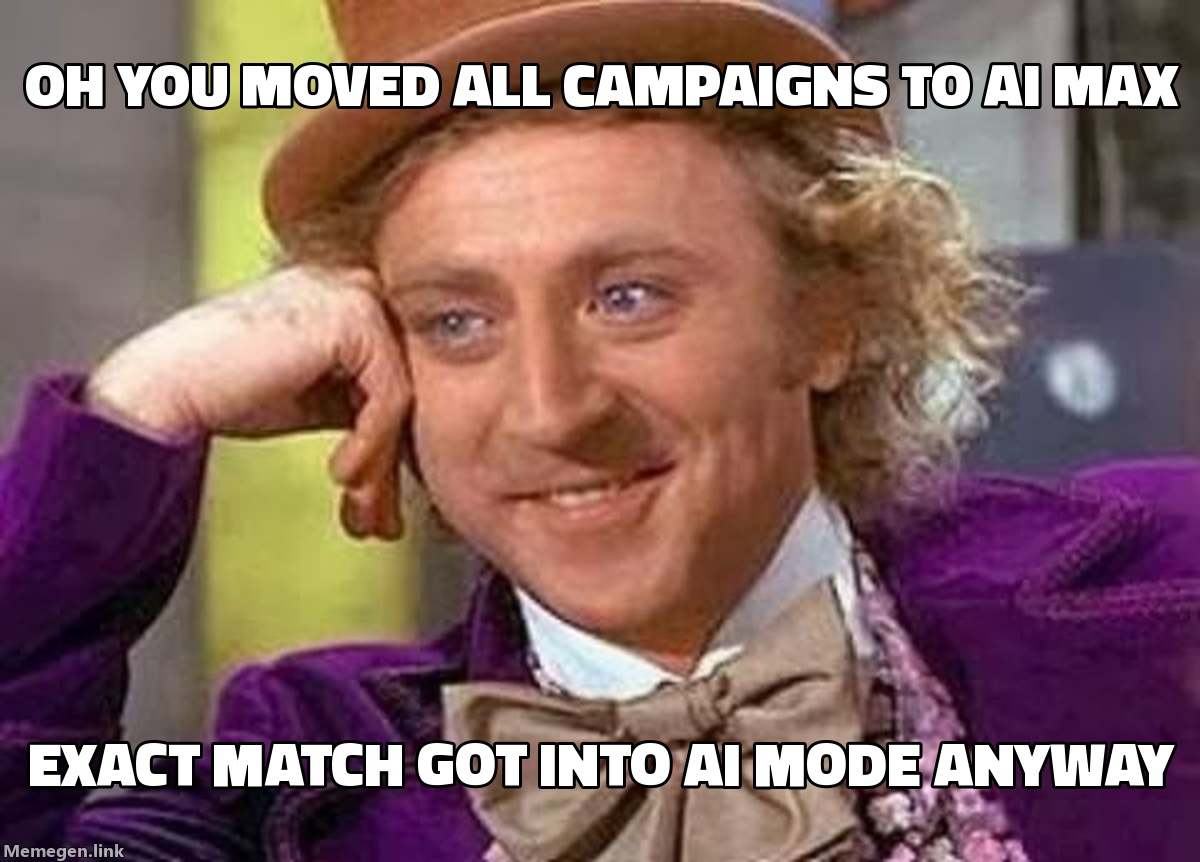
If you spent the first week of September feeling forced into AI Max because it was the only way to appear in Google's AI Mode results, you have a reason to pause.
On September 4, Google's Ads Liaison Ginny Marvin confirmed a new test: exact and phrase match keywords are now eligible to trigger text ads in AI Mode. No AI Max required. No Performance Max. No Broad Match with Smart Bidding. The catch is that Google will only serve those ads when it identifies what it calls "explicit and direct user intent." That phrase is undefined. Google published no criteria for what qualifies.
What the test actually changes
AI Mode is Google's conversational search experience. Since launch, the company's official position was that only AI Max, Performance Max for Search, or Broad Match with automated bidding could place ads there. The implication: if you wanted any shot at that surface, you needed to accept Google's automation.
This test breaks that logic.
Exact and phrase match campaigns that you built for precision and control may now be appearing in AI Mode when a user's query is specific enough for Google's systems to detect strong purchase intent. You haven't changed a setting. The delivery layer has changed underneath you.
According to Search Engine Land's coverage, Marvin described it as "a small experiment that recently kicked off" — which is classic product communications understatement. Tests at Google Ads scale affect millions of accounts. A change that quietly alters where your exact match keywords serve without any advertiser action is not small.
Why this arrives at a convenient moment
The timing here is not coincidental.
Google started auto-migrating legacy Broad Match and Automatically Created Assets campaigns to AI Max on September 1. Advertiser reaction ranged from confused to frustrated. Independent analyses across hundreds of retail campaigns have recorded ROAS drops in the weeks following the forced migration, while Google's internal data claims a lift. The gap between those two numbers has made advertisers skeptical of the whole AI Max push.
Exact match in AI Mode is a pressure relief valve. It lets Google say: you don't need to hand over your entire account structure to access AI Mode traffic. Your existing campaigns can get there if the signals align.
Whether that's true for your account, in your category, against your specific competitors, is a separate question Google cannot answer for you.
The part that should concern you
"Explicit and direct user intent" is doing a lot of work in this announcement and there's no lever you can pull to engineer for it. No targeting setting, no bid modifier, no keyword qualifier maps to this concept. Google's systems decide whether a query clears the threshold, and they're not sharing the criteria.
That means you cannot proactively optimize for AI Mode inclusion the way AI Max's expanded matching is designed to work. You get in when Google decides you belong there. This has real consequences for forecasting — you cannot reliably predict AI Mode impression volume from your exact match campaigns, which makes budgeting for that traffic nearly impossible.
It also means that if this test eventually becomes a permanent feature, it will likely stay a black box. You'll see the impressions; you won't see the logic.
What to look at in your account right now
Pull placement reports for campaigns using exact and phrase match. Look for AI Mode as a distinct placement type. If you're seeing impressions there that weren't present before September, the test is running in your account.
Also watch your cost-per-click. Based on Search Engine Land's analysis of early AI Mode ad data, the placement has historically carried a CPM and CPC premium over standard search results. If AI Mode traffic starts routing through your exact match campaigns, that cost difference will show up in your data before Google issues any update about the experiment.
Keep an eye on Quality Scores for affected campaigns. The ad serving context in conversational AI Mode differs from standard search, and early AI Max data suggests Quality Score signals can shift when campaigns start appearing in these environments.
What Google is actually signaling
This test is arriving two weeks into a forced migration that has not landed well. Meta is growing its ad revenue at roughly twice Google's rate, and analysts now expect Meta to overtake Google as the largest digital advertising platform by end of year. The pressure on Google Ads to retain advertiser confidence — without reversing course on its AI-first strategy — is as high as it's been in years.
Giving exact match campaigns a path into AI Mode is a way to offer advertisers something back without abandoning AI Max. Whether it scales to a permanent feature or stays a narrow experiment depends on what the performance data shows at Google's end.
Keep your exact match campaigns in good shape. Watch your placements. And don't assume the only path into AI Mode traffic is the one Google spent September pushing everyone toward.
If you want to see how your current campaign setup is positioned across AI Mode and standard search — and whether you're already getting traffic in places you didn't expect — run a free audit. It takes about three minutes.
Exact match is not obsolete. It's just been upgraded in ways Google didn't announce.
Sources: Search Engine Land, Google, September 2026