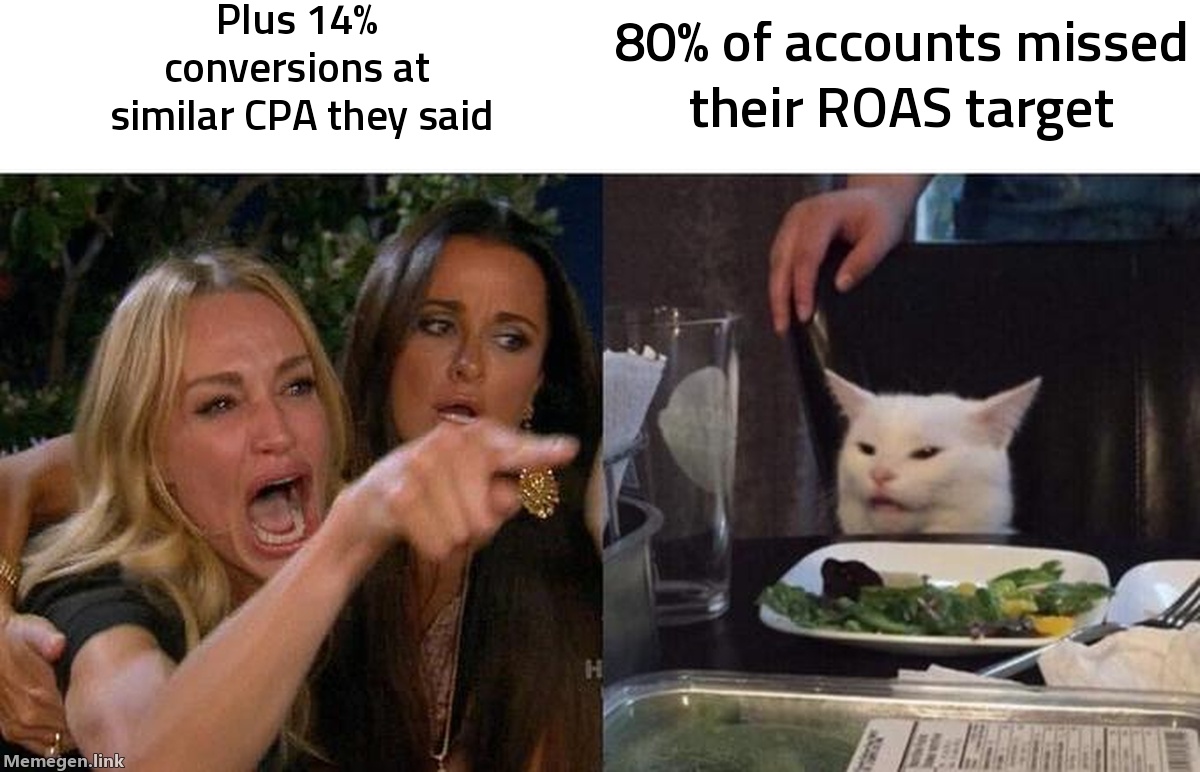
The September 1 migration has been running for nine days. If you pulled your CPA this morning and the number looks worse than August, you're not alone — but you also may not have enough context to act yet. Smarter Ecommerce (SMEC), a European retail PPC analytics firm, analyzed more than 250 retail campaigns following the September AI Max rollout. According to Search Engine Land's coverage of the study, median revenue is up 13%, median CPA is up 16%, and only about one in five accounts held within their original ROAS targets.
Google's official product page for AI Max says the feature delivers 7% more conversions at a similar CPA when using the full feature suite. Other benchmarks cited in industry coverage, including from AdExchanger, have put the figure at 14% conversion improvement. The SMEC data doesn't invalidate either figure — it shows what they're averaging over. According to Search Engine Journal's coverage of the same study, the performance distribution ran from +42% ROAS improvement at the top to -35% decline at the bottom, with most accounts clustered in the middle at an elevated CPA.
The miss rate isn't random
The finding that matters most isn't the median — it's what explains the spread. According to SMEC's analysis, as reported in Search Engine Journal, the gap between accounts that held their ROAS targets and those that didn't traces almost entirely to conversion signal quality: how complete, clean, and timely the data going into Smart Bidding was before September 1.
AI Max is still Smart Bidding underneath. The search term expansion and text customization are the visible changes. The bidding model was already running before migration — and already learning, or failing to learn, from whatever conversion data you supplied. If your tracking was degraded before September 1, the migration didn't reset that. It inherited the same incomplete signal set and is now trying to optimize against it across a wider query space.
That's the mechanism behind the roughly 80% miss rate that the SMEC study, as reported in Search Engine Journal, identified. It's not that AI Max is poorly designed. It's that good automation requires good inputs, and the September migration happened to every account regardless of whether those inputs were in place.
What the top-performing accounts have in common
The accounts sitting near +42% in the SMEC distribution share a few structural characteristics. Server-side conversion tracking — Conversion API or an equivalent integration — rather than pixel-only setups. Conversion actions that pass purchase value, not just event counts. Offline conversion data imported where the final transaction happens outside the browser. And brand exclusions set correctly before migration, so the expanded query matching isn't spending budget on branded terms that inflate conversion rates and distort the bidding signal.
None of these are new requirements. Smart Bidding has needed clean signals for years. What changed on September 1 is that AI Max expanded the query surface without changing the signal quality baseline underneath. If your inputs were already good, the expansion surfaces more converting queries. If your inputs were already noisy, the expansion amplifies that noise across a larger spend footprint.
Nine days of data tells you one thing
Calibration is real and the window matters. Smart Bidding goes through an adjustment period after structural changes, and AI Max migration is a structural change. The first 7–10 days of data are unreliable for directional performance calls. Accounts running fewer than 30 conversions per week should extend that window to three weeks before drawing conclusions.
What nine days does tell you is whether the categories of query expansion are directionally right. Your search terms report now shows AI Max as a distinct match type — it appears as its own category alongside Exact, Phrase, and Broad, which is a new report structure introduced by the migration. Filter for AI Max traffic and look at the queries. Are they adjacent to your product or completely unrelated? That distinction matters more than the CPA number right now.
If you're seeing queries from unrelated categories at high spend, check two things: whether brand exclusions migrated correctly, and whether final URL expansion is sending the system to landing pages that match the expanded query intent. Both can be audited without changing campaign settings.
Four checks that move the needle
Conversion tracking completeness: pull your conversion actions and check whether you're passing purchase value on every event, or only the ones that survive an unbroken pixel session. iOS traffic, browser extensions, and VPNs routinely break browser-side tracking. Server-side CAPI coverage tells you the gap.
Brand exclusion accuracy: run a filter in your search terms report for your own brand name. If branded queries are appearing in AI Max traffic and converting at an inflated rate, they're creating a false CPA baseline that makes your real performance look better than it is — which means Smart Bidding is over-bidding on non-brand terms chasing that baseline.
Attribution model: if your conversion actions are still on last-click, your bidding model is working from a compressed view of the purchase path. Data-driven attribution gives AI Max more signal about which query types contribute upstream.
Conversion value rules: confirm these migrated correctly if you modulate bids by device, audience, or location. AI Max doesn't always carry value rules across unchanged, and a missing rule can materially change bid behavior on your highest-value segments.
Where this leaves you
The SMEC data gives you a realistic distribution instead of averaged platform benchmarks. A +16% median CPA isn't a signal to disable AI Max — it's a signal to audit signal quality first. The accounts at +42% ROAS did something right before migration. The path from week one to week four is more about data quality than campaign structure.
The free audit at gromerce.com/audit surfaces exactly these gaps — conversion tracking coverage, CAPI signal quality, brand exclusion completeness — in a few minutes. It's the right starting point before making structural changes based on nine days of migration data.
AI Max is averaging a 13% revenue lift across a wide distribution. Your job right now is to understand which end of that distribution your account is heading toward, and why.
Sources: Search Engine Land, Search Engine Journal, September 2026