The standalone Local Services Ads interface is being retired. Google is moving every LSA campaign into the main Google Ads platform as a new Performance Max campaign type built around pay-per-lead goals. The announcement came quietly, but the consequences — especially around historical data — are significant enough that most affected advertisers should act before they receive their migration notice.
What changed
According to Google's help center documentation and coverage from Search Engine Land and Search Engine Journal, the migration begins in August 2026 for select US home and storefront service categories: pest control, appliance repair, plumbing, HVAC, house cleaning, lawn care, roofing, and moving. Broader categories and service-area businesses follow through late 2026. Non-US accounts and remaining categories migrate in 2027.
There's no opt-in list. If your account category is in scope, you migrate. Google sends a notice 14 days before your specific migration date and a reminder 7 days out.
The name is misleading — but not in the way you'd expect
When Google calls these "Performance Max campaigns," that's technically accurate but functionally confusing. Standard PMax campaigns can run across Search, Shopping, Display, YouTube, Gmail, and Maps. The pay-per-lead PMax campaigns for local services only run on Google Search and Maps — the same two placements you were already on.
So what actually changes?
The dashboard moves from a separate standalone interface into your main Google Ads account. Manual bidding ends. You get consolidated reporting alongside your other campaigns. The pay-per-lead billing model stays identical. So does keyword-less targeting. Where and how your ads appear to local customers does not change.
The experience will feel different operationally — particularly for agencies that have separate workflows for LSA vs. standard Google Ads — but the underlying ad behavior is the same.
The data cliff
This is the part most advertisers aren't accounting for.
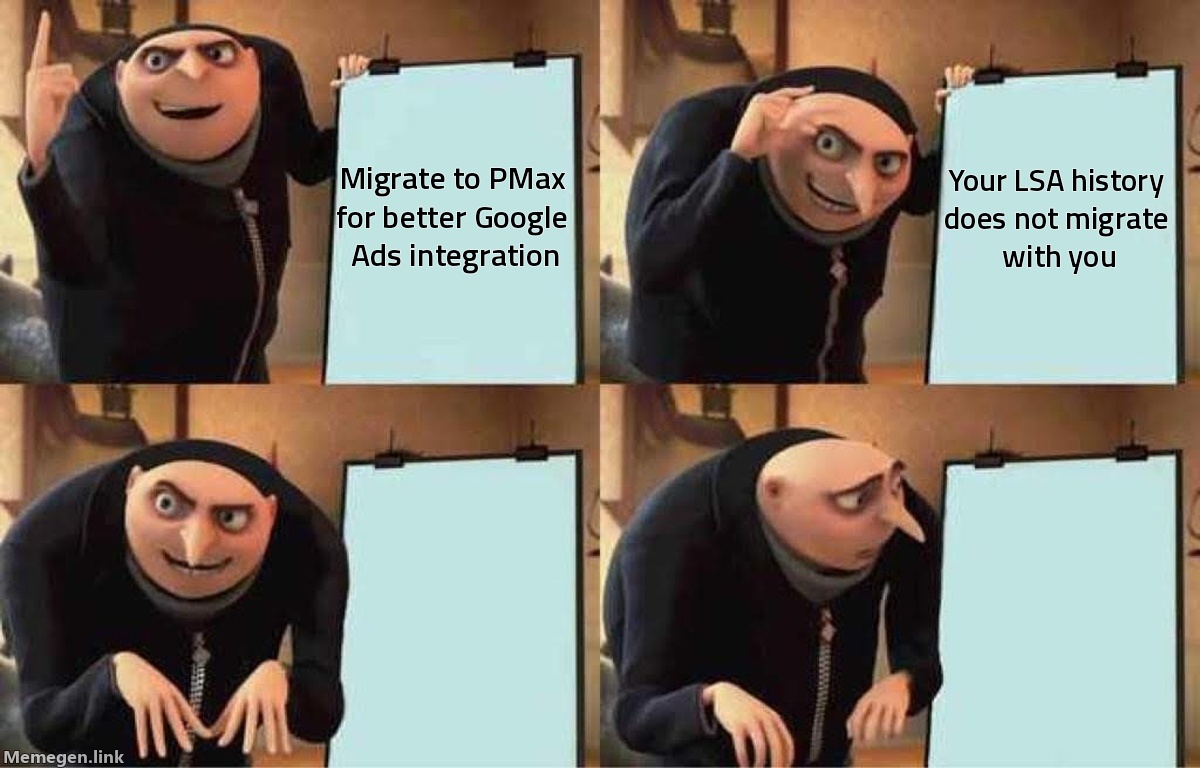
Per Google's help center documentation and reporting from Search Engine Journal: once a campaign migrates, the old LSA dashboard and its historical performance reports are permanently gone. Lead histories transfer over. Your cost-per-lead averages, monthly lead volume, competitive ranking history, and trend data do not.
The 14-day notice window is real, but it's not generous. If you're managing dozens of LSA accounts, building an export workflow manually inside a two-week window is its own operational project. The accounts that will be most disrupted are those where LSA performance is used to inform bid targets, seasonal budgets, or client reporting benchmarks.
What to export before your migration date:
- Monthly cost-per-lead averages for the trailing 12 months
- Lead volume broken down by service category
- Review count and average rating at time of migration (context for any post-migration performance changes)
Who should be most concerned
The accounts that should move fastest are those using LSA performance history to justify current budgets to clients or stakeholders. Once that reference point is gone, any post-migration performance dip has no baseline to be measured against. That's not a data problem — it's a client conversation problem.
Agencies managing multiple accounts should build a tracking sheet now with each account's migration category, expected wave timing, and export status. Google isn't giving you a global deadline; it's giving each account 14 days. That means the window for any given account can open and close without you noticing if you're not watching.
The broader consolidation pattern
This migration follows the same playbook as Google's DSA-to-AI-Max transition and the Local Inventory Ads default change. Google is centralizing everything into the main Google Ads interface. The standalone tools were built for specific use cases; the consolidated interface is built for Google's optimization stack.
None of this is bad in itself. Having LSA data in the same reporting layer as your Search and Shopping campaigns gives you a more complete cost picture. But every consolidation comes with a data cliff, and Google's notice periods are short enough that preparation has to come before the announcement, not after.
If you want a view of which conversion actions and measurement gaps exist in your current Google Ads setup before this migration hits, the free audit at gromerce.com/audit surfaces those in a few minutes.
The pay-per-lead model isn't going away. The interface you use to manage it is.
Sources: Search Engine Land, Search Engine Journal, Google Ads Help Center, WordStream, July 2026