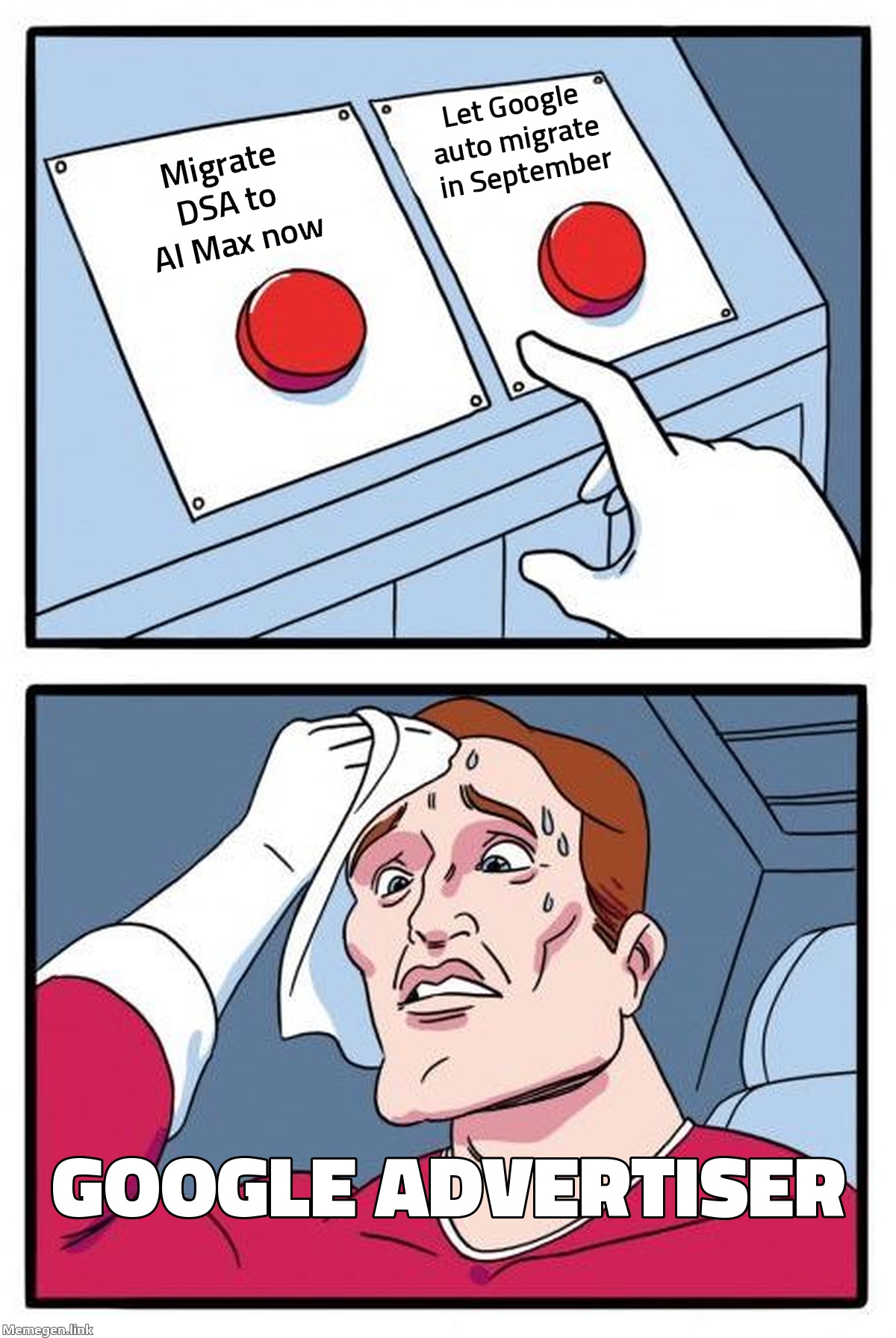
If you're running Dynamic Search Ads, you have until September before Google flips the switch automatically. After that, your DSA campaigns get auto-upgraded to AI Max with Google's default settings — not yours.
Google announced this in April. Most advertisers haven't started migrating yet. That's a problem.
What's actually changing
Dynamic Search Ads crawl your website and generate ads based on page content. You configure page targets, build negative keyword lists, and Google matches queries to your pages. It's been reliable for capturing long-tail traffic without manually building out thousands of keywords.
AI Max replaces the whole system. It still reads your website, but adds three capabilities DSA never had.
The first is Smart Search Term Matching. Instead of matching queries to your page content, AI Max matches queries to real-time user intent signals. It can show your ads for queries that don't match your pages exactly, if Google's model predicts they'll convert.
The second is Dynamic Text Customization. Your headlines and descriptions get generated and customised in real time for each individual query. Static ad copy becomes the exception, not the rule.
The third is Final URL Expansion, and it carries the most risk. AI Max can send users to any relevant page on your site, not just the page you targeted. If the model thinks your checkout page is more relevant than your product landing page for a given query, it'll send the user there.
Average performance across early adopters: 7% more conversions at a similar CPA/ROAS. That's real. But so is the reduction in control.
What happens if you wait
If you don't migrate voluntarily before September, Google auto-upgrades your DSA campaigns with its defaults. All three AI Max features turn on simultaneously. Your ad group structure may be flattened. Negative keyword lists may not carry over completely. Page feed targets get ignored.
Advertisers who sat through similar forced migrations (when RSA replaced expanded text ads, when Smart Campaigns replaced standard) typically saw two to four weeks of performance instability before things settled. If September sits anywhere near your peak season or a planned product launch, that's exactly the wrong time to be in a learning period.
What the voluntary window gives you
The migration window runs through August. During this period you have control that the auto-upgrade doesn't offer.
You can choose which features to enable. You don't have to turn on all three simultaneously. If Final URL Expansion makes you nervous, start with just Smart Search Term Matching and add the others once you see how the model behaves in your account.
You can specify URL exclusions upfront. Block pages you don't want the AI sending traffic to: login pages, confirmation pages, blog archives, account dashboards. Set inclusion patterns based on URL structure so expansion stays within your product or category pages.
You can carry over your negative keywords properly. During a manual migration, you audit and re-confirm your negative lists before importing. Auto-migration skips this step.
And you get learning time before everyone else. If your campaigns have three months to stabilise before September, you'll be optimising when competitors are still in their reset period.
The features that need the most attention
URL expansion causes most migration problems. Default behaviour is permissive: the AI will find relevant pages you didn't intend to target. Audit your site before migrating and build your exclusion list first. Any page that isn't a landing page belongs on that list.
Auto-generated headlines are easier to manage but still worth reviewing. AI Max pulls from your existing assets — current headlines, page titles, product feed — and assembles new combinations. You can pin specific headlines to positions if there's messaging you can't afford to have modified automatically.
Don't ignore the ad group structure. When Google auto-migrates DSA campaigns, it may merge ad groups that you deliberately kept separate. A manual migration lets you map your existing ad groups into AI Max's structure before the model starts learning, which preserves more of your historical performance signal.
What to do this week
Check your Google Ads account for the voluntary migration tool in campaign settings. If it's available, start with your smallest or least-critical DSA campaign to get a feel for the setup before touching campaigns that drive significant revenue.
Build your URL exclusion list before migrating anything. Then go campaign by campaign, verifying that negative lists transferred correctly after each one.
If you're not confident your campaign structure is clean going into this, fix that first. A messy DSA campaign with overlapping targets and gaps in negative coverage gets messier when AI Max starts expanding its reach. The Gromerce free audit will surface structural issues, keyword conflicts, and tracking gaps in about three minutes.
The September deadline is firm. Your only choice is whether you control the migration or Google does.
Related articles: google-ads-ai-mode-placement-2026 · google-ads-ctr-rising-conversions-flat · google-ads-data-retention-cut-june-2026
Sources: Google Ads blog, Search Engine Journal, MediaPost, Real Internet Sales, May 2026