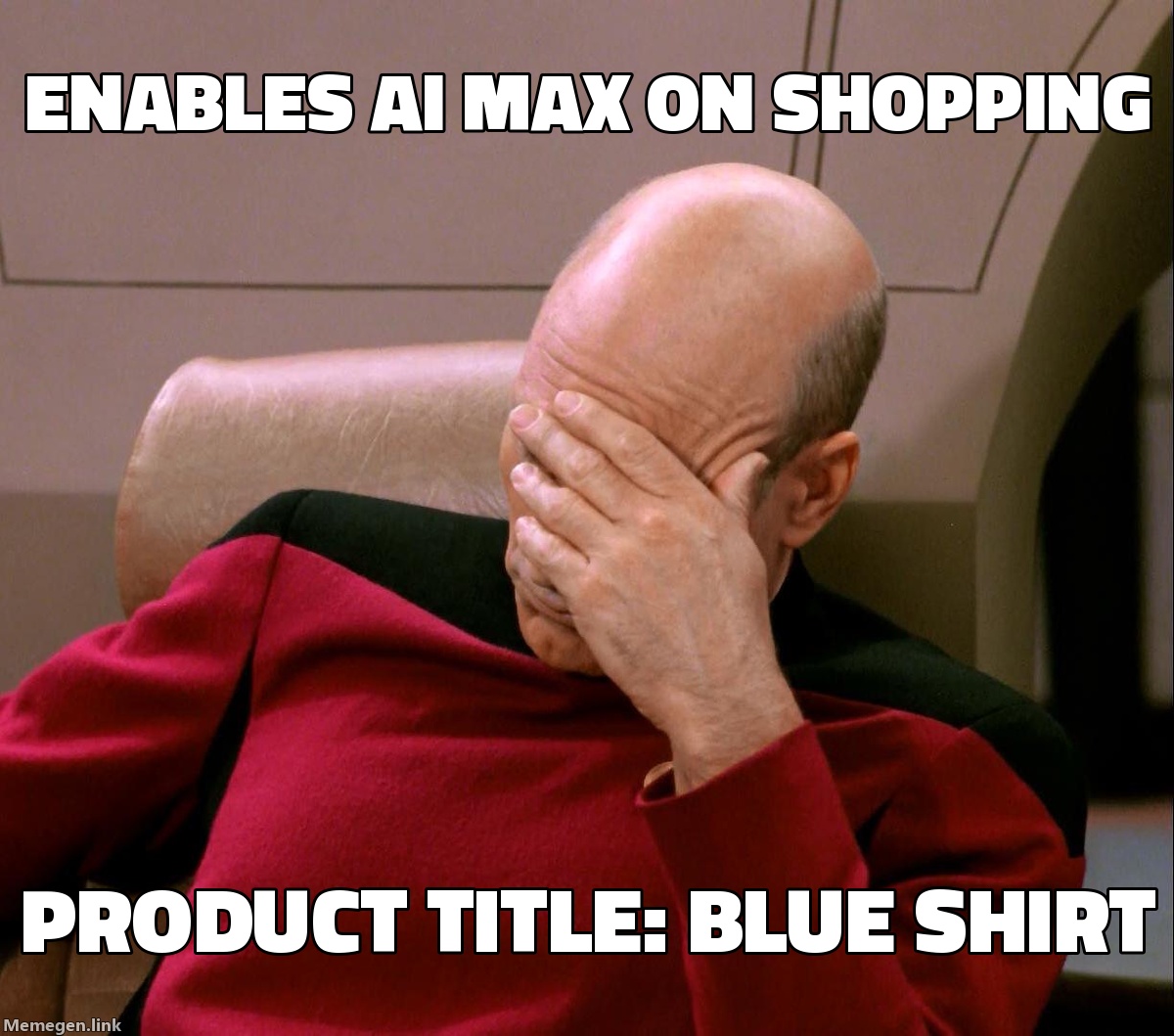
AI Max is now running standard Shopping campaigns
On April 30, Google expanded AI Max to standard Shopping campaigns. Not just Performance Max. Not just Search. Any advertiser running a standard Shopping campaign can now flip a single toggle and let AI Max take over: it reads your Merchant Center feed, writes the headlines, picks the landing page, and decides whether to serve a text or Shopping format based on what it thinks will work best for each query.
The pitch is conversational query coverage. Someone types "lightweight running shorts for hot weather that won't chafe" and AI Max reads your feed's material and fit attributes, then writes an ad that answers that intent. Traditional keyword-matched Shopping would serve whatever your product title says, which is usually "Men's Running Shorts Blue." The intent matching is real. The problem is what happens when the feed has nothing worth reading.
What the numbers actually say
Google claims 7% more conversions when you use the full AI Max feature suite for Shopping. An independent study covering 250 retail campaigns put the average outcome at 35% lower ROAS compared to traditional match types.
Those two numbers are not contradicting each other. They describe the same thing from opposite ends of the data quality curve. The campaigns pulling down that 35% average were running on thin Merchant Center feeds: product titles that hadn't been updated in years, empty descriptions, missing category attributes. AI Max had minimal material to work from, so it generated the best ads it could, and the ROAS reflected that.
Campaigns running on enriched feeds with reliable conversion signal closed most of the gap. AI Max rewards feed quality the way Meta Advantage+ rewards creative volume: give it nothing, get nothing back. That is not a surprise. It is, however, a problem for any account that treats the Merchant Center as a set-and-forget inventory list.
What AI Max actually reads from your catalog
This is the part most Shopping account owners underestimate. AI Max is not using the keywords you bid on or the ad copy you wrote. It reads Merchant Center attributes directly:
- Product title structure (the first 70 characters determine how the system interprets and describes the product)
- Descriptive attributes: material, fit, color, size, intended use case
- Product description, which most brands skip because it does not display in standard Shopping; AI Max uses it as context when writing ad copy
- Product type and category taxonomy
Google specifically named fabric softness, material durability, and fit as the attributes it uses to match conversational apparel queries. For electronics, it is spec and compatibility data. For home goods, it is dimensions and material descriptions.
A feed title like "Men's Merino Polo, Slim Fit, Breathable, Anti-Odor, Blue" gives AI Max enough signal to write an ad answering "odor-resistant travel shirt" queries. A title that says "Blue Polo Shirt" gives it almost nothing. The AI writes around what it has. What it has in most accounts right now is not enough.
The feed is the creative brief. Not a metaphor — that is technically what is happening. The attributes you populate become the inputs for every headline, description, and landing page choice AI Max makes.
Three days before Google doubles down
Google Marketing Live is May 20, three days from now. Based on what has already been announced, Google is not softening its AI Max push. The AI Brief feature launching at GML lets you steer AI Max with your brand voice and messaging guidelines. That is useful. But AI Brief sits on top of feed data. It does not replace it. A well-written brand brief cannot compensate for a Merchant Center catalog where 60% of products have empty descriptions and no attribute data populated beyond the basics.
If you go into GML, enable whatever new AI features get announced for Shopping, and then see erratic performance, the feed is the first place to look. Not the bidding strategy. Not the audience signals. The feed.
What to do before the keynote
- Pull a Merchant Center feed export and check how many products have empty description fields. In most accounts, it is above 60%.
- Rewrite product titles to lead with category, then the key differentiating attribute (material, fit, use case), then the variant detail. The old "product name + color + size" format is not enough.
- Fill in the optional attributes Google accepts for your vertical. For AI Max, there are no optional attributes in practice — they are all inputs.
- Verify that your conversion event data is accurate and sending back reliable revenue signals, since AI Max bidding is only as good as the data it trains on.
You do not need to rebuild the entire catalog this week. But you do need to know where the gaps are before you add another layer of automation on top of them.
If you want a clear picture of how your Shopping account is actually structured before the next round of AI features lands, the free audit at Gromerce shows you the gaps in under three minutes.
Feed quality is Shopping ROAS now. That is the one sentence this entire shift comes down to.
Related articles: Your Google Ads Are Showing in AI Mode Now — Here's What That Changes · Google Expands Smart Bidding Exploration to Shopping and PMax — And Changes How Your Budget Spends Itself · Google's AI Overviews Are Answering Your Keywords. Your Ads Are Still Running.
Sources: Search Engine Journal, Search Engine Land, ppc.land, Marketing Brew, April–May 2026