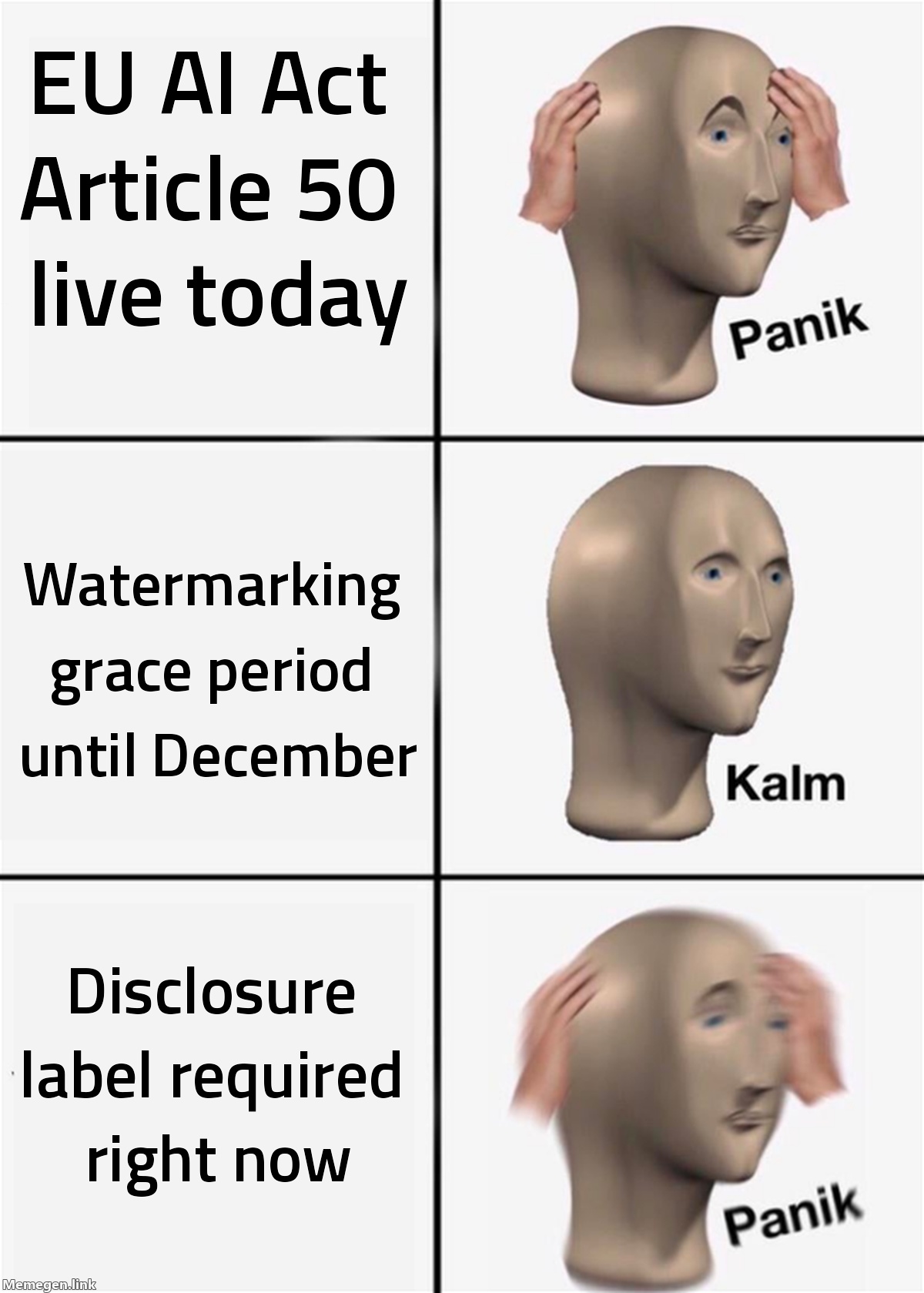
Article 50 of the EU AI Act entered application this morning. If you're serving AI-generated ad creative to any audience in the EU's 27 member states, the disclosure obligation is now in force.
This is not the December deadline you've probably heard about. That covers a different layer entirely. The visible disclosure requirement — a readable label on AI-generated content — started at midnight with no grace period.
What Article 50 actually requires
Two obligations entered force today, and they operate on different timelines.
The first is a visible disclosure to the end user. If your ad creative was generated by AI — image, video, audio, or synthetic human likeness — a readable label must appear on that content when it reaches EU audiences. The European Commission hasn't finalized a standard icon yet. The working interim format is a text label: "AI" in English, "KI" in German, "IA" in French and Spanish. Placement needs to be prominent, not buried.
The second is machine-readable metadata — a cryptographic tag embedded in the media file using the C2PA Content Credentials standard, which records how the content was produced. According to Google and Adobe, both of whom are actively building C2PA support into their creative tools, this technical layer has a three-month extension. The machine-readable requirement applies from December 2, 2026.
Today's obligation is the first one. The label.
What counts as AI-generated content in ads
For advertisers, Article 50 covers more than most teams have prepared for.
AI-generated product images are in scope. If you generated backgrounds, lifestyle shots, or product renders with Midjourney, DALL-E, Adobe Firefly, or Google Imagen for EU-facing campaigns, those assets need a disclosure label on any impression served from today.
AI-generated video is in scope. This includes Veo 3 creative, TikTok Symphony Dreamina output, and any footage where AI generated or substantially altered the visual content.
Synthetic voices are in scope. Any AI-generated voiceover in an ad — including outputs from platform-native audio tools — qualifies as AI-generated content under Article 50.
Synthetic human likenesses are the highest-stakes category. If an ad shows what appears to be a real human face, body, or voice but was created or substantially altered by AI, disclosure is required regardless of whether the depicted person is real or fictional. Advertising is commercial speech, and the artistic expression exemption doesn't eliminate the disclosure obligation in a commercial context.
Where the liability sits
Article 50 uses the term "deployer" — the organization putting AI-generated content in front of users. That's the brand running the campaign, not the AI tool vendor.
If you used Veo 3 to generate a video and it runs as a YouTube ad in Germany, Google built the model. You are the deployer. Per the AI Act text, the maximum fine for Article 50 non-compliance is €15 million or 3% of global annual turnover, whichever is higher.
For agency-client relationships, this matters. The deployer is typically whoever owns the campaign, which puts liability on the advertiser even when an agency produced the creative. The July 1 update to Google's Ads Terms of Service already made the same point on the platform level: advertisers are explicitly responsible for reviewing all AI-generated assets. Article 50 extends that responsibility as a matter of EU law.
Why December doesn't extend your timeline
The C2PA watermarking deadline has been widely reported as "the EU AI Act deadline." Most marketing and legal teams have internalized December 2 as the compliance target. That framing is inaccurate.
The December buffer exists because the technical infrastructure for cryptographic content metadata isn't universally built into every AI creative tool yet. The EU recognized this and gave platforms extra time. But that grace period covers only the machine-readable metadata layer — the C2PA cryptographic tag in the file.
The visible disclosure label requires no technical infrastructure beyond editing the creative asset. It has no grace period. It applied from August 2.
Running unlabeled AI creative in EU markets from today creates enforcement exposure under national market surveillance authorities, which each EU member state designates independently. Any of the 27 can initiate action.
Four checks before any EU campaign goes live
Pull every active EU-targeted campaign and flag assets produced by AI tools. This includes creative built with external tools that platforms don't auto-label — anything outside Google's own AI systems or Meta's Advantage+ Creative.
Add a visible "Made with AI" text label to every flagged asset. Use the correct language variant for the target country if you run country-specific creative. Until the EU standardizes its icon, text is compliant.
Map which of your AI tools will output C2PA Content Credentials by December. Adobe Firefly and Google Asset Studio are building this. Tools that don't yet support C2PA are your December work items.
Document your tool stack now. Google's My Ad Center requires advertisers to declare external AI tools used to produce assets running through Google Ads. If you're generating creative outside Google's own systems, that declaration obligation sits with you.
If you want to see how your EU-facing campaigns hold up across tracking, creative compliance, and attribution gaps, the free audit at Gromerce gives you a read in three minutes.
The enforcement window opened this morning. Content generated before today carries no retroactive requirement. Everything from this point forward does.
Sources: TechCrunch, Bloomberg, Adobe, Google, August 2026