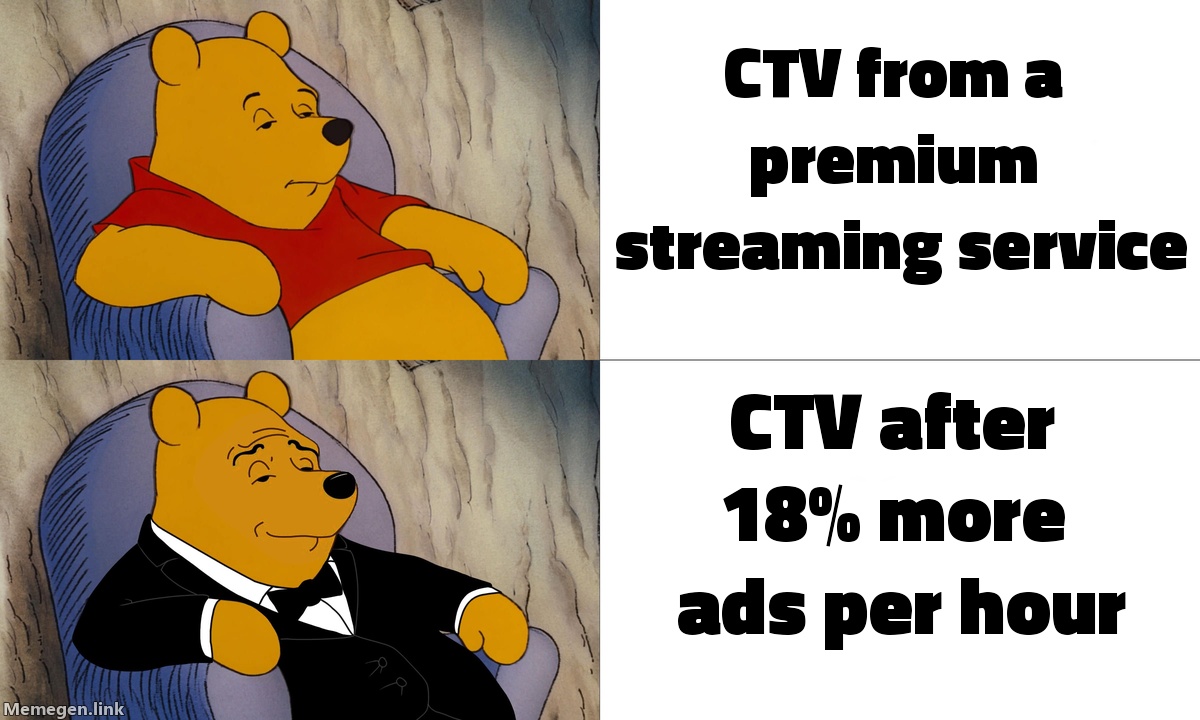
Streaming platforms have been quietly renegotiating the deal they made with viewers. You pay a lower subscription fee, you get ads. That was the trade. In 2026, some platforms have adjusted the terms without announcing it.
According to Ampere Analysis data reported by eMarketer and Digiday, ad loads increased by 18% across major streaming services between January and August 2026. That's not a blip from one platform doing something unusual. It's a systematic shift toward extracting more ad revenue from existing subscribers.
who's adding the most
The platform breakdown per Adweek: Paramount+ is now running more than nine minutes of ads per hour. Hulu is at 8.23 minutes. Disney+ is at 7.54. Netflix, which entered ad-supported streaming later than its competitors and positioned itself as more restrained, is still under 2.5 minutes per hour — but Digiday found a 74% year-over-year increase in its own load. Where a platform sits today matters. The direction it's moving matters more.
The exception is Amazon Prime Video, which reduced its ad load during the same period. It's the only major service moving against the trend. This isn't an oversight. It's a positioning decision — fewer interruptions, higher attention per impression, a more premium environment that can command higher CPMs from buyers willing to pay for quality over scale.
what more ad time actually does to your inventory
The immediate arithmetic might look favorable. More ad inventory on streaming platforms means more supply, which can push CPMs down on these platforms programmatically. If you're buying streaming through a DSP, you may see cheaper rates on Paramount+ than you did six months ago.
The issue is what else happens to that inventory. More ad breaks per hour means more pod positions. The first ad in a pod captures a fundamentally different level of attention than the third or fourth. If Paramount+ is running nine minutes of ads per hour, a real share of that inventory is late-pod placements — technically completed views, but in a context where viewers have already reached for their phones.
This is the measurement gap most CTV buyers aren't watching. They track cost-per-completed-view and reach. They rarely track pod position or per-platform completion rates by ad slot. The CPM looks fine. The attention quality may not be.
the Hulu-Disney+ consolidation changes the math
Hulu and Disney+ have been merging their ad inventory throughout 2026. Hulu's ad revenue already exceeds Disney+'s by more than 2x, and the combined platform is tracking toward $5 billion in annual ad revenue, according to industry reporting. At that scale, the consolidated Disney-Hulu buy offers reach that's hard to replicate elsewhere in streaming.
But it's two ad-heavy environments becoming one combined inventory pool. Both are running 7 to 9 minutes of ads per hour. The scale argument is real. So is the clutter argument. For a performance campaign where frequency and pod position matter, buying the combined Disney-Hulu inventory because of reach without tracking the environment quality is a mistake that won't show up cleanly in your dashboard.
why Prime Video's choice should affect your Q4 allocation
Amazon Prime Video running fewer ads per hour creates a different kind of inventory. Fewer available positions per hour means higher competition for those positions, which drives CPMs up. The question isn't whether it's more expensive — it is. The question is whether the attention environment justifies the difference.
For DTC brands heading into Q4 with CTV budgets, the Prime Video positioning is worth evaluating on its own, separate from Amazon's retail media capabilities. The inventory carries a different character from Paramount+, and treating them as the same category of CTV spend is the kind of blending that produces misleading benchmarks.
the question to take back to your programmatic partner
Most brands aren't buying CTV directly. They're buying through Trade Desk, DV360, Amazon DSP, or agency managed buys. The optimization objective is typically reach and cost-per-completed-view — not pod position or per-platform attention quality.
Ask whoever manages your CTV to show you CPMs and completion rates broken out by streaming platform, not blended. If that breakdown doesn't exist in your reporting, the data is being aggregated in a way that obscures the quality gap between platforms.
The 18% ad load increase is an industry-level signal, not a direct account action item. What it tells you is that "CTV on streaming services" is becoming a less uniform category. The platforms keeping ad loads low will get higher CPMs because the inventory is genuinely different. The ones adding more ad minutes per hour will have cheaper inventory that performs differently.
Your Q4 allocation should reflect that distinction. If it doesn't, you're letting the algorithm decide which environment to put you in.
Gromerce's free audit takes three minutes and shows you where your paid budget is landing before Q4 allocations finalize.
Streaming ad loads went up 18%. CTV attention quality didn't go up with them.
Sources: eMarketer, Digiday, Adweek, MediaPost, September 2026