The number that doesn't add up
The basic rule of digital advertising: when more advertisers compete for the same inventory, prices go up. More demand, constrained supply, higher CPMs and CPCs.
Ecommerce broke that rule last quarter.
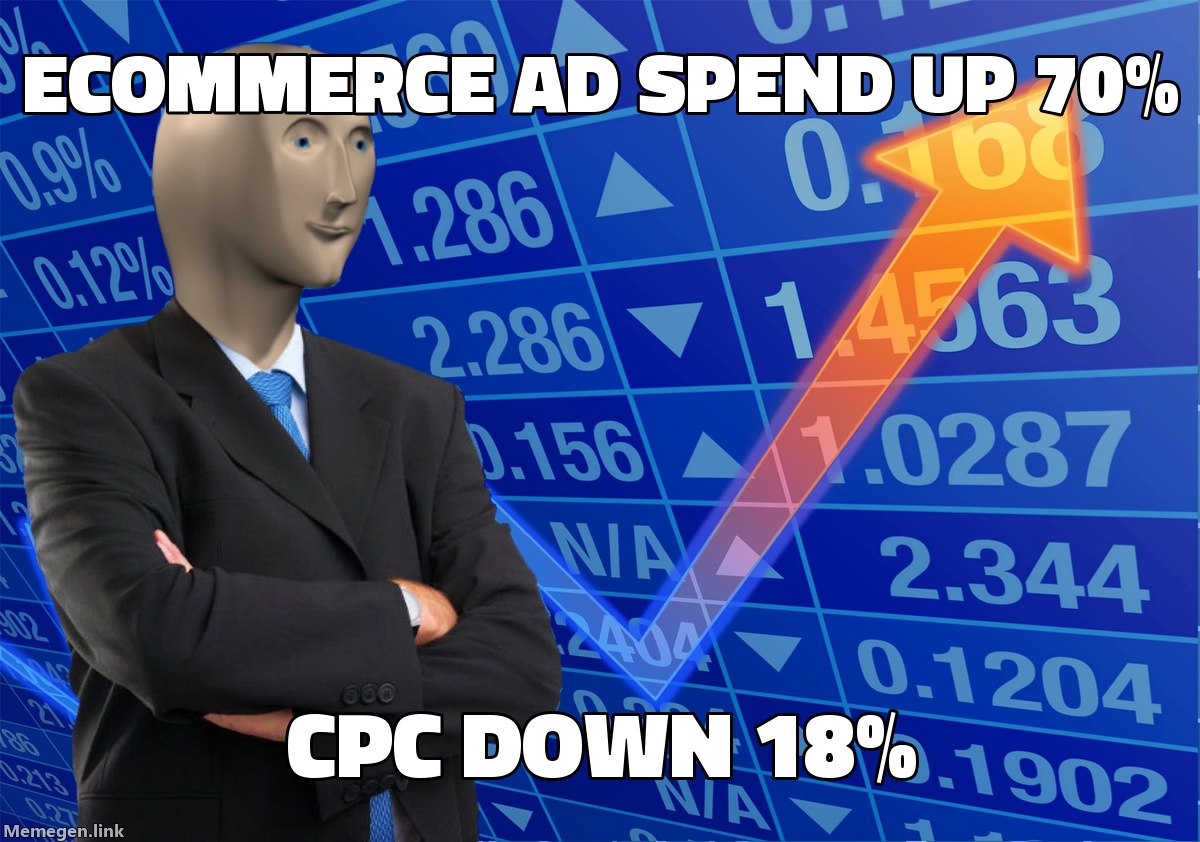
According to Emplifi's Q2 2026 Social Ads Benchmark Report — based on anonymized data from more than 7,700 Meta ad accounts — ecommerce brands increased median monthly social spend by 70% year over year, from $16,426 to $27,966. Emplifi also found that ecommerce click-through rates rose 29% while cost per click fell 18% to $0.133. That's the lowest CPC of any industry Emplifi tracks.
More spend. Cheaper clicks. The usual logic says pick one. The data says both.
Why the math works out
CPC is a derived metric: CPM divided by CTR times 1,000. If your CTR jumps 29% and CPM stays roughly flat, CPC drops accordingly. That's largely what happened. Meta's underlying impression inventory didn't get dramatically cheaper. What changed was how well ecommerce ads converted impressions into clicks.
That's a creative quality and targeting precision story.
Advantage+ Shopping Campaigns have absorbed a larger share of ecommerce budgets throughout 2026, especially after Meta cut the minimum conversion threshold from 50 weekly conversions to 25 in April. More accounts moved into the Advantage+ model. The AI found more efficient paths to in-market audiences as it had more signal to work from. Better CTR means Meta's algorithm rewards those ads with better delivery. Better delivery means the same CPM buys more clicks.
The accounts spending more efficiently didn't just get lucky. They gave the system what it needed to improve.
Who captured the efficiency — and who didn't
The Emplifi report covers industry aggregates. What the data implies but doesn't state: these efficiency gains are not evenly distributed.
A 70% spend increase means ecommerce competition on Meta intensified significantly. Yet aggregate efficiency still improved. Some accounts improved enough to pull the median down even as others likely got worse. Median figures mask distribution.
The accounts most likely to have captured those CTR gains are the ones with clean CAPI setups, full conversion events flowing, and active Advantage+ Shopping campaigns with well-managed catalogs. Those accounts gave Meta's AI the signal it needed to improve targeting precision over time. High-quality signal leads to better audience selection, which leads to higher CTR, which leads to lower CPC.
Accounts running degraded Pixel setups, missing CAPI, or relying on manually managed audiences didn't benefit from the same optimization loop. They spent more into a more competitive auction without the AI advantage. That's a real cost.
Three things to check against this benchmark
If your Meta CPC is well above $0.133, there are usually two places the problem lives: creative that isn't pulling clicks, or targeting hitting the wrong people at the wrong time. Both are signal quality problems. Adjusting bids won't fix them.
If you haven't scaled Meta budget in 2026, the industry data suggests you may be underallocating relative to where efficiency actually is right now. A 70% spend increase with falling CPCs is a rare combination — it's an argument for testing higher budgets against your ROAS targets before Q4 CPMs reset the math.
If you've been holding back on Advantage+ Shopping because of control concerns, the benchmark data doesn't support that instinct. The efficiency gains correlate with the shift toward AI-optimized campaigns. Manual campaigns didn't get 29% more efficient last quarter.
One caveat worth holding: Emplifi's data covers Meta only. Google Shopping CPCs are moving differently, and TikTok dynamics are distinct again. This isn't a cross-channel recommendation. It's a Meta-specific finding that should prompt a Meta-focused audit.
What the broader split tells you
Emplifi's data shows ecommerce brands spent 70% more on Meta last quarter. The cross-industry median was 13%. That gap is a story about where DTC and ecommerce marketers decided to put incremental dollars in 2026.
Some of that shift came from frustration with Google's increasingly opaque auction and the forced AI Max migrations. Some came from Meta's Q2 earnings validating that its AI-driven ad system was working. Some came from the efficiency data itself: as Advantage+ delivered better CPCs, accounts scaled further.
For brands still deciding where to lean into for Q4, the benchmark is about as clear a signal as you'll get before October CPMs reset everything. The efficient accounts found the combination: more budget, better signal, AI-optimized campaigns. The question is whether your account is in that group.
If you want to know where you stand against these industry benchmarks, the free audit at Gromerce gives you a read on signal quality and spend efficiency in a few minutes.
Sources: Emplifi, PR Newswire, September 2026