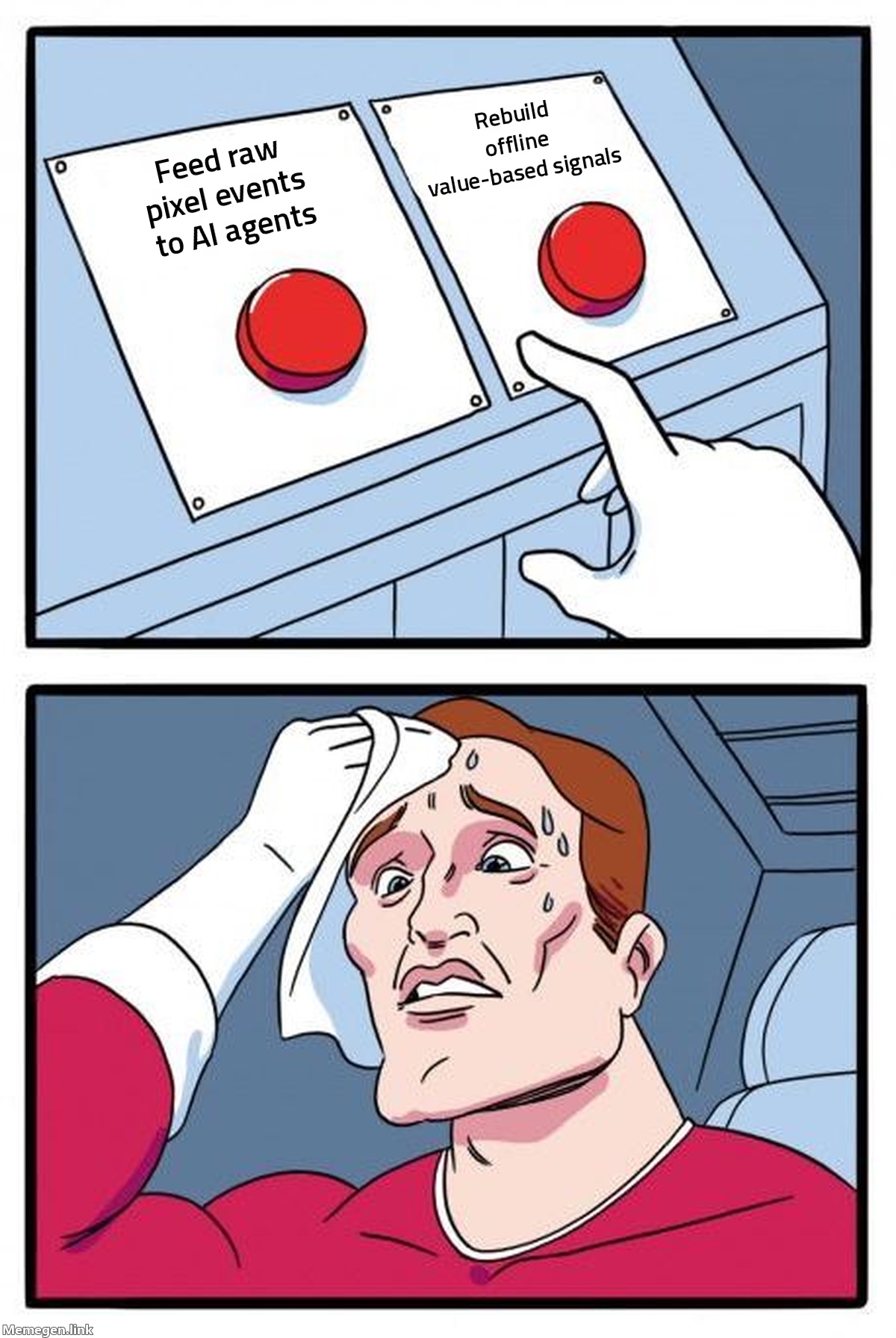
Automated ad buying does not fix broken data. It accelerates it. When an agency or internal media team plugs an autonomous bidding script, a Meta Advantage+ campaign, or a Google AI Max workflow into an ad account with polluted conversion events, the machine does not stop to question whether a conversion is profitable. It simply asks where it can buy 500 more of them before midnight for under $22 apiece.
If you feed unvetted inputs into machine learning systems, your media efficiency collapses from the inside out. Marketers routinely blame creative fatigue, rising CPMs, or macro consumer softness when their acquisition economics erode. In reality, the culprit is almost always structural: the audience signals for ai ad campaigns that teams hand over to the platform are fundamentally flawed, training predictive bidding models to systematically hunt down your least valuable prospects.
The Mechanistic Trap of Autonomous Audience Expansion
Every modern programmatic algorithm operates on a single incentive: maximize the volume of the assigned conversion event within the target efficiency constraint. The system does not possess contextual business logic. It does not know that a user who downloads a top-of-funnel whitepaper with a burner email address has a 0.3% probability of buying software, while an executive scheduling a custom integration demo has a 42% close rate.
When you pass unqualified lead form submissions or unsegmented checkout events back to Google or Meta as primary conversions, the autonomous agent identifies the path of least resistance. It locates the cheapest demographic clusters that routinely trigger that pixel event.
Why Algorithms Love Low-Value Buyers
Low-intent users convert on free offers and entry-level discounts at three to four times the rate of enterprise decision-makers or affluent repeat buyers. Because an algorithmic agent evaluates its own performance against conversion frequency and cost-per-action (CPA), it will shift 70% to 80% of daily delivery away from high-friction, high-value prospects toward high-volume, low-margin tire kickers.
The campaign dashboard looks phenomenal for the first 30 days. CPA drops by 24%, conversion volume ticks up by 38%, and mid-level managers draft celebratory memos. Sixty days later, finance discovers that downstream pipeline revenue has declined by double digits, lead-to-opportunity velocity has cratered, and customer service ticket volume has doubled from discount abusers demanding refunds.
By the time leadership realizes what occurred, the platform’s core machine learning model has already anchored on the behavioral traits of low-tier converters. Because Google controls 90% of campaign decisions, trying to steer the algorithm back toward enterprise buyers through surface-level ad copy tweaks rarely works once the underlying model has calibrated to junk data.
Why Audience Signals for AI Ad Campaigns Fail Without Offline Verification
The fundamental vulnerability of modern campaign automation is latency between the platform click and cash collection. A browser pixel records an event in milliseconds, but business value takes weeks or months to materialize.
When media buyers fail to bridge this gap with verified offline conversion data, the bidding engine treats every click-to-convert action identically.
Standard Signal Flow (Broken):
User Click -> Form Submit / Low AOV Buy -> Pixel Fires -> AI Scales Lookalike Cluster -> High Volume, Low Margin

Value-Verified Signal Flow (Correct):
User Click -> CRM Validation -> Profit Margin / Qualified Lead Tag -> Server-to-Server Upload -> AI Scales High-LTV Buyers
Consider direct-to-consumer eCommerce brands running automated shopping campaigns. If you pass raw transaction revenue to the algorithm without adjusting for gross margin, return rates, or customer acquisition status, the AI will naturally prioritize items with high purchase frequency and low margins. It will aggressively target existing brand loyalists who were already navigating directly to the checkout page, claiming attribution credit for transactions your business owned anyway.
In B2B lead generation, the disparity is worse. Without automated conversion value rules tied to actual CRM qualification stages—such as Sales Qualified Lead (SQL) or Closed-Won Revenue—AI campaign agents optimize directly for form spam and bot traffic that bypass basic reCAPTCHA hurdles.
The algorithmic loop feeds on itself:
- Low-intent prospects fill out forms quickly.
- The platform receives the signal within 60 seconds.
- The AI agent assumes this audience profile represents your ideal customer persona.
- The system expands audience targeting to millions of behavioral lookalikes exhibiting the exact same browsing patterns.
- Ad spend concentrates almost entirely on users who convert cheaply and never buy.
This operational distortion is why marketing accountability for AI ad campaigns breaks the moment algorithms touch creative and audience delivery simultaneously without strict guardrails.
3 Critical Flaws in How Teams Feed First-Party Signals to Ad Algorithms
Fixing your campaign efficiency requires diagnosing where your input data is rotting. Across hundreds of accounts evaluated during a Gromerce audit, bad audience configurations usually stem from three distinct setup errors.
1. Zero-Dollar Conversion Parity
Setting all primary conversion actions to an equal value of $1.00 or leaving value tracking disabled forces smart bidding to rely entirely on target CPA logic. In target CPA environments, an AI engine will always buy the cheapest conversion available, regardless of whether that user has purchasing power. If your pricing spans from a $15 monthly subscription to a $2,500 annual plan, feeding the algorithm an unweighted pixel fire ensures your ad spend floods the $15 tier until inventory exhausts.
2. High Match-Rate Blindspots in Customer Lists
Uploading unsegmented first-party CRM lists into audience signal modules (such as Meta Custom Audiences or Google Customer Match) often poisons the algorithmic well. If you dump a flat CSV of 100,000 historical contacts containing unsubscribed users, churned accounts, and free-trial dropouts into an AI seed list, the network matches those hashed identities against consumer profiles. The AI then spends campaign budget locating prospects identical to the people who abandoned your product two years ago.
3. Ignoring Server-Side Signal Latency
Ad networks require rapid feedback to adjust real-time auction bids. When brands delay their offline conversion imports by 14 to 30 days, the AI agent is forced to optimize 100% of its intra-month bidding decisions on superficial client-side pixel events. By the time your CRM sync passes actual closed revenue back to the network, the machine learning model has already burned through the monthly allocation on bottom-funnel scrap.
| Signal Pipeline Element | Default Automated Setup | Engineered AI Guardrail | | :--- | :--- | :--- | | Optimization Target | Raw Form Submit or Topline Revenue | Qualified Margin-Adjusted Deal Value | | Data Ingestion Point | Unfiltered Browser-Side Pixel | Server-to-Server CAPI / Enhanced Offline Imports | | Seed Audience Inputs | Flat CRM Contact Lists (All Time) | Top 15% Net LTV Customers (Active Past 180 Days) | | Algorithmic Constraint | Free-roam target CPA / Broad Match | Strict Exclusion Lists + Value-Based Bidding Rules |
The Mechanics of Value-Based Algorithmic Calibration
To regain control over automated ad campaigns without sacrificing the real-time bid adjustments that machine learning excels at, you must transition your accounts from binary conversion counting to value-based bidding (tROAS).
Value-based bidding works because it changes the objective function of the platform's AI agent. Instead of instructing the algorithm to find any user who will submit a form for $50, you command it to maximize absolute predicted conversion value while meeting a target return ratio.
To execute this transition effectively:
First, implement dynamic conversion value rules directly inside your ad platforms. If your average sales cycle takes 45 days, assign an estimated economic value to intermediate micro-conversions based on historical pipeline conversion rates. If 10% of users who schedule a demo sign a $10,000 contract, that demo booking action is worth exactly $1,000 to the algorithm.
Second, purge your audience signal seed lists. Strip out every customer who purchased at a net negative margin, required excessive support intervention, or canceled within the initial 90 days. Build your AI seed signals exclusively around the top 20% of your account base by recurring margin contribution.
Third, enforce customer acquisition exclusions. If your automated campaigns are allowed to bid on existing customers without strict value suppression rules, algorithms will systematically cannibalize your owned retention revenue to artificially lower reported acquisition costs.
What to Do This Week
Stop adjusting campaign budgets, paused ad sets, and headlines until you fix the core signals guiding the machine.
- Open your conversion settings in Google Ads and Meta Events Manager. Document every conversion action currently designated as "Primary" or marked for automated bidding optimization.
- Demote non-monetary micro-conversions immediately. Turn newsletter subscriptions, PDF downloads, and preliminary checkout steps from "Primary" to "Secondary" optimization actions. These should only be tracked for reporting observation, never used to guide algorithmic bidding.
- Rebuild your customer seed lists. Filter your CRM for the top 15% of your customer base by lifetime net margin over the trailing 12 months. Export that cohort and upload it as your primary audience signal asset.
- Deploy a hard negative customer exclusion list across every automated acquisition campaign, preventing the AI from juicing conversion metrics using contacts already stored in your sales pipeline.
Automated bidding systems do exactly what you pay them to do. If you train them on vanity conversions and contaminated audience records, do not act surprised when they scale your losses with absolute precision.
Sources:
- Search Engine Journal: "AI Agents Won't Fix Bad Audience Data, They'll Amplify It" (Skydeo / Greg Jarboe, 2026)
- Google Ads Decoded: "Build campaigns that drive high-converting, sales-ready leads" (Google Ads Blog, 2026)