What changed on July 6
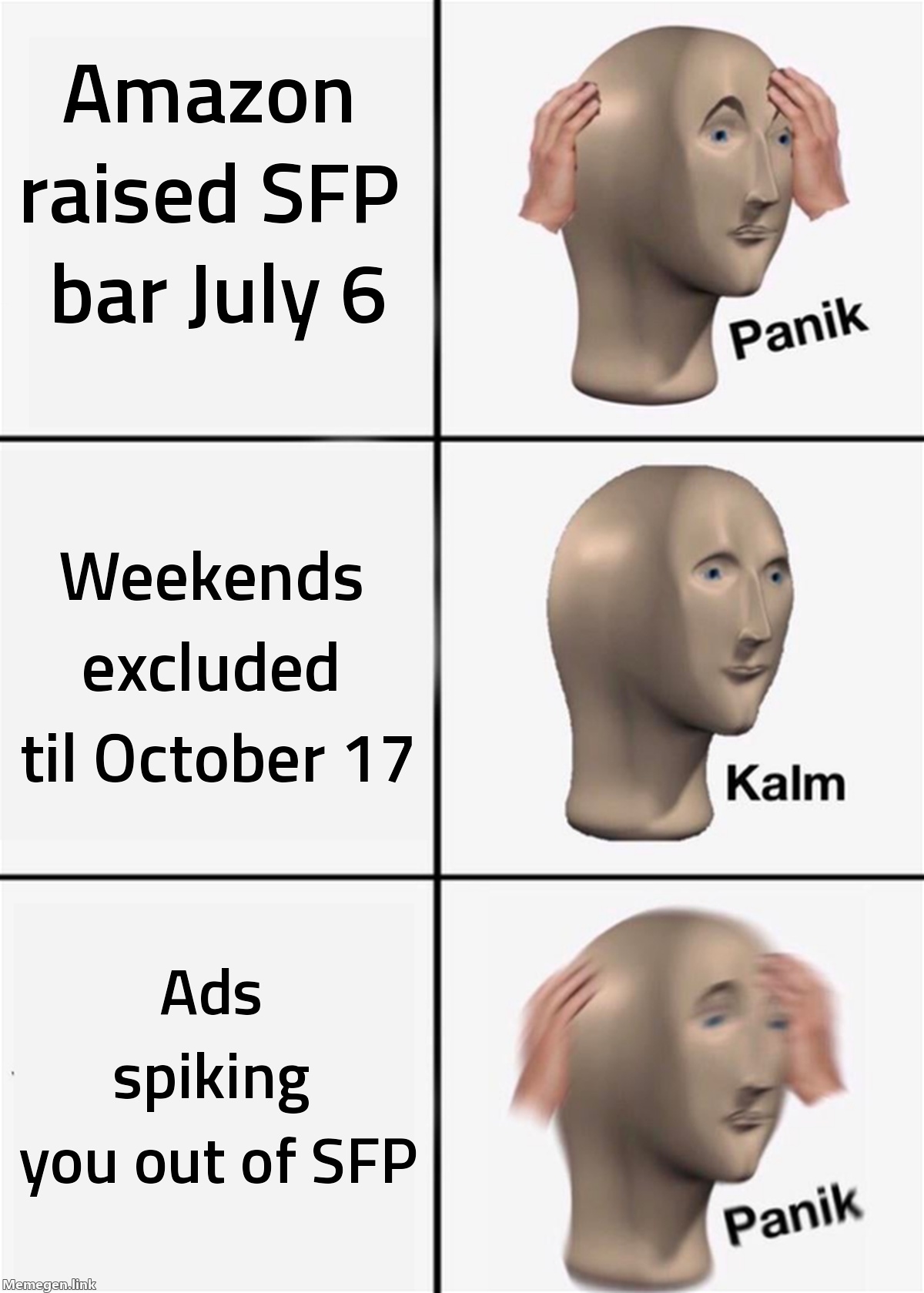
Amazon raised the delivery speed requirements for Seller Fulfilled Prime — the most significant upward revision to the program since its relaunch to new enrollees in 2023.
Standard-size products now require 40% of Prime page views to show one-day delivery (up from 30%), 75% to show two-day delivery (up from 70%), and 90% within five days. Oversize products need 15% one-day coverage, 45% two-day, and 80% within five days. Extra-large products need 25% two-day and 60% within five days, with no one-day requirement for that tier.
These aren't advisory targets. SFP accounts that fall below threshold lose the Prime badge. Products get removed from Prime-filtered search and fall below the featured offer threshold. Sponsored Products campaigns lose their conversion baseline in the same week your organic listing deteriorates.
The change happened quietly. Amazon updated seller dashboards and sent notifications, but the mechanism connecting the new speed bar to paid media performance is one most advertisers haven't mapped out yet.
Why your ads are working against your compliance
Sponsored Products campaigns directly affect your SFP speed metrics. This is the part most Amazon advertisers haven't accounted for.
Amazon calculates speed coverage by looking at what percentage of Prime page views show delivery within the required window. Every campaign that brings more shoppers to your listings adds page views to that denominator. If your warehouse can process 500 orders per day within SFP speed standards and a Sponsored Products ramp pushes volume to 700, those additional 200 page views count against your metrics — not for them.
An SFP account sitting at 38% one-day coverage on standard-size products has a two-percentage-point buffer before it loses compliance. A Sponsored Products campaign that adds 15% more page views in a week can close that gap. The account may not register the problem until the Prime badge disappears — and by then, the same ad spend is driving traffic to a listing that no longer converts like a Prime listing does.
According to Amazon's own data, reducing estimated delivery time by one day drives approximately 5% in incremental sales. That relationship runs both ways.
The gap between your advertising budget and your fulfillment capacity is the number that actually determines risk here, not your ROAS.
The October 17 problem
Amazon excluded weekends from SFP speed metric calculations through October 17, 2026. This exclusion was introduced alongside the July thresholds to give sellers time to adapt. When it ends, Saturday and Sunday fulfillment goes back into the coverage calculation.
If your warehouse doesn't ship on weekends, your current dashboard numbers are not your real compliance position. The speed metrics you're hitting right now exclude two out of every seven days. That's a meaningful difference for accounts close to threshold.
Amazon is launching a Delivery Promise tool in September 2026 that will let sellers set shipping speeds by ZIP code and configure daily cut-off times. That tool is how you model the October change before it happens — not after. A seller who maps their per-ZIP weekend delivery capabilities in September is in a different position than one who discovers the compliance drop on October 18.
What to check before your next campaign
The answer isn't to pause your Sponsored Products spend. Prime-badged listings convert at a meaningfully higher rate than non-Prime alternatives. You want ads and compliance working in the same direction.
The answer is to know your compliance clearance before you commit to a campaign that will spike demand.
Pull your SFP speed metrics dashboard and look at coverage by size tier. If standard-size one-day coverage is more than five percentage points above the 40% threshold, a meaningful Sponsored Products scale-up is lower risk. If you're within two points, run the math on what a 15–20% traffic increase does to your numbers before you approve the budget.
Two things to do now: check your threshold clearance by size tier, and figure out what your weekend fulfillment profile looks like before October 17 removes the exclusion. Both are operational decisions that will have direct consequences for your paid campaign performance in Q4.
If you want to see how your paid media setup maps against your Amazon catalog and fulfillment infrastructure, the free audit at Gromerce surfaces the connection points your ROAS dashboard doesn't show.
Ads that drive traffic to a listing losing its Prime badge in the same week are expensive in ways that don't show up until the next reporting cycle.
Sources: ppc.land, Shipsage, Stack Influence, Amazon Seller Central, July–August 2026