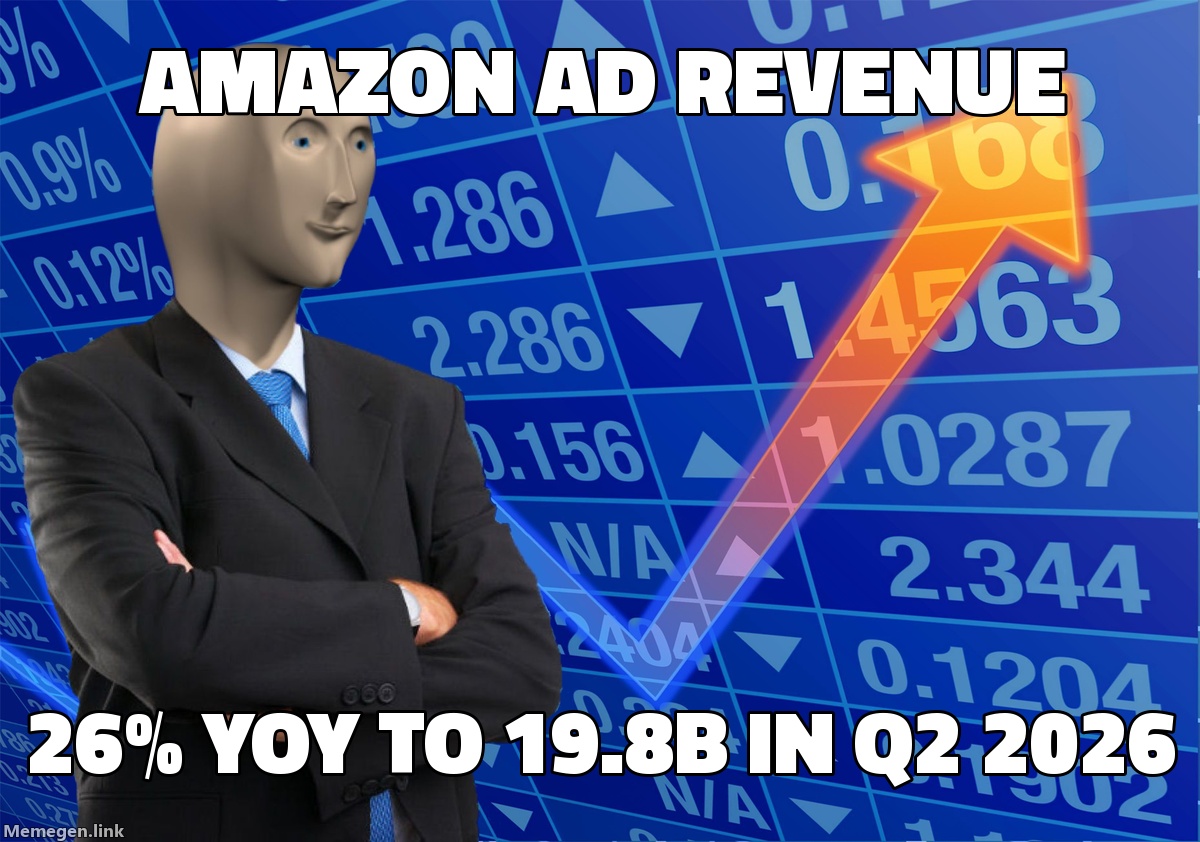
Amazon reported $19.8 billion in advertising services revenue for Q2 2026, up 26% year-over-year, according to the company's earnings released July 30 and reported by Yahoo Finance. That's the largest quarterly ad number Amazon has ever printed.
CEO Andy Jassy's earnings commentary went further than the headline. Two data points from that call are worth building into your account strategy.
The number in context
Amazon's advertising segment has become the fastest-growing major platform in digital. Per MediaPost's reporting on the Q2 results, the $19.8 billion figure came from Sponsored Products (still the platform's largest unit), Prime Video advertising, Amazon DSP, Sponsored Brands Video, and newer AI-native formats. Multiple segments growing at once means the platform isn't pulling a single lever — demand is broadening across the ecosystem.
The context that matters for budget decisions: Amazon's ad business is built on purchase-intent signals. Someone on Meta may be in a browsing mindset. Someone on Amazon is already in the store. That difference in context has always been the argument for Amazon advertising, and it shows up in where the growth is happening.
What Jassy said about Sponsored Prompts
The most actionable figure from Amazon's Q2 2026 earnings call, per Yahoo Finance's reporting: shoppers who click a Sponsored Prompt convert to a sale 48% more often and spend 21% more on average than those who don't click. Jassy cited this as a driver of the advertising segment's acceleration.
Sponsored Prompts are the ad units embedded in conversational AI shopping through Alexa+ and Alexa for Shopping. They're not traditional keyword-triggered Sponsored Products placements. They surface when a shopper searches through an AI interface and receives a commerce recommendation inside the response — closer to a product being cited in a conversation than a banner triggered by a query.
That 48% conversion premium over baseline is meaningful. Sponsored Products is already considered efficient for purchase-intent audiences. Adding nearly half again in conversion rate — in the same ecosystem — is a gap most DTC brands haven't adjusted their budgets to reflect. Most aren't running Sponsored Prompts at all.
There's a prerequisite: Sponsored Prompts pull from your product catalog, descriptions, and customer reviews to surface relevant results in conversational queries. If your catalog attributes are thin, or your titles read as keyword strings rather than natural descriptions of what the product does, you won't show up in that AI layer regardless of whether you've created the campaign.
Ads Agent: what the performance data shows
Amazon also reported on its Ads Agent AI tool during the Q2 call, per Amazon Ads: 8% lower cost per impression and 6% lower cost per acquisition compared to campaigns not using it. The tool expanded to 11 new countries in Q2.
These are Amazon's own measurements, so treat them as directional. The direction is consistent with what's happening at Google and Meta: platform AI bidding tools are outperforming manual setups in large-sample platform data. The quality of your catalog and creative inputs determines what the machine optimizes against. A thin feed gives Ads Agent nothing useful to work with.
Sports inventory is already gone
Thursday Night Football, NBA, WNBA, and NASCAR inventory on Prime Video all sold out in Q2, according to Amazon's earnings commentary. Amazon added more than 30 new advertisers to NBA placements in its first full season carrying the league.
For most DTC brands, Prime Video live sports is not the immediate budget question. But it tells you something about the platform's direction: premium inventory is being absorbed faster than it's being created, and that's where long-term CPM pressure comes from.
Two things to check in your account
First: open Amazon Ads and confirm whether you have Sponsored Prompts campaigns running. If you don't, that's the highest-conversion format on the platform sitting unused — not a channel-fit question, a setup question.
Second: assess your catalog for AI-readiness. Complete product attributes, descriptions written in natural language (not keyword fragments), and a current review corpus are what both Sponsored Prompts and Ads Agent depend on. This is different from optimizing titles for keyword matching — it's optimizing for how a shopper describes what they need in a sentence.
Amazon printed $19.8 billion in one quarter. The brands contributing to that number are already running these formats. The window to enter Sponsored Prompts and Ads Agent at pre-scale CPMs is still open, but it narrows each quarter as more advertisers find the conversion premium.
If you want to see how your current paid channel allocation holds up, the free audit at Gromerce benchmarks your setup in three minutes.
The Amazon ad business isn't growing because of a single thing. AI-native formats, premium video, and performance units are all compounding in the same ecosystem — at the same time.
Sources: Amazon Ads, Yahoo Finance, MediaPost, July 2026