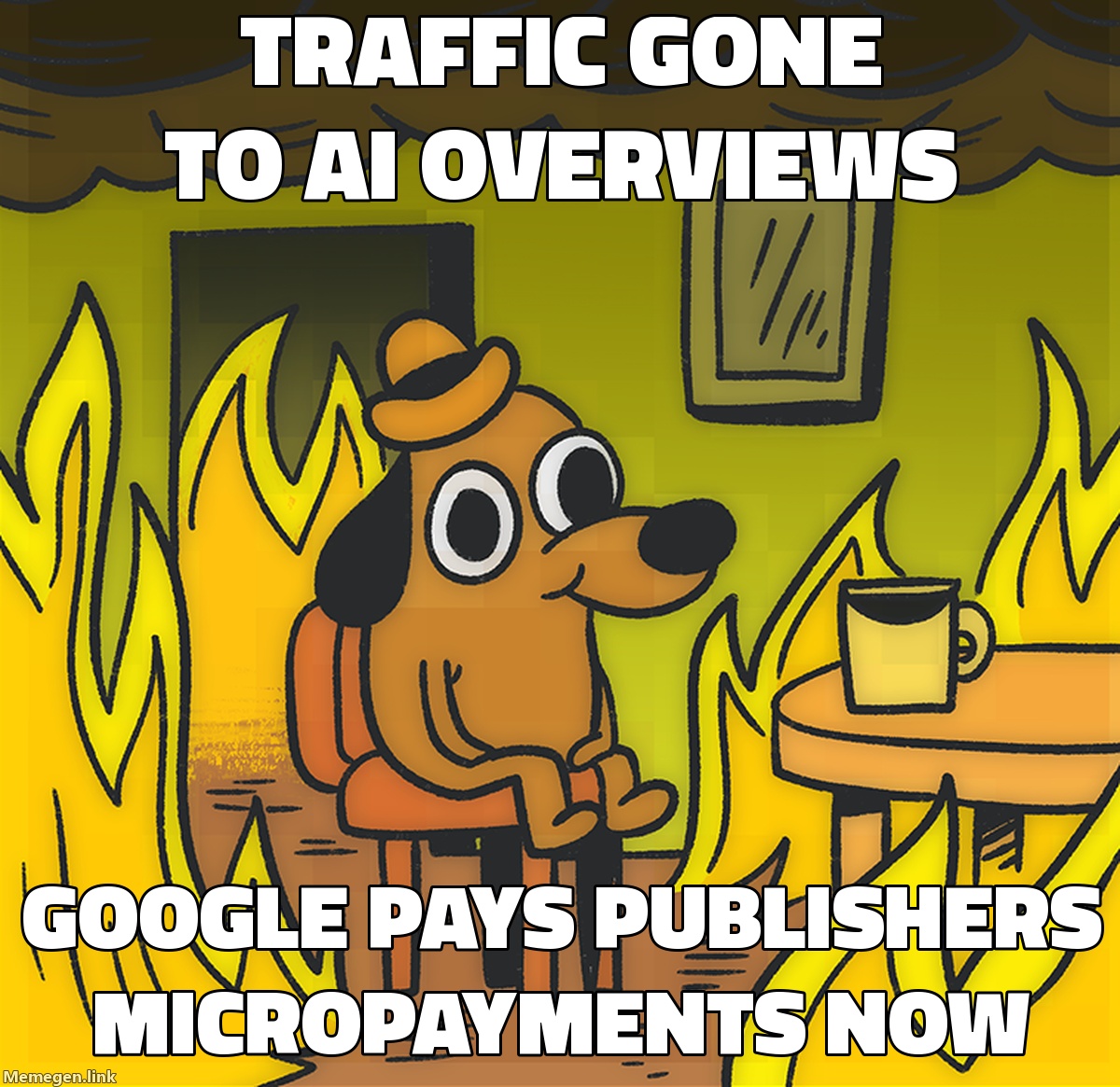
Google is quietly paying publishers for content that appears in its AI answers. The program is called the AI Contribution Pilot, it runs through Google Search Console, and it's been rolling out to select publishers in recent weeks. Digiday reported the details this week, and industry coverage has confirmed the program is actively running.
Here's how it works: publishers enrolled in the pilot receive a new AI earnings widget in their Search Console dashboard showing monthly earnings. The payment is usage-based — no flat fee, no long-term commitment — and it applies to content that "significantly contributes" to responses generated across Google's AI products: AI Overviews in Search, AI Mode, and the Gemini app. Publishers can opt out at any time.
The amounts aren't public. Some observers have already dismissed the program as a legal fig leaf — a small payment that lets Google continue using publisher content while deflecting the antitrust and copyright suits that have mounted as AI Overviews expanded. That criticism isn't wrong. But the mechanism itself tells you something that matters more than the check.
Google is pricing what used to be free
For the past year, publishers have operated under an uncomfortable arrangement: their content fuels AI answers that keep users inside Google's interface, but those same answers reduce the clicks that bring traffic back to the publisher's site. Antitrust suits by publishers have been triggered specifically by the traffic declines tied to AI Overviews expansion, as Digiday and Search Engine Land have both covered extensively.
The AI Contribution Pilot doesn't fix that. It doesn't restore click-through rates. What it does is create a pricing signal: Google now has a mechanism for assigning dollar values to individual content contributions to AI answers. That's a meaningful shift in how Google sees the web.
Google has until now resisted the lump-sum licensing deals that OpenAI and Apple have used with major publishers. This program goes in the opposite direction — granular, per-use, query-level pricing. Which means Google's system now has to know which content earned it the most in AI answers. That data exists somewhere. It shapes which sources get prioritized in future answers.
What this means if you run paid search
The direct paid media implication runs through a simple chain.
More publishers will now have financial incentive to create content that earns AI citations — not just content that earns organic clicks. If quality, citeable content becomes more financially valuable, more of it gets produced, which makes AI Mode more useful, which keeps more users in AI Mode rather than clicking paid search results. The organic-to-paid traffic ratio was already shifting. Programs like this push it further.
That's not a reason to cut paid search. It's a reason to understand what's happening above your paid listings and below your brand's AI citation share, because both affect your overall performance in ways that CPC reporting alone doesn't show.
The Gromerce free audit looks at both sides — your paid performance and your AI search visibility — in a single view. If you haven't checked how your brand shows up in AI Overviews for your top commercial queries, the audit tool is the fastest way to do it.
What content-producing brands should actually do
First, check Search Console for any new AI-related widgets or reports. The AI Contribution Pilot is currently invite-only for select publishers, so you may not see anything yet. But Google has been steadily expanding Search Console's AI reporting capabilities since June, and more access is likely coming.
Second, stop treating content that earns AI citations but no clicks as a failure. Your analytics don't capture AI impressions that generate brand awareness without a click. That's not a small rounding error — for commercial queries where AI Mode provides complete answers inline, it could represent a large share of your actual exposure.
Third, if you're running paid search alongside a content program, talk to your content team about which of your pages are showing in AI Overviews. The synergy between AI citation and paid ad performance on the same query is real — Google's own data from Search Console's June AI reporting launch showed meaningful lifts in paid CTR when the brand also had an AI Overview citation on the same query.
The bigger picture
Google is building commercial infrastructure around AI search. Publishers get usage-based payments. Advertisers pay for placement. Users stay inside Google's products. Every layer has a price. The AI Contribution Pilot formalizes the publisher side of that arrangement.
Where that leaves brand content teams is an interesting position: you may soon be both an advertiser paying Google and a content publisher being paid by Google, on different sides of the same query. That's a more complex commercial relationship than most paid media strategies have been built to handle.
The content and paid search silos are collapsing. Your measurement stack probably hasn't caught up yet.
Sources: Digiday, Search Engine Land, September 2026