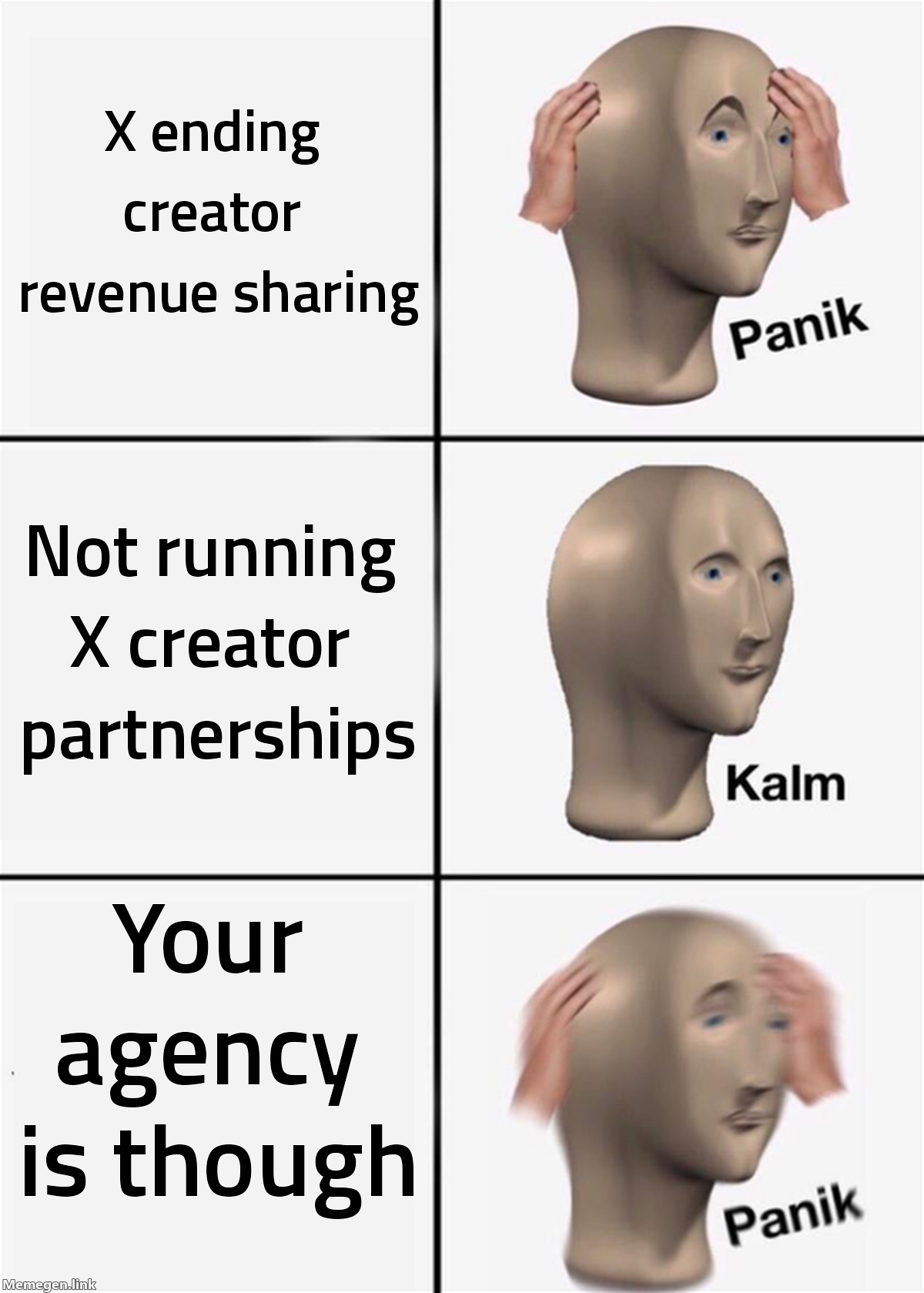
What's happening
X is shutting down its Creator Revenue Sharing program on September 7, 2026. The last payout under the old model lands around September 11. Starting September 8, creators can apply for the replacement: the Original Content Rewards Program.
New enrollments into Revenue Sharing closed August 7. If a creator joined after that date, they're already on the waiting list for the new program. The switch is complete — there's no parallel-running period.
The old program versus the new one
Revenue Sharing paid creators based on ad impressions generated in replies to their posts, specifically from Premium users. The flaw in that model was obvious in practice: any post that drove reply volume got paid, regardless of whether the creator wrote it themselves. Aggregators, reposts, and lightly edited clips from other platforms produced the same ad-adjacent impressions as original reporting or video.
The Original Content Rewards Program changes the incentive structure. Creators earn based on qualified impressions their original posts receive from verified users. Grok AI reviews the content before rewards accrue.
What qualifies: your own writing or reporting, photos and videos you created, memes and illustrations you made.
What doesn't qualify: reposts, aggregated news content, cross-platform clips, lightly edited versions of other people's work.
The eligibility bar is also steeper. New program applicants need 500 verified followers, 500,000 qualified Home Timeline impressions in the last 90 days, and an active Premium subscription. Not every creator who qualified for the old program will meet those criteria.
Who this actually affects
X's paid advertising products are unchanged. Promoted Posts, standard X ad campaigns, and first-party targeting aren't moving. If you're running direct paid campaigns on X, nothing in your account changes September 7.
The impact is on creator partnerships — and on what those partnerships assume.
Some brands work directly with X creators through paid sponsorship deals where the creator posts branded content and the brand pays per post. Others run X campaigns that depend on creator activity as amplification: using X's Promote feature to boost a creator's post, or building influencer outreach that assumes creators are posting at volume because the platform is rewarding them for it.
In both cases, the creator's relationship with the platform is shifting. A creator who built their following through high-volume aggregation — curating trending topics, reposting popular clips, collecting replies — won't qualify for Original Content Rewards. Their incentive to maintain posting volume disappears. So does their reason to stay active on X if original content creation was never their actual output.
What to check before September 7
Two things are worth reviewing before the cutoff.
Whether your creator partner was enrolled in Revenue Sharing. If they were, they need to apply for the new program starting September 8. Meeting the eligibility requirements isn't guaranteed — some creators who qualified under the old model won't hit the new thresholds.
Whether their content would qualify as original under Grok AI enforcement. Look at their last 90 days of posts. If most of their output was reposts, news aggregations, screenshots from Reddit, or lightly edited clips from TikTok — that account is unlikely to qualify. Grok is actively flagging duplicate and derivative content, according to TechCrunch's reporting on the program.
This doesn't automatically mean ending the partnership. But it's worth having the conversation with your creator before September 7, not after.
What this means for ad quality on X
X's reasoning is straightforward. The old program was generating revenue for engagement bait. Grok now catches copied and derivative content before it spreads, which devalued the strategy anyway. Paying impressions from accounts posting other people's work was a losing model for everyone, including X.
For advertisers, a tighter creator ecosystem is better in theory. Fewer aggregator accounts running high-volume reposts means cleaner ad adjacency and more meaningful engagement metrics. The long-term version of X that emerges from this reset is more attractive for brand advertising than the current one.
In the near term, expect some volatility. Creators who can't qualify for the new program may reduce posting frequency or leave the platform. X campaign engagement metrics may shift through September and October as the creator base adjusts. Watch CPMs and interaction rates on any active X campaigns during this period — not to overreact, but to understand what the baseline is becoming.
For most DTC e-commerce brands, none of this changes the core X calculus. Direct response performance on X is still weaker than Meta or Google for product-focused campaigns. The creator ecosystem change is a long-cycle improvement, not a reason to activate X as a new performance channel this month.
If you want a clearer picture of where your current ad budget is working, the free audit at Gromerce benchmarks your account against 20 industries in under three minutes.
Sources: TechCrunch, Engadget, September 2026