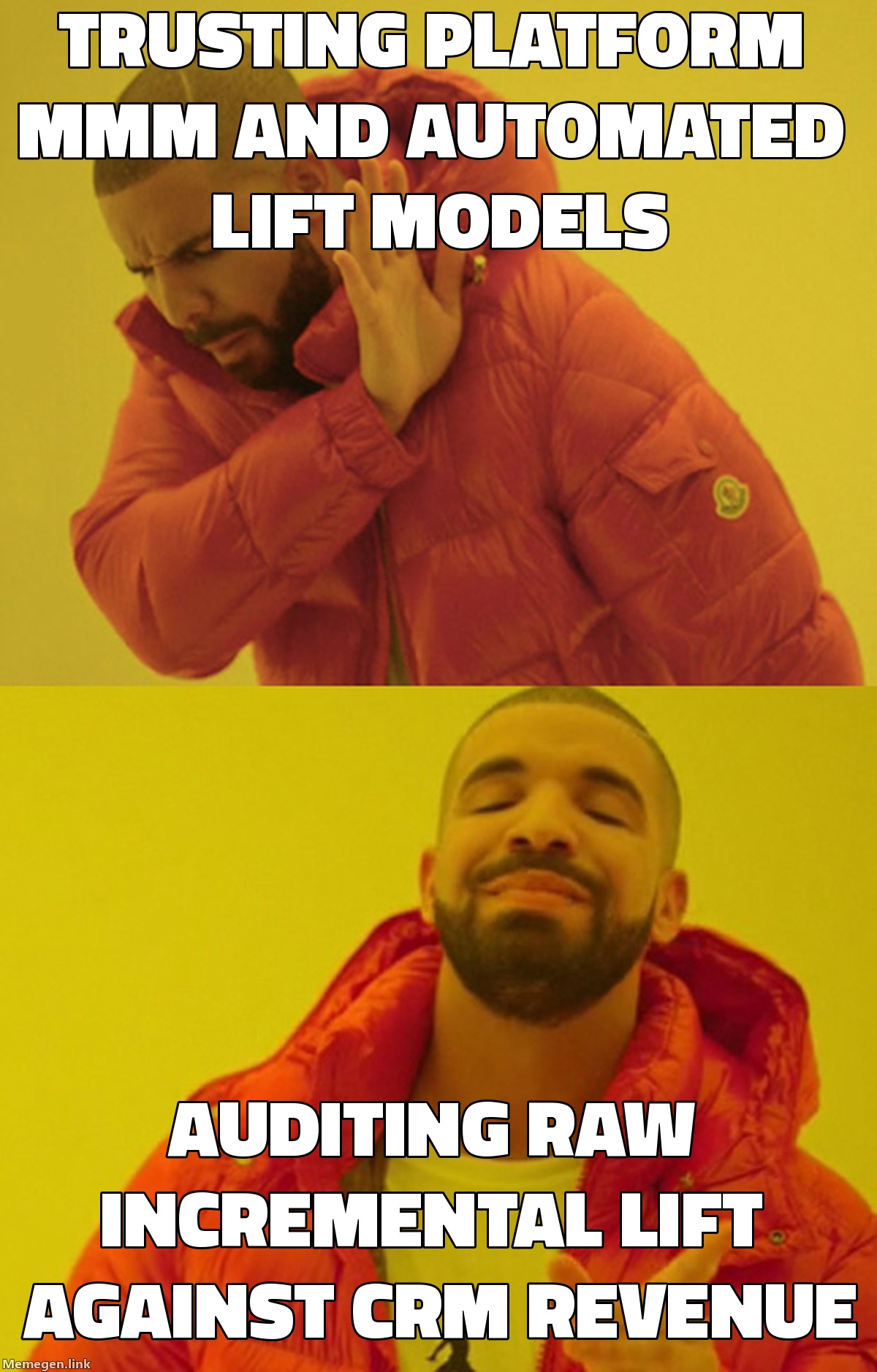
The Fatal Flaw in the Modern Marketing Measurement Stack
Google just released another framework telling advertisers to build a unified measurement infrastructure. The pitch sounds airtight on paper: combine in-platform Data-Driven Attribution (DDA) for day-to-day bidding, Media Mix Modeling (MMM) for macro budget allocation, and incrementality experiments to calibrate the middle. Ad tech evangelists call this triangulation. They sell it as the definitive answer to signal loss, privacy crackdowns, and cross-channel blind spots.
If you deploy this textbook modern marketing measurement stack with an ad spend under $150,000 a month, you will not get clarity. You will get an expensive, mathematically noisy illusion of precision.
Triangulation assumes three flawed measurement methodologies somehow cancel out each other’s errors to reveal objective truth. In real accounts, they compound each other. Data-driven attribution overcredits automated discovery formats that harvest existing brand intent. Open-source media mix models require spending variance and signal volume that mid-market accounts simply do not generate. Incrementality tests frequently choke the very smart bidding algorithms they are trying to measure.
When we run a Gromerce audit across growing accounts spending between $30,000 and $200,000 monthly, the biggest budget drain is rarely poor copy or bad bidding targets. It is budget allocated to campaigns that appear profitable only because the measurement stack was engineered by the platforms selling the inventory.
In-Platform Attribution Still Grades Its Own Homework
Google wants DDA to steer your daily tactical optimizations. The problem is that in-platform DDA is fundamentally deterministic within Google's walled garden and deeply biased toward self-preservation.
When Google rolled out Performance Max and Demand Gen, it removed the ability to inspect exact placement-level conversion pathways. DDA assigns fractional credit across YouTube shorts, Discover feeds, Gmail ads, and Search queries based on proprietary black-box algorithms. If a user searches your brand name on Monday, sees a Demand Gen image ad on Tuesday, and buys through an organic search on Wednesday, Google's DDA assigns heavy touchpoint weight to that mid-funnel impression.
The ad did not generate the purchase. The purchase was already locked in. But on your dashboard, Demand Gen suddenly boasts a 3.4x ROAS. As we documented when analyzing why your ROAS is a lie: how to audit Google Ads conversion value inflation, platforms routinely take credit for baseline transactions by claiming credit for unclickable or low-intent view-through impressions.
When media buyers see that inflated ROAS, they pump an additional 25% of their budget into top-of-funnel automated campaigns. What happens to blended top-line revenue? Nothing. It stays flat, while customer acquisition cost (CAC) creeps up 18% over the following six weeks. DDA is an operational execution engine for bid automation, not an incrementality truth engine. Treating it as strategic validation guarantees you will fund ads that simply intercept customers already walking through your front door.
Why Media Mix Modeling Fails Mid-Market Accounts
To counter DDA bias, Google promotes open-source MMMs like Meridian and LightweightMMM. The advice to mid-market advertisers is simple: let regression models calculate the diminishing returns of your channels so you can allocate spend scientifically.
Here is what platform consultants do not tell you: MMM is an aggregate statistical tool built for nine-figure brands with diverse, slow-moving media mixes. It relies on macro-level spend and revenue fluctuations over 104 to 156 weeks of historical data.
For an advertiser spending $50,000 to $100,000 across Google, Meta, and perhaps TikTok, running an MMM introduces three severe points of failure:
- Collinearity and Spend Stability: Efficient media buyers do not wildly oscillate their budgets week over week. You keep spend steady to maintain algorithmic stability. If Google Search spend is $10,000 every single week, the MMM has zero mathematical variance to test. It cannot tell whether $10,000 in Search spend produced $40,000 in revenue or if the business would have made $35,000 anyway.
- Confidence Intervals Wider Than Your Margins: When mid-market datasets run through Bayesian MMMs, the 90% credible intervals for channel ROAS routinely range from 0.8x to 4.2x. A metric that tells you your Meta ad spend is returning somewhere between losing 20% and generating a 300% profit is completely useless for boardroom capital allocation.
- Macro Shock Confounding: Mid-sized brands change pricing, alter landing pages, launch product variants, and run promotional discounts constantly. An MMM cannot distinguish whether an August sales spike was driven by a new Demand Gen campaign or a flash 20%-off sitewide sale unless you have years of impeccably tagged promotional data.
If you do not have a dedicated data engineering team and at least $2 million in annual paid media spend per distinct marketing channel, building an MMM will consume 80 hours of analyst time to produce numbers you cannot defend to your CFO.
The Operational Cost of Incrementality Testing
The third pillar of the proposed measurement stack is incrementality testing: conversion lift studies and geo-holdouts. Google tells advertisers to use lift experiments to calibrate MMM priors and validate DDA.
Lift studies are conceptually pure. You hold out a randomized audience or geographic region, run ads to the exposed group, and measure the delta in revenue. But in practice, incrementality experiments break the machine learning systems running modern ad accounts.
When you run a matched-market geo-test—shutting off Google Ads in 15% of your sales regions for 4 weeks—you starve Google's smart bidding algorithms of conversion density. Conversion volume drops, target CPA bidding throttles back, and the account enters a learning reset. By week three of the holdout, you are not testing the true incremental value of your campaigns; you are testing a crippled bidding algorithm operating with artificially depressed conversion data.
Furthermore, platform-provided "conversion lift" tools inside Google and Meta are systematically designed to validate their own inventory. They use modeled lift calculations that infer what the holdout group would have done based on synthetic controls. If you rely on platform-hosted lift experiments without external statistical validation, you are asking the casino to audit its own roulette wheel.
This creates a structural operational trap. As ad algorithms take over more targeting, as we highlighted in our breakdown of why Google controls 90% of campaign decisions and why downstream tracking is your only lever left, isolating causal impact without permanently degrading automated bidding performance has become nearly impossible for standard ad budgets.
The Pragmatic 3-Tier Measurement Alternative
You do not need a million-dollar data science team or enterprise software subscriptions to measure performance accurately. You need clear boundaries between operational bidding data, channel contribution, and financial reality.
| Measurement Layer | Primary Tool | Primary Question Answered | Frequency | | :--- | :--- | :--- | :--- | | Tactical Execution | Platform DDA (In-Engine) | Which creative, keyword, or asset cluster drives real-time action? | Daily | | Portfolio Contribution | First-Party CRM & Click Tracking | What is our true Marketing Efficiency Ratio (MER) and New Customer CAC? | Weekly | | Strategic Validation | Simple Spend Pulse / Geo Switch | Does turning off this specific channel or campaign impact top-line bank deposits? | Quarterly |
Stop trying to force all three layers into a single dashboard. They serve entirely different masters:
- Use in-platform DDA strictly for algorithmic pacing: Let Google Ads use DDA to hunt for signals within its own ecosystem. Do not use DDA to decide whether Google deserves more budget than Meta or direct mail.
- Track true Blended Efficiency (MER) at the bank account: Measure Net New Revenue divided by Total Ad Spend weekly. If Google claims a 40% jump in revenue from your new video campaigns but overall store revenue increases by 2%, that campaign is cannibalizing existing traffic. End of story.
- Run crude, high-conviction switchbacks instead of complex geo-holdouts: If you want to know if brand search or middle-funnel video is incremental, cut the budget in half for 14 days during a non-promotional window. Monitor net revenue in your first-party backend. If total revenue does not drop by at least the margin-adjusted profit of those conversions, you have your answer.
What to Do This Week
Do not waste this quarter trying to configure a complex econometric model or setting up fragile synthetic control geo-tests. Execute this three-step audit across your Google Ads account:
- Audit View-Through and Engaged-View Conversions: Navigate to your Google Ads campaign dashboard. Add the columns View-Through Conv. and Engaged-view conv. alongside your primary conversion numbers. If your Performance Max or Demand Gen campaigns rely on view-based actions for more than 15% of their total reported conversion value, your reported ROAS is artificially inflated.
- Review the Model Comparison Tool: Open Tools > Measurement > Attribution > Model comparison. Compare Data-Driven Attribution against First Click for the last 60 days. Look specifically at your Search campaigns versus your visual/automated campaigns. If Search drops by more than 30% under DDA while your automated campaigns gain 40%+, Google is shifting mathematical credit to asset types that require zero search intent.
- Establish an Inelastic Baseline: Identify the bottom 20% of your campaigns based on first-party assisted conversion value. Pause the bottom performer for 10 business days. Watch your Shopify or CRM daily net cash flow. If the bottom line remains unaffected, reallocate that budget directly to proven search terms with exact-match intent or drop it straight to your company's operating margin.
Triangulation sounds brilliant in a conference keynote. But until your media spend hits seven figures across distinct channels, running an over-engineered measurement framework is just paying a heavy tax to confirm numbers that your bank account already knows are wrong.
Sources:
- Google Ads Blog: Build a measurement stack you can rely on to steer your campaigns (Ads Decoded Series)
- Google Meridian Open Source MMM Documentation and Best Practices Guide
- PPC Hero: Incrementality, Media Mix Modeling, and Modern Campaign Attribution Analysis