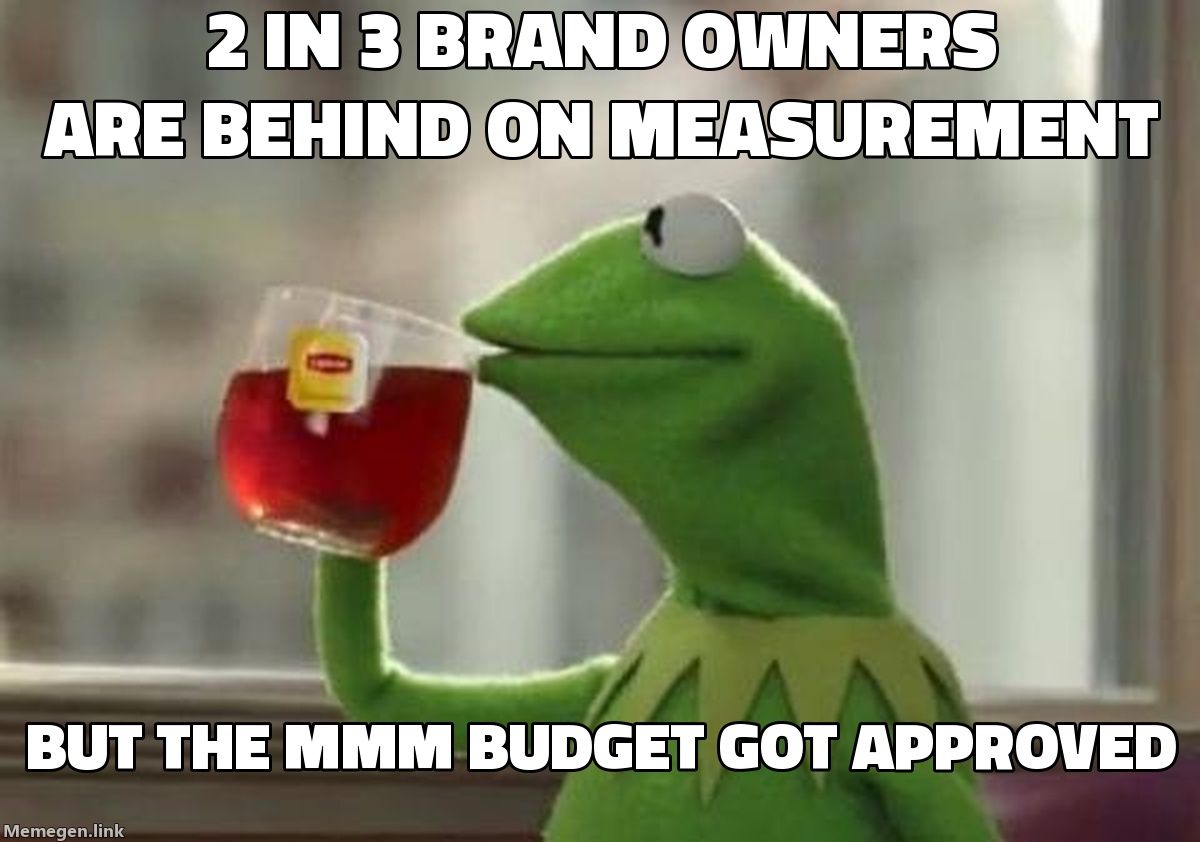
Everyone has the data. Almost nobody can act on it.
The World Federation of Advertisers published its Paid Media Effectiveness Handbook today, developed with Ebiquity and representing brands with over $40 billion in annual paid media spend. The headline finding sounds alarming: two-thirds of brand owners are behind on paid media measurement.
The part that should actually worry you is buried one paragraph deeper.
Eight in ten of those same advertisers already run marketing mix modelling and brand lift studies. The tools aren't the problem. The gap between having measurement output and doing something useful with it — that's what's failing.
What the numbers actually say
Three statistics from the WFA report define the problem:
80% of advertisers run MMM and brand lift studies. Only 13% rate themselves as strong on speed from data to insight. And less than 3% say they're fully confident they can separate short-term performance impact from long-term brand-building effect.
Read that in sequence. You have the model. You're slow to act. You can't tell which part of your spend is doing which job. That's the actual state of paid media measurement across a $1.15 trillion industry — one the WFA describes as roughly the size of Switzerland's entire GDP.
The 75% figure is more optimistic but equally revealing: three-quarters of respondents expect more than half of their budget allocation decisions to be measurement-led within three years. Which implies that today, most decisions aren't.
Why speed kills the model
MMM is a slow instrument. A proper marketing mix model typically runs on 4–12 weeks of data cycles, sometimes longer depending on the vendor and the reporting cadence built into the contract. By the time the output reaches a budget owner in a format they can act on, the campaign conditions it was measuring may have changed.
This is where the 13% figure gets interesting. The brands that can act quickly on measurement aren't necessarily running more sophisticated models. The WFA report is explicit on this: the organizations that lead on effectiveness have built operating systems, governance, and commercial alignment that ensure measurement output reaches the decisions that matter. That's a structural problem, not a tooling problem.
You can have the best attribution model on the market and still lose months between the insight and the bid strategy change. Most brands do exactly that.
The long-short split no one can make
The less than 3% figure — the share of advertisers confident they can separate long-term brand impact from short-term activation — is the one with the most direct budget implication.
Without this separation, brand and performance budgets end up competing for credit against the same conversion data. Last-touch attribution overstates activation and understates brand. MMM helps, but only if the model has enough historical data, the right inputs, and enough organizational trust to actually shift money out of short-term channels when the model says to.
Most brands don't have all three. So the practical outcome is predictable: performance budgets hold or grow, brand budgets get cut in reviews, and CPMs keep rising because everyone is buying the same high-intent search and social inventory at the same time. The Gartner CMO survey from earlier this month showed CMOs cutting loyalty and retention spend by 29% while acquisition costs hit record highs. That's the same dynamic playing out at the budget level.
What the leading brands are doing differently
The WFA report doesn't recommend a specific tool stack. It points to three structural factors that separate brands who use measurement from brands who collect it:
A governance layer that sets clear rules for when measurement output overrides gut feel or historical precedent. Not every decision — but specific decision types, with a defined process.
Commercial alignment between the marketing function and the finance function on what the measurement is trying to answer. When finance doesn't trust the model, measurement output doesn't change any decisions. The model exists for internal reports and award submissions.
Decision velocity built into the operating model — meaning the time between insight and action is short enough to be useful. This doesn't require faster models. It requires fewer approval steps between the analyst and the budget holder.
None of these are software purchases.
What to check in your account
The measurement gap isn't abstract. In practice, it shows up as late budget decisions, over-investment in easy-to-attribute channels, and campaign changes that happen a cycle after they should.
A useful diagnostic: track how long your last three attribution or MMM reports sat between completion and the point where someone changed a bid, a budget, or a channel allocation. If the average is longer than two weeks, the model is telling you about a market that no longer exists.
The free Gromerce audit won't run your MMM for you, but it will surface the attribution and tracking gaps that limit what any model can tell you in the first place.
The industry has built an extraordinary set of measurement tools. What it hasn't built is the operating model to use them fast enough.
Sources: World Federation of Advertisers, Ebiquity, Gartner CMO Survey, July 2026