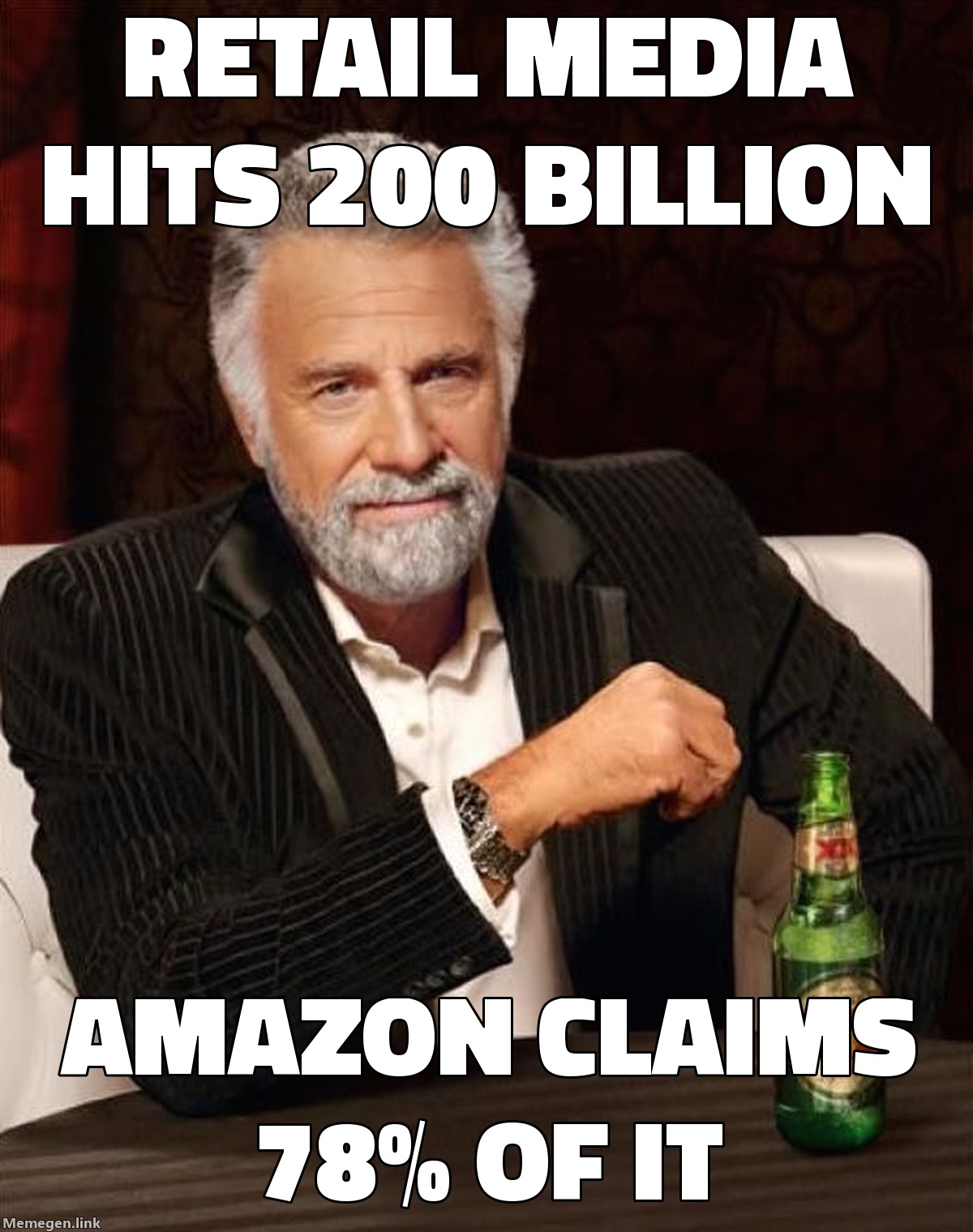
The milestone is real. The celebration should come with caveats.
WARC's Future of Commerce Media 2026 report puts global retail media investment at $200.4 billion this year, rising to $223.4 billion in 2027. If you work in e-commerce advertising, that number has almost certainly appeared in a vendor pitch deck in the last six months.
The $200 billion figure is accurate. The problem is what it leaves out.
Who actually wins at $200 billion
According to WARC's Future of Commerce Media 2026 report, Amazon accounted for 78% of US retail media spend in 2025. Walmart came in at 7.5%. Every other retail media network — Instacart, Target's Roundel, Home Depot, Albertsons Media Collective, Kroger Precision Marketing, and dozens of regional operators — shared the remaining 14.5%.
That 14.5% is the market most brands are navigating when they talk about "diversifying into retail media." It's a much smaller pond than the headline number implies, and the fish in it are paying higher CPMs every quarter.
Amazon's dominance makes sense. It has years of purchase behavior data, the highest purchase-intent audience of any ad platform, and a closed-loop attribution model that no other retailer has matched. But it means that when WARC says retail media is growing, the bulk of that growth is going to one company.
If your products don't sell through Amazon — or perform poorly there — the $200 billion milestone is largely someone else's story.
Growth is cooling, and not slowly
WARC's report forecasts global retail media growth to fall to 9.8% by 2027 (excluding Amazon) — the lowest year-on-year rate since WARC began tracking the category. Europe is already moving toward single-digit growth. The US is holding up better, but the US numbers are heavily influenced by Amazon's continued expansion.
For brands that entered retail media networks in 2022 or 2023 expecting the trajectory to continue, the math has changed. Sponsored product CPMs on non-Amazon networks have risen as more brands compete for the same placements. The measurement tools at most non-Amazon retailers still lag well behind what Amazon Ads provides. And the incrementality question — whether retail media spend is actually driving net new sales or just taxing existing buyers — is getting harder to defer.
The ad load problem
WARC's report flags what has been quietly building: retail media ad loads are rising to the point of creating shopper friction. On some platforms, sponsored placements now dominate the first screen of product search results before any organic listings appear.
The early performance of retail media was partly a function of proximity to organic results — ads that looked like recommendations rather than interruptions. As the ratio shifts, the channel's inherent advantage of high purchase intent starts getting offset by the same ignoring behavior that degraded display advertising over the previous decade.
This is not an immediate crisis for well-placed, category-dominant brands. It is a real signal for brands running broad keyword coverage across a retail network without tight SKU focus — the returns are going to keep compressing.
What to do before Q4 planning
You're going to see the $200 billion number weaponized in negotiations for upfront commitments over the next three months. The right posture is not skepticism about retail media as a category — it genuinely outperforms most channels on conversion intent. The right posture is more rigorous measurement before you commit.
Four things worth doing before you lock Q4 budgets:
- Separate your Amazon spend from everything else and set distinct ROAS targets for each
- Ask any non-Amazon network you're spending on for incrementality data, not just attributed conversion reports
- Map your SKU coverage: are you buying keywords you'd win organically anyway?
- For networks with rising ad loads, test whether increased CPMs are still delivering proportional volume
By 2027, WARC's Future of Commerce Media report projects retail media will represent 15.2% of total global advertising investment. That's not a niche anymore. Treating it like one — with loose measurement and blended attribution — is the budget risk hiding inside the headline milestone.
If you want to see how your current retail media allocation fits your broader channel mix, the free audit maps that in a few minutes.
The $200 billion is real. So is the 78%.
Sources: WARC Future of Commerce Media 2026, Campaign Live, August 2026