The SparkToro headline will tempt you into the wrong decision.
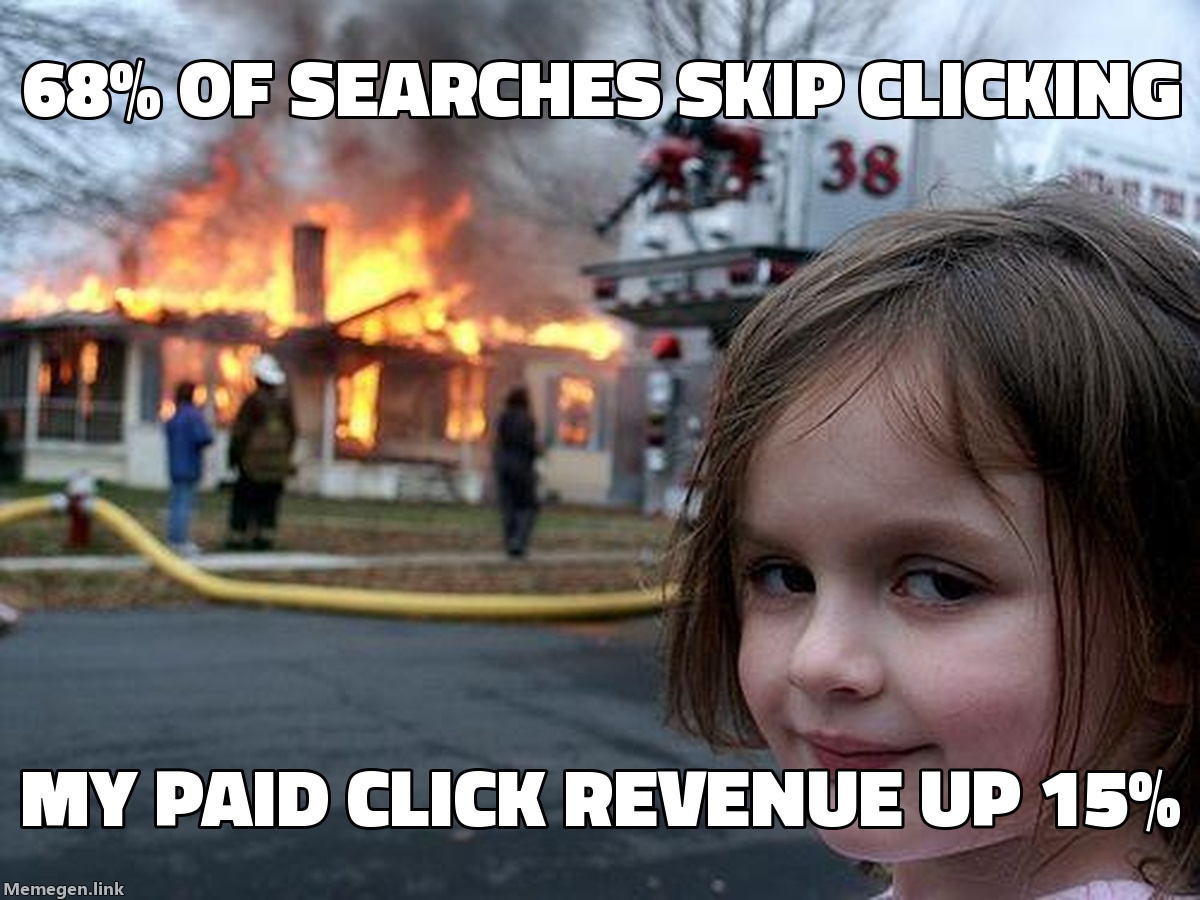
SparkToro published their 2026 study using Similarweb clickstream data: 68.01% of US Google searches ended without a click in the first four months of this year. That's up from 60.45% in 2024, a 7.5-point jump in two years. AI Overviews now appear on more than 20% of all searches, and when one shows up, click-through rate drops roughly 60%.
That's the number people screenshot and post on LinkedIn. Here's the part they skip.
In the same window, Google's Q1 2026 ad revenue grew 15% year-over-year to $77.25 billion. Paid click volume went up. Organic search bled out. Paid search got stronger. Understanding why changes how you should run your campaigns this week.
What actually happens to 1,000 searches
SparkToro traced where clicks go across a large enough sample to map the distribution. Of every 1,000 US Google searches in early 2026:
- 680 end with no click at all
- 276 send traffic to the open web (organic and paid combined)
- 44 reach Google-owned properties (Maps, Images, Shopping panels, YouTube)
Paid clicks account for roughly 6% of all searches. That sounds negligible. It's not, because AI Overviews and featured snippets absorbed the easiest traffic first: informational queries, how-to questions, definition lookups, the ones with the lowest purchase intent. What's left in the click-bearing 32% skews heavily toward commercial and transactional intent.
When someone clicks a paid result in 2026, they passed through a filter. AI Mode tried to answer their question and didn't finish the job. These are the buyers. That's why revenue went up while clicks per search went down.
Where e-commerce sits in this picture
Not all queries zero-click at the same rate. The critical distinction is informational versus transactional.
"How does creatine work" gets absorbed by a panel. "Buy creatine online" still sends traffic because there's nowhere inside Google to complete that transaction.
Product searches, category searches, brand comparisons with commercial modifiers — these are in the resilient bucket. AI Overviews haven't found a way to complete the purchase on Google's behalf yet. (Agentic checkout is expanding, but it's not the mass-market reality for most verticals today.)
Most e-commerce brands bid on both types without separating them. That's where the problem lives: not the aggregate 68% zero-click rate, but the share of your keyword list that's in the high-zero-click zone.
What to check in your account
Four things worth doing this week:
-
Pull a search term report. Flag every query containing how, what, why, where, or which. These are your highest-risk informational terms. Check conversion rate against your account average. If they're significantly below, they're absorbing AI Overview traffic that should never have reached you anyway.
-
Look at impression share by match type. If broad match is pulling significantly more volume than exact and phrase, you're capturing informational variants alongside transactional ones. Add negatives around the informational signals.
-
Shopping campaigns are structurally safer. Product Listing Ads surface on commercial queries by design. If you've been cutting Shopping budget to fund Search, reconsider — Shopping sits in the more protected part of the distribution.
-
Cut awareness or content-support keywords entirely. These are in the high-zero-click zone by definition.
The wrong conclusion
The 68% stat will get used to justify moving budget off Google. For most e-commerce brands, that's the wrong call. Organic search is losing traffic. Paid search is not. The channel isn't broken; it's concentrating. Fewer clicks go to organic, and more of the paid clicks that remain come from buyers.
Marketers who cut Google Search budgets because of a zero-click headline give up the strongest-converting click surface left.
You don't need to fix the 68%. You need to make sure your spend is in the 32%.
If you want to know which search terms in your account are in the zero-click risk zone, Gromerce's free audit will map your current keywords against conversion rate and intent in a few minutes.
The organic story is grim. The paid story is not.
Sources: SparkToro, Similarweb, Search Engine Land, June 2026