Since March 24, Shopify has enrolled every eligible US merchant into its Agentic Storefronts program without requiring you to do anything. That means your store is already discoverable — and in most cases purchasable — inside ChatGPT, Google AI Mode, Gemini, and Microsoft Copilot. No setup. No opt-in prompt most merchants noticed.
Customers can ask ChatGPT to find a product matching their specific requirements, receive a recommendation from your store, and complete a checkout inside a browser window without ever leaving the AI interface. Shopify handles the transaction. You ship the order. The mechanics feel identical to any other sale.
Except for the fee structure. That part deserves attention.
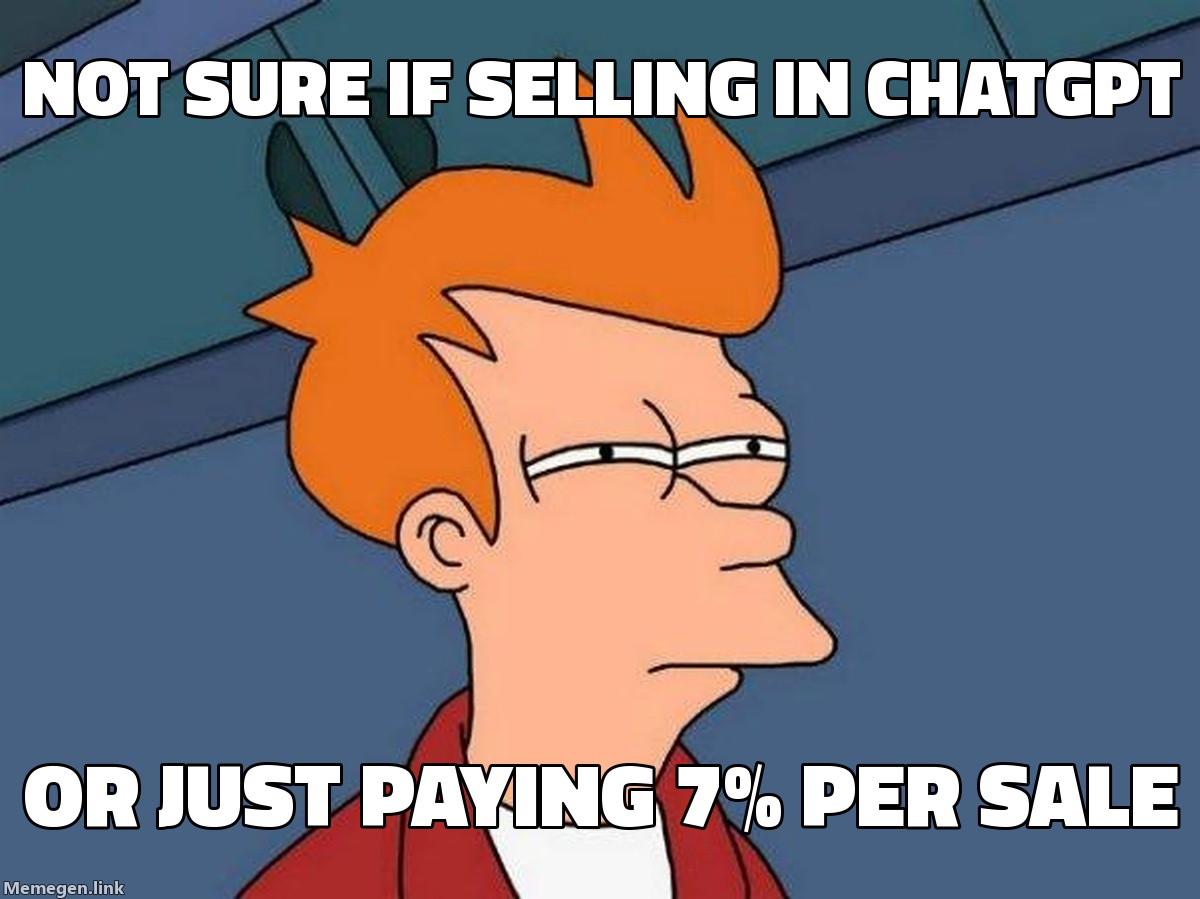
The 7% per sale reality
OpenAI charges merchants a 4% "Agentic Storefronts fee" on every completed sale through ChatGPT. After a 30-day free trial, that charge kicks in automatically. Stack that on Shopify's standard 2.9% payment processing and you're giving up roughly 7% of each sale before fulfillment, returns, or ad spend enters the picture.
On a $100 order, that's $7 off the top — before cost of goods. On typical DTC margins of 30–40%, that compression matters. It's not a dealbreaker for every brand, but it's also not a rounding error.
The honest comparison is against your existing acquisition costs. If your blended CPA on Meta or Google sits at $35 on a $100 average order value, that's a 35% effective acquisition cost. ChatGPT at 7% looks cheap by comparison. But that math only works if conversion quality holds up: if AI-referred buyers return more, buy smaller baskets, or require more post-purchase support, the numbers shift quickly. That data is still thin.
Google and Gemini cost you nothing — for now
Sales completed through Google AI Mode and the Gemini app carry no additional fees beyond standard payment processing. That's a meaningful difference in per-transaction economics and it's likely the result of deliberate positioning rather than generosity.
Google co-developed the Universal Commerce Protocol (UCP) with Shopify — a standard also backed by Walmart, Target, Visa, Mastercard, and American Express — to keep AI commerce transactionally open. If UCP becomes the dominant infrastructure, Google benefits from the commerce layer without charging merchant fees. If it doesn't, expect fees.
For now, if you're going to put any energy into optimizing for a single AI shopping channel, Google AI Mode is the one that doesn't cost extra per sale.
The orders data is real
Shopify reported that AI-attributed orders for merchants are up 11x since January 2025. That figure came from Shopify President Harley Finkelstein on an earnings call — it's not a projection, it's transactions. AI-referred orders are growing faster than AI-referred traffic, which means conversion rates through these channels are improving over time, not declining.
Shopify's Shop App GMV grew 70% year-over-year in Q1 2026, with unique buyers up over 50%. The platform is not hedging on agentic commerce. It's betting the next phase of merchant growth on AI-led discovery and purchase, and the early volume data is validating that direction.
The question for your brand isn't whether this channel matters. It's whether you're visible in it and whether the economics work at your margin structure.
Four things to check in Shopify right now
AI commerce discovery runs on structured product data, not keyword-optimized pages. How ChatGPT and Gemini surface your products depends on what Shopify serves to their agents: product titles, descriptions, pricing, attribute clarity.
Four things worth doing before the ChatGPT trial period ends:
- Go to Sales Channels in your Shopify Admin and verify Agentic Storefronts is active. If you're a US merchant on an eligible plan, it almost certainly is — you just haven't seen it.
- Audit your product titles and descriptions for specificity. "Blue ceramic mug" surfaces below "16oz handmade ceramic mug, wide base, microwave-safe" when an AI agent is matching a buyer's stated requirements to your inventory.
- Run the margin calculation at 7% cost on ChatGPT sales and compare it to your current blended CPA. If paid acquisition is already expensive, this channel may pencil out even with the fee — but you need the actual numbers, not the assumption.
- Track AI-referred sessions separately in your analytics. Google AI Mode traffic will show up differently than ChatGPT traffic. Both are worth watching, but the fee difference means you want to know which is converting.
Your SEO was built for search crawlers. AI commerce runs on structured product signals. Those are related but not identical, and the gap between them is where visibility in these channels gets lost.
If you want a fast read on how your current account and landing page setup handles AI-driven traffic, the free Gromerce audit takes three minutes and surfaces the gaps that tend to matter most.
No platform builds a checkout layer out of goodwill — the fee is coming to every AI channel eventually, and the only question is whether you're selling enough volume through them to care.
Related articles: chatgpt-ads-self-serve-what-it-means · chatgpt-product-feed-ads-ecommerce-2026
Sources: Shopify, PYMNTS, Modern Retail, Internet Retailing, May 2026