What changed
Microsoft Advertising added job seniority targeting to its LinkedIn Profile targeting feature on June 15. The update covers 10 standardized seniority levels: CXO, VP, Director, Manager, Senior, Entry, Owner, Partner, Training, and Volunteer.
The capability works inside both Search and Audience Network campaigns. It's available at campaign and ad group level. And it supports observation mode — you can see how conversion performance varies by seniority without restricting who sees your ads.
This is live now in 29 markets, including the US, Canada, UK, Australia, and major markets across EMEA and APAC.
What this is not
To be clear: this isn't about running ads on LinkedIn.com. Microsoft is applying LinkedIn's professional identity graph as a targeting filter on top of Bing's search traffic.
When someone with a LinkedIn profile searches on Bing, Microsoft matches that session to their LinkedIn professional attributes — seniority level included — and uses that to determine whether your ad serves. You're still buying Bing search inventory. LinkedIn's data is a layer on top of it.
Google does not have this. LinkedIn Profile targeting in search is exclusive to Microsoft Ads.
The CPM gap
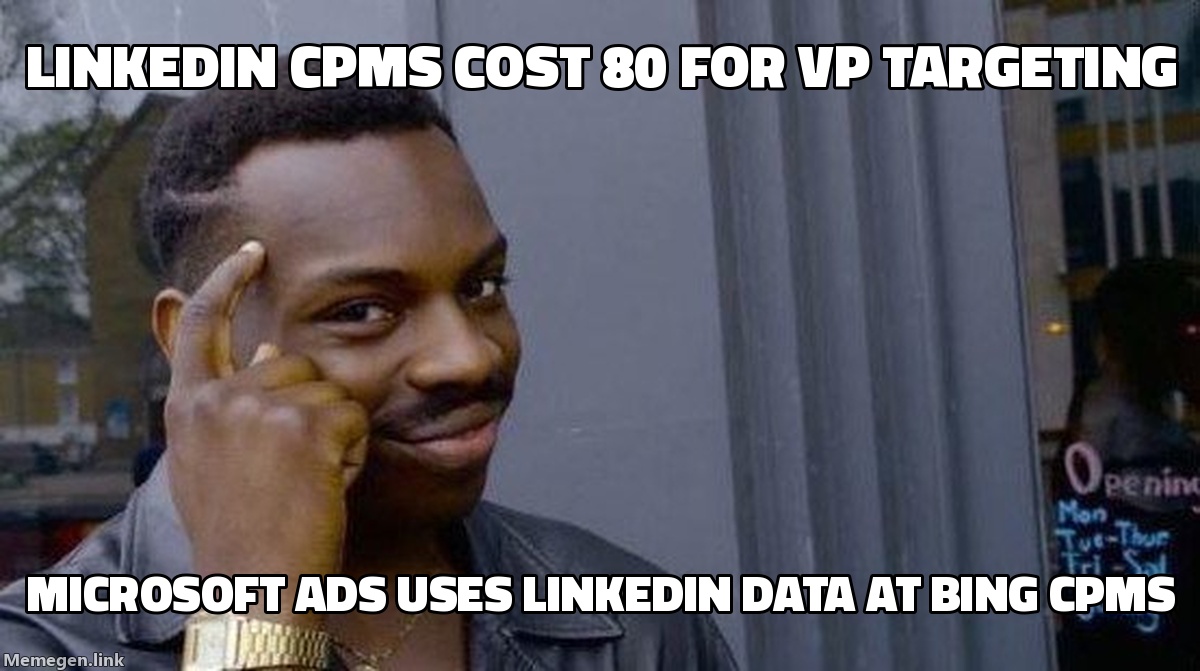
LinkedIn CPMs for decision-maker audiences run $50–$100. Bing Search CPCs for B2B categories typically land at $3–$15, with effective CPMs for higher-volume campaigns in the $10–$25 range.
The contexts are different. LinkedIn is passive — someone scrolling their feed between meetings. Bing search is active intent — someone typing a query because they want to solve a problem right now. For bottom-funnel campaigns, active intent usually converts better. For brand awareness and category-level research, passive feed is often the right surface.
But here's the practical point: if your campaigns are primarily conversion-focused, you're potentially paying LinkedIn CPMs to reach someone in a passive scrolling moment, while missing the same person the moment they actually search for a solution. The seniority filter lets you show up at that search moment, to the right decision-making tier, at search-level costs.
Who actually benefits
The obvious use cases are B2B SaaS, professional services, enterprise software, and consulting. If you're selling something where the purchase decision sits at Director level or above, you now have a lower-cost path to reach that person in an active search context.
But this extends to e-commerce brands with any B2B dimension. Corporate gifting, office supplies, professional tools, bulk team ordering — all of these have business buyers who also search on Bing. If your catalog or pricing structure appeals to procurement-level decisions, this targeting layer is worth evaluating.
The brands for whom this won't move the needle: pure B2C e-commerce with no B2B purchase patterns, and accounts where Microsoft Ads volume is already too thin to generate meaningful seniority-segmented data.
Start with observation
The right first move is not to hard-target by seniority. Add seniority segments as observation layers on your existing Microsoft Ads Search campaigns. No budget change, no campaign restructure — just a data collection layer.
After 4–6 weeks, look for conversion rate variance. If VP and above converts at 1.5x or better compared to your campaign average, you have a clear signal: either set positive bid modifiers for those segments, or build a dedicated campaign with Director+ as a hard targeting filter and test Manager as a middle tier with a smaller modifier.
If there's no meaningful difference across seniority levels, you've saved yourself from narrowing reach unnecessarily. Bing's volume is already constrained — don't further reduce your eligible audience without data that justifies it.
The Bing volume reality
The honest caveat: Bing holds 6–8% of US search volume. For most e-commerce brands, Google dominates and Microsoft Ads is a secondary channel or an afterthought. Seniority targeting doesn't change that underlying volume constraint.
But for B2B categories where average deal size is high and audience precision matters more than scale, the economics work even at lower volume. If your CRM shows that Director-level contacts close at 2x the rate of entry-level contacts, the attribution math justifies running a smaller but more precise Bing campaign alongside your LinkedIn spend — not instead of it.
The other factor: Bing's demographic skews older and more established than Google's overall mix. The LinkedIn data layered on that base is quite precise. Targeting quality in practice tends to outperform what raw Bing volume numbers would suggest.
What makes this worth testing now
Microsoft has had LinkedIn company, industry, and job function targeting for years. Seniority is the missing filter that B2B advertisers most wanted — it's the dimension that separates who decides from who researches. Adding it means you can finally build meaningful bid hierarchies in Bing search based on buying authority, not just job category.
For brands already active on Microsoft Ads with any B2B component, this is a straightforward addition this week. For brands not yet running Microsoft Ads, seniority targeting alone probably doesn't justify the account setup — but it's the most compelling reason to reconsider that decision if you're running a high-ticket B2B product or service.
If you want to see where B2B targeting gaps show up in your current paid media mix, the free audit at Gromerce surfaces them in under three minutes.
LinkedIn seniority in Microsoft Ads search is not a replacement for LinkedIn advertising — it's a lower-cost intent layer for the same decision-maker you're already paying LinkedIn CPMs to reach on their feed.
Sources: Search Engine Land, Social Media Today, PPC Land, ppcnewsfeed.com, June 2026