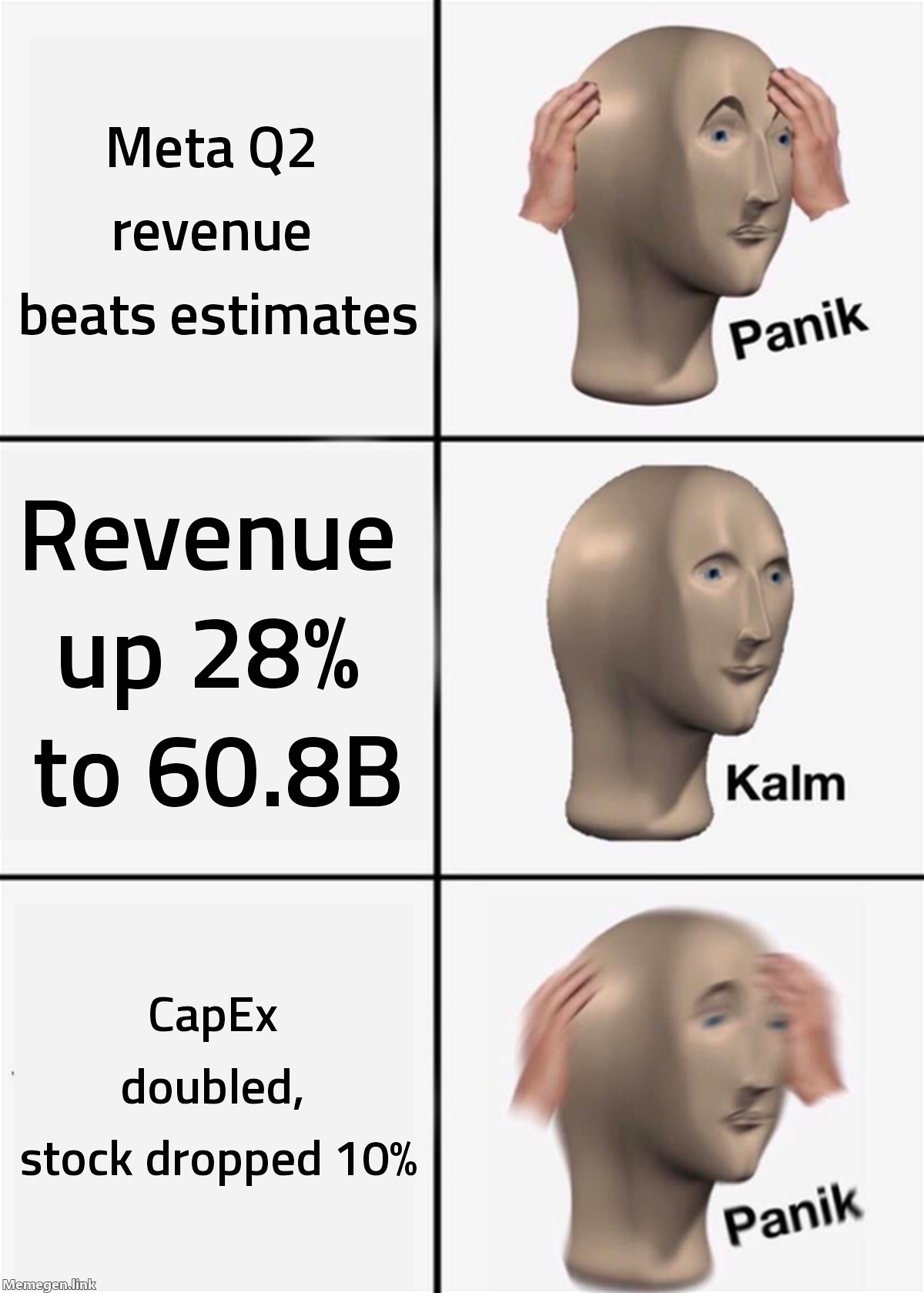
Meta reported $60.8 billion in Q2 2026 revenue on July 29, up 28% year-over-year and above the $60.29 billion analyst consensus, according to Yahoo Finance and Meta's official Q2 2026 earnings release. Net income came in at $15.8 billion, down from $18.3 billion in Q2 2025, despite a revenue base that was meaningfully higher. Shares fell 9.64% in after-hours trading, according to Yahoo Finance, closing at $529.15 from the regular session close of $585.61.
The reason for both results is the same thing: AI infrastructure spending.
The CapEx number that moved the stock
Per Meta's Q2 2026 earnings release, quarterly capital expenditures hit $31.1 billion, up from $17.0 billion in Q2 2025. Capital spending more than doubled in a single year. Annualized, Meta is on pace for roughly $125 billion in CapEx, which aligns with the guidance Zuckerberg gave earlier this year.
That spending compresses profit. Per the earnings release, free cash flow came in at $784 million for the quarter, a dramatic narrowing from what Meta would generate at these revenue levels without the infrastructure program. The company is converting most of its operating cash generation into AI buildout.
Investors punished this. Not because the results were bad, but because they expected profit growth alongside revenue growth and got infrastructure investment instead.
What's driving the 28% revenue growth
Meta's ad revenue grew 28% in Q2, according to the company's earnings release, while WPP Media's 2026 forecast puts the broader digital ad market at around 7% growth (excluding political spending). The gap between those two numbers has to come from somewhere.
Some of it is advertiser volume. More brands are spending on Meta than a year ago. But a meaningful portion is efficiency: Advantage+ AI optimization is delivering better conversion outcomes per dollar than manual targeting approaches, which means brands are spending more because the returns justify it. That's why Meta keeps taking share.
The infrastructure Meta is building is what makes Advantage+ better over time. Your ad spend funds the AI that eventually optimizes your next campaign. The cycle isn't subtle.
Who benefits and who doesn't
Advantage+ needs signal to perform. That signal comes from CAPI firing on real purchase events, large audience pools for the algorithm to draw patterns from, and clean product catalog data for Dynamic Ads. The accounts feeding Meta's AI the most complete data are the ones seeing the strongest efficiency improvements.
Accounts running Advantage+ without strong CAPI setup, thin conversion histories, or small audience pools are paying for an AI system that doesn't have enough data to optimize against. Meta's AI infrastructure investment widens that gap over time. The better the underlying AI gets, the more it rewards accounts with clean signal and the more it penalizes accounts without it.
If you ran manual campaign structures in Q2 because Advantage+ didn't perform well, the more likely explanation is the signal quality, not the algorithm.
The stock reaction isn't your concern
Meta beat revenue estimates by around $510 million. Net income still fell $2.5 billion versus Q2 2025. The stock dropped because the market is pricing the risk that Zuckerberg's AI infrastructure bet takes longer to compound than the current CapEx level requires.
That's a legitimate investor concern. It's not particularly relevant for advertisers. The AI spending is already improving targeting quality and creative tooling on the platform. The Q2 revenue growth is the evidence. Whether that compounds into the kind of return Zuckerberg is betting on over 5 years is a different question.
What advertisers should take from the results: the ad platform is getting better, the rate of improvement is accelerating, and the improvement is being funded by CapEx at a scale that makes the gains durable rather than incremental.
Two account checks before Q3 planning
First, verify your CAPI setup is firing on all purchase events, not just some. Incomplete CAPI is the single most common reason Advantage+ underperforms — the algorithm is optimizing against a partial view of your actual conversions.
Second, check whether your Advantage+ audience pools are large enough to give the algorithm meaningful room to work. Very tight audience restrictions on Advantage+ Shopping campaigns limit the AI's ability to find incremental buyers. If you've been excluding large segments by default, the Q2 data is a reason to test whether those exclusions are earning their keep.
Meta printed $60.8 billion in a single quarter. For DTC brands, that number matters less than the infrastructure it's funding and whether your account is positioned to benefit from it.
If you want to see how your current Meta setup holds up against peer accounts, the free audit at Gromerce benchmarks your signal quality and structure in three minutes.
The AI infrastructure spending that's compressing Meta's profits this quarter is what's improving your ad targeting for next quarter. That's the trade Zuckerberg is making, and for advertisers with clean setups, it's working.
Sources: Yahoo Finance, Meta Investor Relations, WPP Media, July 2026