What Zuckerberg actually said
In June 2025, Mark Zuckerberg told investors and press that Meta was building toward fully automated ad creation. The pitch reduced to its simplest form: provide a business URL and a monthly budget, and Meta's AI handles the rest — creative generation, audience targeting, placement decisions, and bid management.
The stated timeline was late 2026.
That's now.
The announcement landed as an industry provocation. According to Yahoo Finance reporting at the time, Omnicom stock fell over 3% on the same day and Publicis fell 3.8%. The read across financial media was that Zuckerberg was forecasting the obsolescence of a significant portion of the paid media services industry.
Fifteen months later, the reality is more nuanced — and more useful to actually understand.
What $60 billion in Advantage+ revenue shows
Meta's Q2 2026 results put Advantage+ campaigns at approximately $60 billion in annualized revenue. The reported return: $4.52 per dollar spent, which Meta says runs 22% higher than manually configured campaigns on the same accounts.
That's a substantial gap.
The mechanism behind it isn't complicated. Advantage+ removes the constraints a human sets — pre-defined audiences, fixed placements, locked creative combinations — and lets Meta's models optimize freely across the full available inventory. When an account has clean first-party data and enough conversion volume, the unconstrained system finds opportunities the manual setup left on the table.
The aggregate figure doesn't mean every Advantage+ campaign outperforms manual. It means the average is up substantially. The accounts pulling that average up look different from the ones dragging it down.
What "just a URL" means in practice
The fully automated version works like this: you provide a website address and a budget. Meta scrapes your product inventory, generates ads from your catalog data and product images, identifies audiences, places bids, and runs the whole thing.
No separate audience build. No placement exclusions to configure. No creative brief.
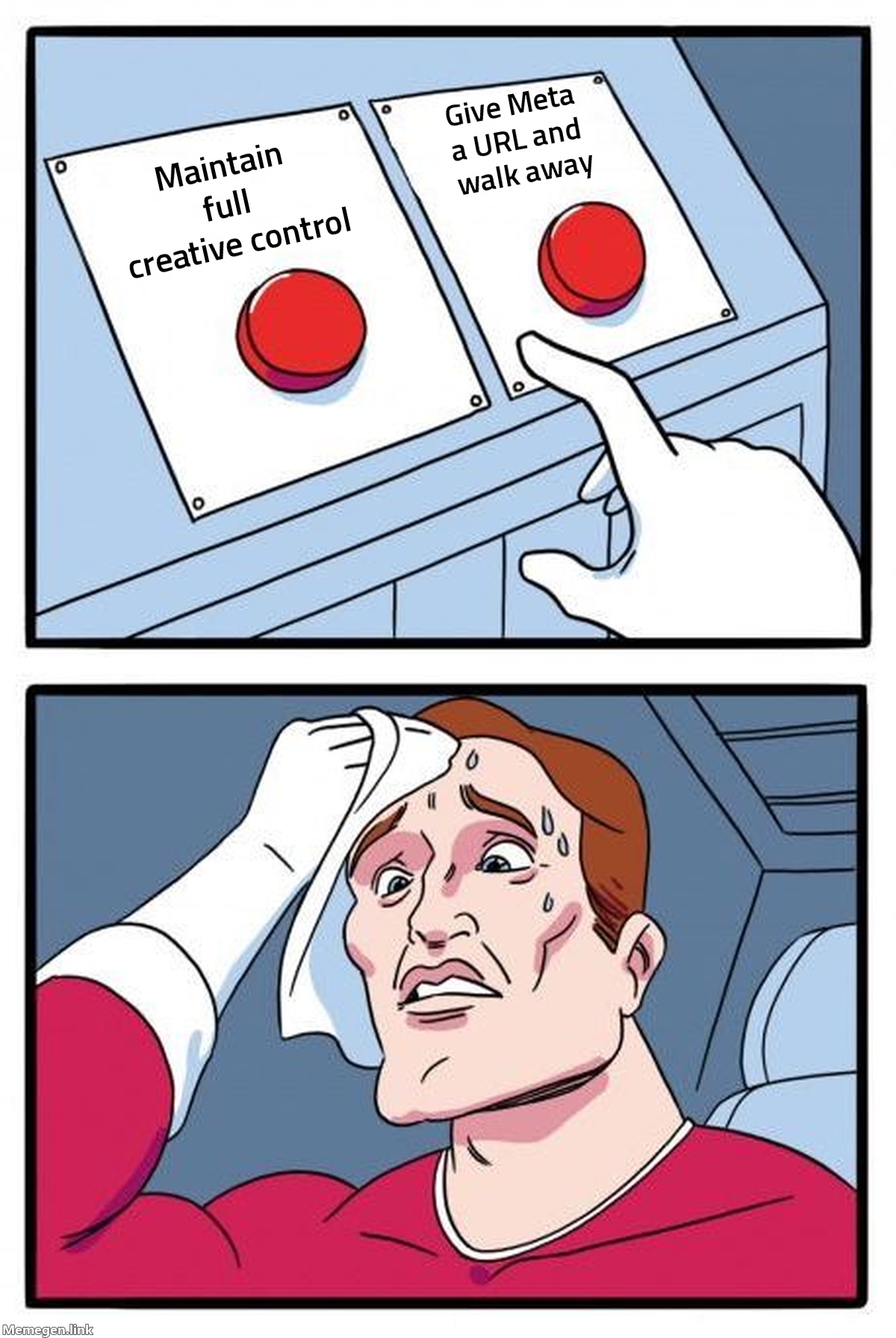
This is not new technology — it's the infrastructure already running under Advantage+ Shopping. The late-2026 expansion removes the remaining manual entry points rather than inventing new capabilities. The change is that you lose the option to configure things the way you want rather than the way Meta's optimization system prefers.
For smaller DTC brands spending under $50,000 per month on Meta, this may genuinely be the more efficient version of the product. The management overhead at that scale is high relative to the volume, and the optimization capability the automation delivers is real.
Where the system breaks down
Full automation works when the input data is clean. If your product catalog has thin attributes, missing descriptions, or images that underperform in generative tools, the AI does not fix that — it generates more ads from the same bad source material and amplifies the problem.
It works at volume. Advantage+ Shopping requires minimum conversion thresholds because the algorithm needs signal. A small account with limited conversion data does not self-optimize toward a ROAS target — it explores inefficiently until the budget runs out.
It works when you don't need control. If your brand has legitimate restrictions — competitive exclusions, category sensitivity, specific audiences you need to reach or avoid — full automation does not accommodate those cleanly. The constraints the system removes are often the ones your business actually requires.
There is also the dependency problem. When Meta's system is making every decision and something breaks — an algorithm shift, a CPM spike in your category, a policy enforcement action — you have fewer levers and less visibility to diagnose and respond.
What to do with this information
Check your current campaign mix and compare ROAS between Advantage+ and manually configured campaigns. If Advantage+ is already ahead in your account, the coming shift represents continuity. If it is not, find out why before the automation expands further.
Audit your product catalog as if it were your creative brief. Attributes, descriptions, and images all feed the generative system. Gaps in any of them become gaps in performance.
Identify which constraints actually matter for your brand — audience restrictions, competitive exclusions, category-level requirements — and think through how to preserve them as manual controls narrow.
The late-2026 automation is not a cliff. It is a gradual tightening of how much configuration the platform still allows. Brands that have been running Advantage+ seriously will experience this as continuity. Brands holding onto manual controls because it felt safer will experience it as disruption.
If you want a clear picture of where your Meta setup stands before the automation expands further, Gromerce's free audit breaks it down in under three minutes.
Sources: Yahoo Finance, Marketing Dive, eMarketer, Meta Q2 2026 earnings, September 2026