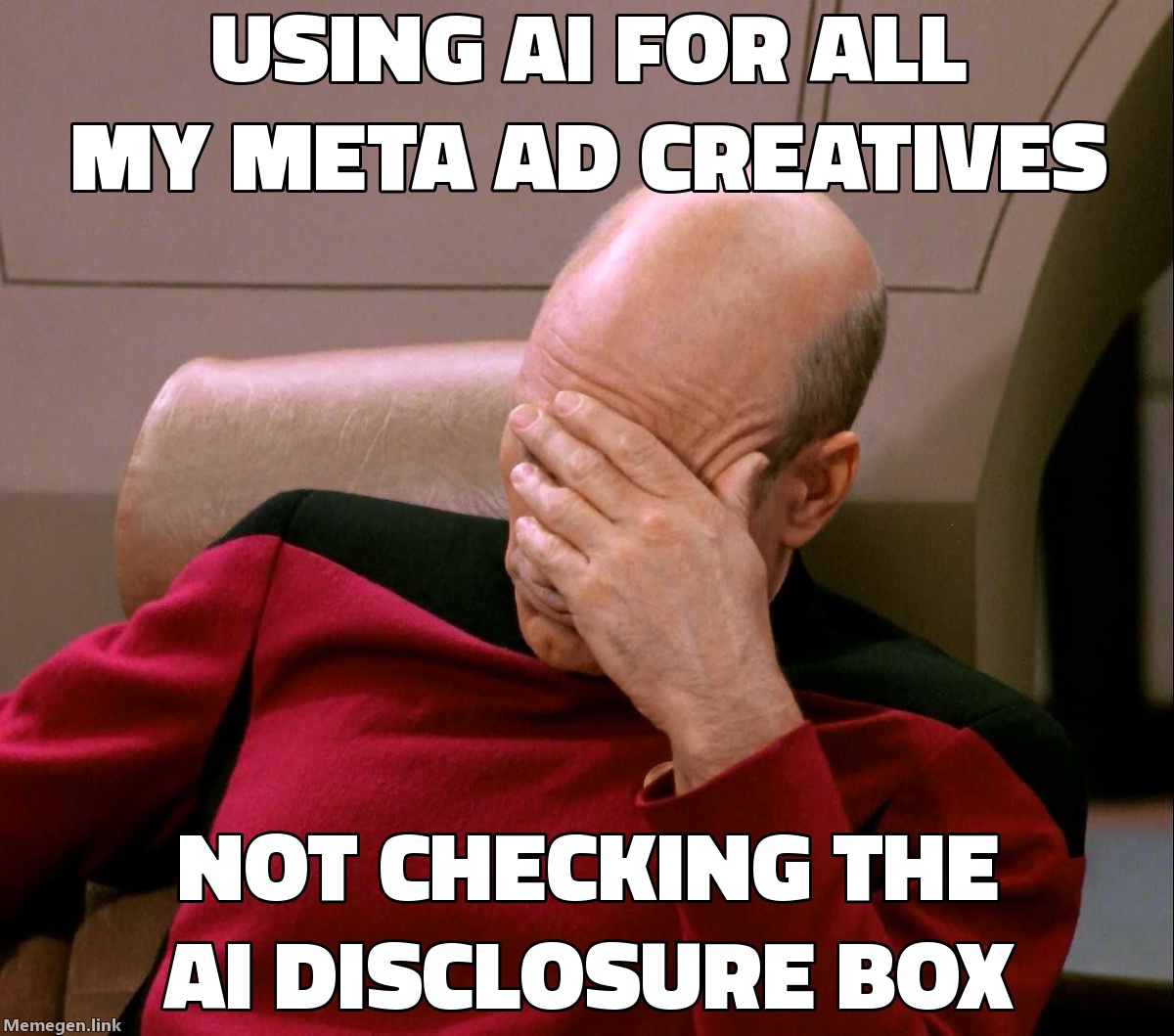
Meta added AI content detection to its ad review system earlier this year. Every ad you submit goes through two scans: one reads C2PA metadata embedded by tools like DALL-E, Midjourney, and Stable Diffusion, and a second runs visual analysis looking for synthetic artifacts — the specific patterns AI generators leave in backgrounds, skin textures, and edges. If either scan finds AI-generated or AI-edited content you didn't disclose, the ad gets rejected.
That policy has been in place since Q1 2026. What changed is enforcement. As of mid-2026, "Undisclosed AI Content" is the third-most-common rejection reason on Meta, accounting for 14% of all rejections. Most brands using AI creative tools know about this policy in the abstract. They're getting caught anyway.
What the disclosure requirement actually is
When you build a Meta ad that includes AI-generated images, AI-generated video, AI voiceovers, or AI-edited visuals — including background swaps and generative fills — you're required to check a box in Ads Manager stating that AI was used. Meta then applies an "AI info" label to the ad, visible to users through the three-dot menu under "About this ad."
The requirement applies to AI content from any source: Meta's own tools (Background Generation, Image Generation, Add Animation) and third-party tools including Adobe Firefly, Canva's AI features, Midjourney, DALL-E, and the generative product photo tools many DTC brands folded into their creative workflow this year.
The policy launched as part of Meta's 47 advertising rule changes across Q1 2026. Enforcement tightened substantially in Q2 as Meta's detection models improved — the rejection rate for undisclosed AI content went from a background noise level to the platform's number-three rejection driver.
How Meta's scanner actually works
The detection operates at two levels. First, it reads C2PA metadata — an embedded standard built into outputs from DALL-E, Stable Diffusion, and most major AI image tools — that describes how an image was created. If your creative has that metadata and you didn't check the disclosure box, the mismatch triggers an automatic rejection.
Second, Meta runs visual analysis looking for synthetic artifacts: the patterns AI generators leave in backgrounds, skin textures, edges, and lighting that differ from photographs. This layer catches content from tools that strip metadata or don't generate it.
The two layers working together mean you can't reliably avoid detection by using a tool that doesn't embed metadata. The visual scan catches what the metadata scan misses.
Four situations where brands keep getting flagged
The most straightforward is using Midjourney or DALL-E for ad images without checking the disclosure box at campaign setup. The fix is checking the box.
The less obvious case is editing real product photos with AI tools. If you used Adobe Firefly to swap a background on a product shot, or used generative fill to clean up an image, Meta considers that a significant AI edit requiring disclosure. Many creative teams don't think of generative editing as "using AI" in the sense the policy means. Meta's scanner does.
Third: AI voiceovers on video ads. Synthetic voice audio requires the same disclosure as AI visual content. Any brand that shifted to AI-generated narration this year — for cost reduction or multilingual versioning — needs to disclose it at the video ad level.
Fourth, and this one catches agencies: creative produced by third-party vendors using AI tools without the brand's knowledge. If a vendor used Midjourney and the C2PA metadata is embedded in the file, Meta's scanner finds it regardless of whether the brand knew. The advertiser owns the disclosure responsibility either way.
What users see when disclosure is in place
When an ad carries proper AI disclosure, users see an "AI info" label accessible through the three-dot menu on the promoted post. Meta is now globally rolling out a "How this ad was made" panel through My Ad Center — clicking through shows users which AI features or tools were involved in creating the ad.
There's no published data yet on whether AI-labeled ads perform differently. The practical frame: disclosure is a compliance requirement, not a performance lever. Getting it right doesn't hurt delivery. Getting it wrong stops the ad before it runs.
The account risk from skipping it
A first violation for undisclosed AI content triggers a policy strike and ad rejection. A second violation within 90 days adds a 24-hour account review hold, during which all campaigns stop running. A third violation can lead to account suspension.
That escalation is fast enough that a compliance miss in one campaign can affect delivery across your entire account for a full day. For brands running time-sensitive promotions, that's not a minor inconvenience.
The fix is a process step. If your creative team uses AI tools on any production asset — image, video, or audio — add an AI disclosure step to your campaign creation checklist. Thirty seconds per campaign prevents the third-most-common rejection reason on the platform from reaching your account.
The free Gromerce audit surfaces policy and signal gaps across your Meta account, including compliance issues that may be sitting in your drafts or recently paused campaigns before they hit review.
Using AI to make ads is legal and increasingly normal. Not disclosing it is what gets the ad rejected.
Sources: AuditSocials, 1ClickReport, Social Media Today, Meta Business Help Center, VirvId, June–July 2026