For 15 years, the number kept growing. Every spring, chiefmartec would release a new count of marketing technology products, and every year the number was bigger. The joke about 10,000 tools to do the same job became 15,000. Then the joke stopped being funny.
Then the 2026 report came out.
15,505 products. Up 121 from last year. That's 0.79% growth — effectively zero in any honest conversation about the industry. For the first time since the count started in 2011, the line went flat.
What the plateau is actually hiding
Flat net growth doesn't mean nothing happened. It means as many things disappeared as appeared.
In 2026, 1,488 new products entered the landscape while 1,367 were removed. The inflow dropped 40% from the previous year — down from 2,489 new entrants in 2025. Removals climbed 13%. The engine of new tool creation is slowing while the rate of failure and consolidation rises.
Content Marketing had the largest single-category outflow: 176 products removed. Not because content marketing became irrelevant. Because Adobe, HubSpot, Salesforce, and Meta all embedded content AI capabilities directly into platforms marketers already pay for. When the enterprise stack absorbs the functionality, standalone tools lose the fight — usually without anyone noticing until renewal time.
That pattern is repeating across multiple categories. The tools being removed aren't obscure experiments. They're the $200–$800/month line items that used to feel essential.
AI didn't add to the stack. It ate categories.
The assumption going into 2026 was that generative AI would create a wave of new tools layered on top of what already existed. Some of that happened. But the dominant pattern is consolidation, not addition.
Google's Asset Studio generates video and images directly inside your ad account. Meta's creative AI tools live inside Ads Manager. Shopify now has a native email product. HubSpot covers content, CRM, automation, and analytics in one subscription. ChatGPT operates as a research and writing workflow that sits entirely outside the traditional tool category.
For an e-commerce brand paying separately for a copy tool, an image generator, a social scheduling app, and a content calendar — at least two of those are likely already covered by something in your existing subscriptions.
The categories still growing are structural: Ecommerce Platforms & Carts grew 19.9%, Mobile & Web Analytics grew 11.3%, and iPaaS / Data Integration grew 8.0% as AI agents need more orchestration infrastructure. These categories are expanding because AI is using them, not because teams are buying more tools for their own sake.
The deployment gap
Here's the number that should actually concern you: 90.3% of marketing organizations say they're using AI agents somewhere in their stack. Only 23.3% have deployed them in full production.
That 67-point gap is the real story in the data.
Most teams are experimenting. Running one AI tool for a narrow use case and calling it AI adoption. The work of wiring AI agents into live campaigns, live budgets, and live customer data is still largely unfinished.
80.6% of deployed agents operate in "assist only" mode — AI suggests, humans approve every action. That's useful but not a production deployment. It's a prototype with a good communication plan around it. The most common reason teams haven't crossed into full production: 56.3% name poor data quality as the primary obstacle. Not the technology. Not the cost. The condition of the underlying data.
What this means for your budget
The practical question is: what are you paying for that you already have access to somewhere else?
Platform consolidation has moved faster than most teams notice. Meta Business Suite has audience insights your standalone analytics tool duplicates. Google Ads generates creative assets your creative tool charges you for. Your Shopify plan includes email automation your ESP used to own.
Auditing your tool stack against current platform capabilities — specifically what's been added in the past 12 months — typically uncovers $15K to $50K per year in redundant spend for a mid-sized e-commerce brand. That's not a marginal savings. That's media budget that could go toward creative tests and channel experiments that actually move your metrics.
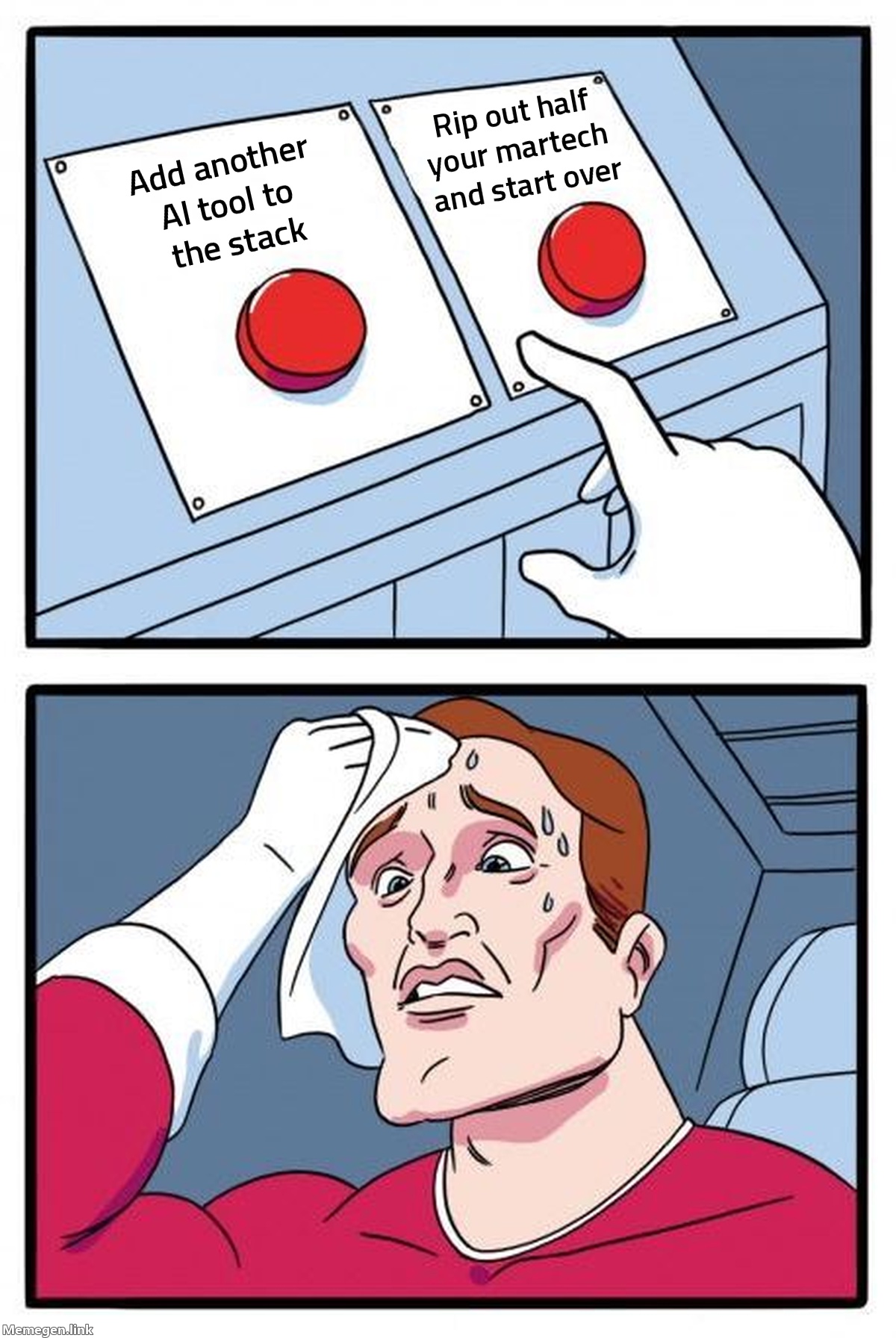
The martech plateau isn't a sign innovation slowed down. It's a sign the standalone tool era is over for most categories. The winning stack isn't the biggest stack. It's the one where what you have is actually running.
If you're unsure where your account has real gaps versus just expensive overlap, the free audit at Gromerce takes a few minutes to show you what's missing and what's redundant.
The question isn't which new tool to add. It's whether what you're paying for is doing anything.
Sources: chiefmartec / State of Martech 2026 (Scott Brinker & Frans Riemersma), CMSWire, MarTech.org, May 2026