What launched yesterday
Google began rolling out the May 2026 core update on May 21. It's the second broad update this year, following the March rollout, and Google says it may take up to two weeks to complete. Ranking volatility runs through approximately June 4.
The underlying change is not minor. Google's core ranking systems are now running on Gemini-based quality models, which means the signals used to evaluate content quality — expertise, depth, user satisfaction — are being re-weighed through a different model architecture than what determined your current rankings.
Some sites will rise, some will fall, and the full picture won't be clear until late next week at the earliest. The mistake is treating this as purely an SEO story.
The AI Overviews factor
This update lands at a moment when AI Overviews appear on roughly 48% of Google searches, up from 34.5% in December 2025. That share has been growing every month, and a Gemini-powered core update is likely to push it further.
What AI Overviews do to click-through rates is not subtle. When an AI Overview appears, position-one organic CTR drops from around 27% to as low as 11%, based on SISTRIX data from March 2026. That's more than half of your expected clicks gone, just from the presence of an AI feature — regardless of whether your ranking changed at all.
Paid ads are not immune here. Seer Interactive found paid CTR on AI Overview queries fell 68% — from 19.7% down to 6.34% — compared to equivalent queries without AI Overviews. Your ads are serving. People are clicking less.
ALM Corp measured the downstream effect: across Q1 2026, classic organic click share fell 11–23 percentage points across every vertical they tracked, while text ad click share gained 7–13 points in those same categories. The brands winning in paid search are capturing traffic that used to be free for the brands that aren't.
How this lands in your paid account
Here is the chain of events that plays out over the next two weeks:
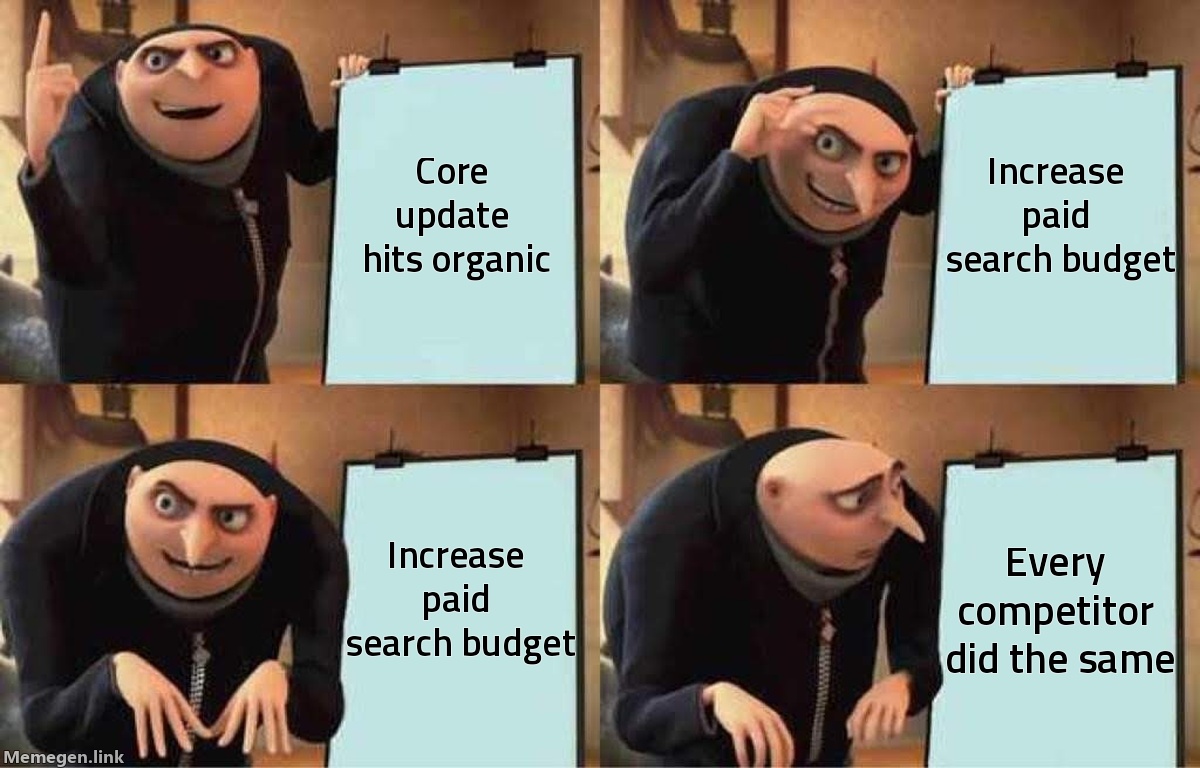
- Brands that lose organic rankings shift budget into paid search to cover the traffic gap.
- That increases auction competition on keywords where they previously relied on organic.
- CPCs rise for every advertiser on those keywords, including you, even if your own rankings held.
- If your rankings also dropped and you're bidding more aggressively, you're bidding against multiple competitors doing the same thing simultaneously.
This is not a hypothetical. It happens after every significant core update, and the March 2026 update already set the baseline for how aggressive the compensation behavior is this year. The May update starts that cycle again.
The structural point worth noting: every Google core update that expands AI answers compresses organic CTR and pushes more volume into paid auctions. That's not an accident. It's how Google's revenue model works when AI features absorb clicks that previously went to organic results. You are competing against the algorithm and against every other advertiser who read this headline this morning.
What to do over the next 14 days
Wait a week before making significant changes to bids. Core update volatility typically takes 7–10 days to stabilize. Making CPC adjustments on day three means adjusting based on noise, not signal.
What you can do now: establish your baseline. Pull Search Console data for the 30 days ending May 20. Note your organic impressions, average position, and clicks per keyword cluster. Starting around May 28, check the same clusters. Where organic visibility is falling, watch whether paid CPC on those terms is rising in your auction insights and Google Ads cost data. That correlation, when it appears, is your evidence of competitive compensation happening in real time.
On AI Overview exposure specifically: in Search Console, filter for queries where AI features are showing. Those are the keywords where your organic CTR is already compressed, regardless of ranking. If you're not in paid on those queries, you may want to be — because the clicks that used to go to organic position one are now going somewhere, and right now they're going to the brands that are bidding.
One thing to avoid: do not increase max CPCs in bulk across your account as a precaution. That donates margin to Google on every keyword, including the ones where you had no ranking change and face no new competition. Wait for the data to show you which specific keyword groups are losing ground, then adjust surgically.
If you want to see which terms in your account are most exposed to core update volatility right now, a free audit at Gromerce will flag the coverage gaps and CPC pressure points in a few minutes.
The May update is Google's second ranking reset this year. The brands that come out ahead are the ones that separate the organic tracking problem from the paid budget response, and don't let the first one trigger a panicked version of the second.
Sources: Search Engine Land, SISTRIX, Seer Interactive, ALM Corp, Coalition Technologies, May 2026