What changed, and when
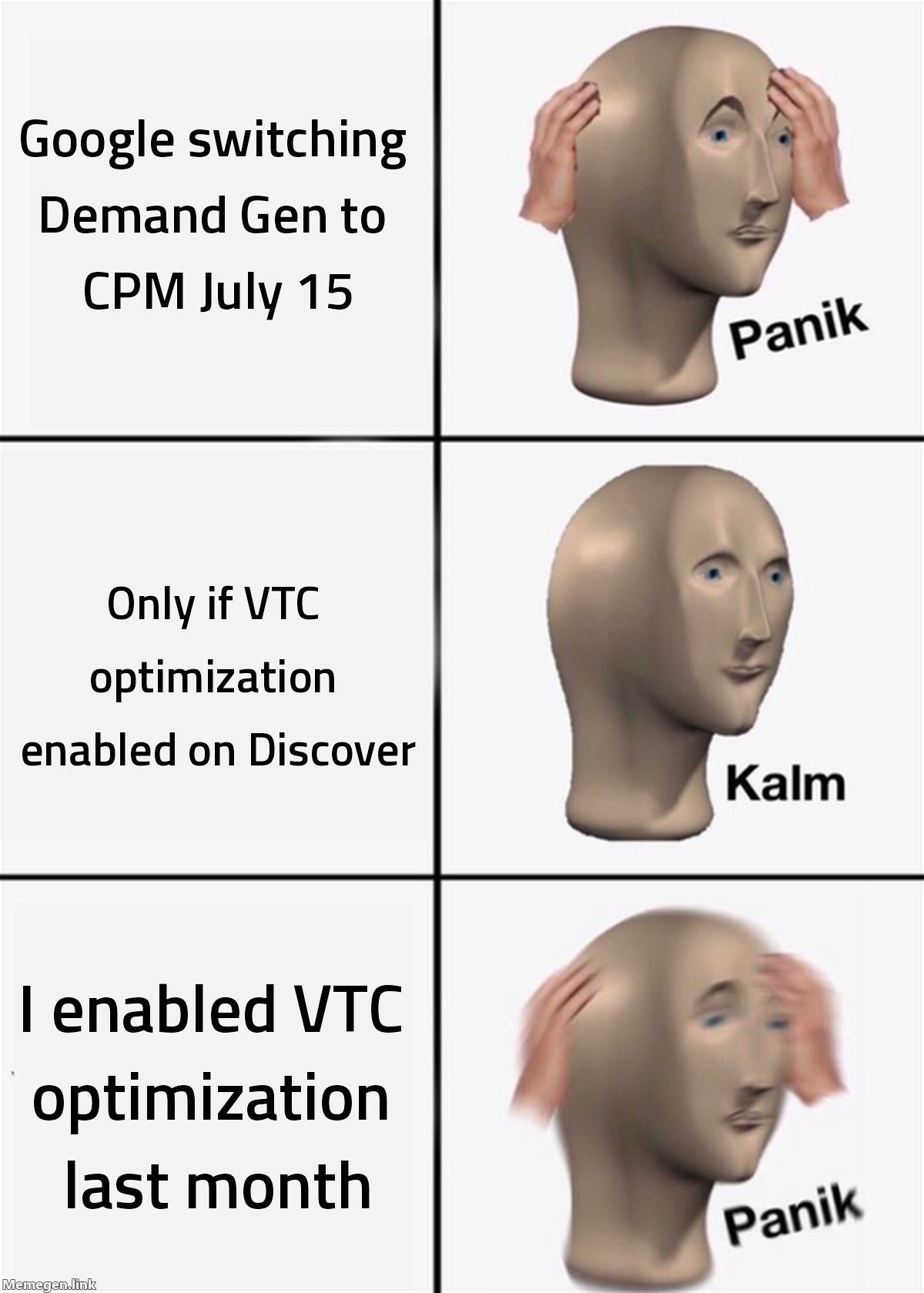
Google sent a notification on June 16 — buried in a week when most advertisers were either stress-testing Prime Day setups or watching Cannes Lions coverage — that Demand Gen campaigns running view-through conversion (VTC) optimization on the Discover placement will shift from cost-per-click to cost-per-mille billing effective July 15.
The stated reason: CPM billing "more accurately reflects the value being delivered" for view-through campaigns, since view-through conversions are triggered by impressions seen, not by clicks taken. That's a reasonable argument. The practical effect on your budget is less tidy.
Under CPC, you pay when someone taps your ad. Under CPM, you pay for every thousand people who see it, whether they click or not. If your Demand Gen campaign serves on Discover with VTC optimization enabled, the billing model switches on July 15 regardless of whether you engaged with that notification.
Who's actually affected
The billing change applies only when two conditions are both true: the campaign serves on the Discover placement, and view-through conversion optimization is switched on.
Neither condition triggers the change on its own. A Demand Gen campaign serving YouTube and Gmail only is unaffected. A Discover campaign without VTC optimization stays on CPC. Both conditions must be present.
One more detail worth knowing: VTC optimization is off by default in all Demand Gen campaigns, including campaigns that predated April 2026 when the feature launched. If you didn't explicitly enable it, you're not in scope. Check anyway.
The accounts most likely to be affected: those who read about VTC optimization in May, got interested in closing the attribution gap on Discover, turned the setting on, and then moved on to other work. That's a meaningful slice of accounts that run Demand Gen with any kind of view-through attribution goal.
The math problem with switching billing models
Under CPC billing, Demand Gen's Discover placement worked on familiar logic — you pay for engagement. CPM billing introduces exposure cost regardless of whether the exposure converts.
If your VTC-enabled campaign is efficiently generating view-through conversions, the switch might be fine. Depending on your impression volume and VTC conversion rate, you might even end up paying less per attributed conversion. But if view-through attribution is inflating your numbers — a real risk with any 1-day window — you're about to pay impression-level costs for a conversion signal that may not be as reliable as it looks in your dashboard.
The billing model change doesn't resolve the VTC attribution question. It just makes the cost of that question visible in a different place on your invoice.
Also check your daily budgets. If your Demand Gen-Discover campaigns are currently pacing to budget on CPC, the same budget may exhaust faster under CPM when impression volume is high. "Spending to budget" doesn't automatically translate to "performing at target."
Four things to do before July 15
Pull your Demand Gen campaigns and look for whether VTC optimization is enabled. That setting is in the bidding and optimization section of each campaign.
If it's on and you want to keep it, model out what your impression volume implies for spend under CPM. Your historical Discover CPM is visible in the campaign placement breakdown report.
If you want to stay on CPC, disable VTC optimization. Google confirms that turning it off opts you out of the billing change. Note that this changes your optimization signal — you give up whatever cross-channel attribution the VTC window was generating.
If you're genuinely unsure whether VTC conversion numbers are adding real signal or just making your reports look better, this billing change is the right moment to run a holdout test. Disable VTC on half your Demand Gen budget for 30 days, compare attributed and unattributed performance, and make the decision with actual data.
The broader pattern
Google has a consistent cadence with AI-powered features: launch with opt-in controls, let advertisers experiment, then gradually fold the mechanics into the standard product — sometimes with billing consequences that arrive separately from the feature announcement.
VTC optimization launched in April. The billing change notification went out in June. The deadline is July. Three months from feature launch to billing model change is fast. It won't be the last time this sequence plays out with an AI optimization feature.
Build the habit of checking your campaign settings whenever you enable any new optimization feature, and revisit the billing documentation independently. Google's feature announcements and billing policy updates don't always travel together.
If you're not sure whether your Demand Gen setup is performing the way you think it is, the free audit at Gromerce surfaces billing drift and optimization settings that have moved away from your original intent.
Three months from feature launch to billing model shift — read the fine print on AI opt-ins before you're paying for them.
Sources: Search Engine Land, Digital Applied, Pearl Organisation, Google Ads Help Center, June 2026