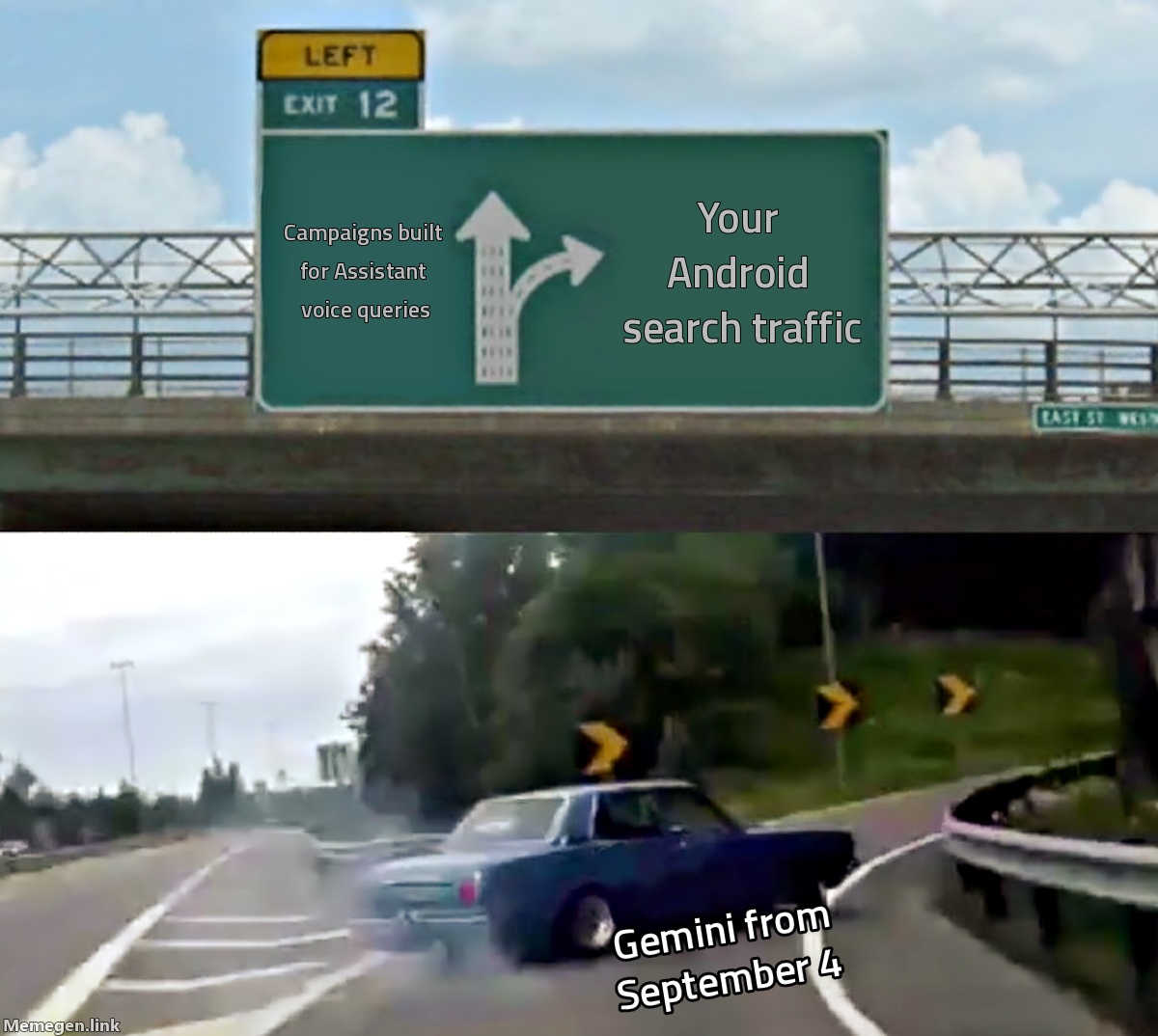
Google confirmed last week that Google Assistant will stop working on Android devices starting September 4. The company is replacing it with Gemini across Android phones and tablets, Wear OS watches, headphones, and cars running Android Auto via phone projection. Once the change reaches a device, there is no way to switch back.
This is not a minor product update. Android runs on the majority of smartphones globally. Every voice query those users make after September 4 goes to Gemini, not Assistant.
What's actually turning off
Assistant is being removed from the devices most people use most often: phones, tablets, Wear OS watches, connected headphones. The phone-projected version of Android Auto is also in scope. Google Home and Google TV are on separate timelines.
The change does not bring Gemini to full feature parity with Assistant immediately. Gemini currently lacks support for Interpreter Mode (live two-person translation), some podcast apps, radio stations, and several third-party music services. If anyone on your team runs automations or routines on those capabilities, they break September 4 with no graceful fallback announced.
For advertisers, those missing features are a side note. The core change is where queries get processed.
How Gemini handles queries differently
Google Assistant was built on an intent-classification model. A user said "Set a timer for 20 minutes" or "Call mom" and the system mapped the request to a defined action. When Assistant triggered a search query, those queries were generally short and structured in ways the auction already knew how to match.
Gemini works differently. It processes requests conversationally — longer phrasing, more specific questions, multi-step intent. "I need running shoes that won't hurt my knees for wide feet under $120" is the type of input Gemini is built to handle. The same request through old Assistant might have been "running shoes wide feet."
Those are different queries to match and bid against. Different in length, in specificity, and in how far they expand from a keyword list.
Why this matters for paid search
Google has spent the past year aligning its ad infrastructure around Gemini-originated queries. AI Max for Search campaigns is built specifically to capture conversational and expanded-intent queries that traditional keyword matching would miss. Without AI Max active, Gemini-originated traffic that falls outside a keyword list goes unserved by that campaign.
The September 4 date doesn't create new ad inventory from nothing. Voice search has always existed. What changes is the volume and the nature of those queries. Android users who have been asking short questions to a limited classifier will now interact with a language model that handles longer, more specific requests. The queries you see in your Search Terms report in October will look different from those you see today.
Whether "different" means more revenue depends entirely on how campaigns are set up. AI Max and broad match campaigns absorb this traffic. Tight exact-match ad groups don't.
The agentic layer underneath
There's a longer-term shift under the September 4 deadline worth flagging.
Gemini is not just a query processor — it's the foundation for Google's agentic commerce infrastructure: the Universal Cart, the Agentic Checkout, the Business Agent for Leads. As voice traffic migrates to that layer, it enters the same system where purchases can complete without a website visit.
That's not an immediate concern for most advertisers on September 5. But it is the direction of travel. The Google experience you're optimizing for today — user types a query, sees ads, clicks through, lands on your page — is not the experience Gemini is being built to produce long-term.
What to check before September 4
There's no account setting that expires on September 4. But the transition creates a natural checkpoint for two things.
First: check whether AI Max is running in your main Search campaigns. The gap in Gemini-intent capture is higher for campaigns still relying purely on keyword lists.
Second: look at the conversational queries in your Search Terms report now, while you still have a pre-transition baseline. After September 4, the mix of that voice traffic will shift. Having a baseline now makes it easier to diagnose what changed when you're reviewing October data.
Three weeks. That's how long you have before the query mix on Android devices changes for every advertiser.
If you want to see how your current campaign structure handles Gemini's expanded query patterns, the free audit tool surfaces the gaps in a few minutes.
Sources: Search Engine Land, MediaPost, August 2026