Google tested something this week that's easy to scroll past and hard to ignore once you understand it: AI-generated summaries added directly beneath standard search ad descriptions in regular Search results.
Not in AI Mode. Not in an AI Overview. In the standard SERP, below your existing ad copy, Google's model writes its own interpretation of what your ad is about and shows it to the person deciding whether to click.
The feature was first spotted by digital marketer Darcy Burk. The summary block includes a disclaimer: "Google AI responses are generated independently and can make mistakes, so double-check responses."
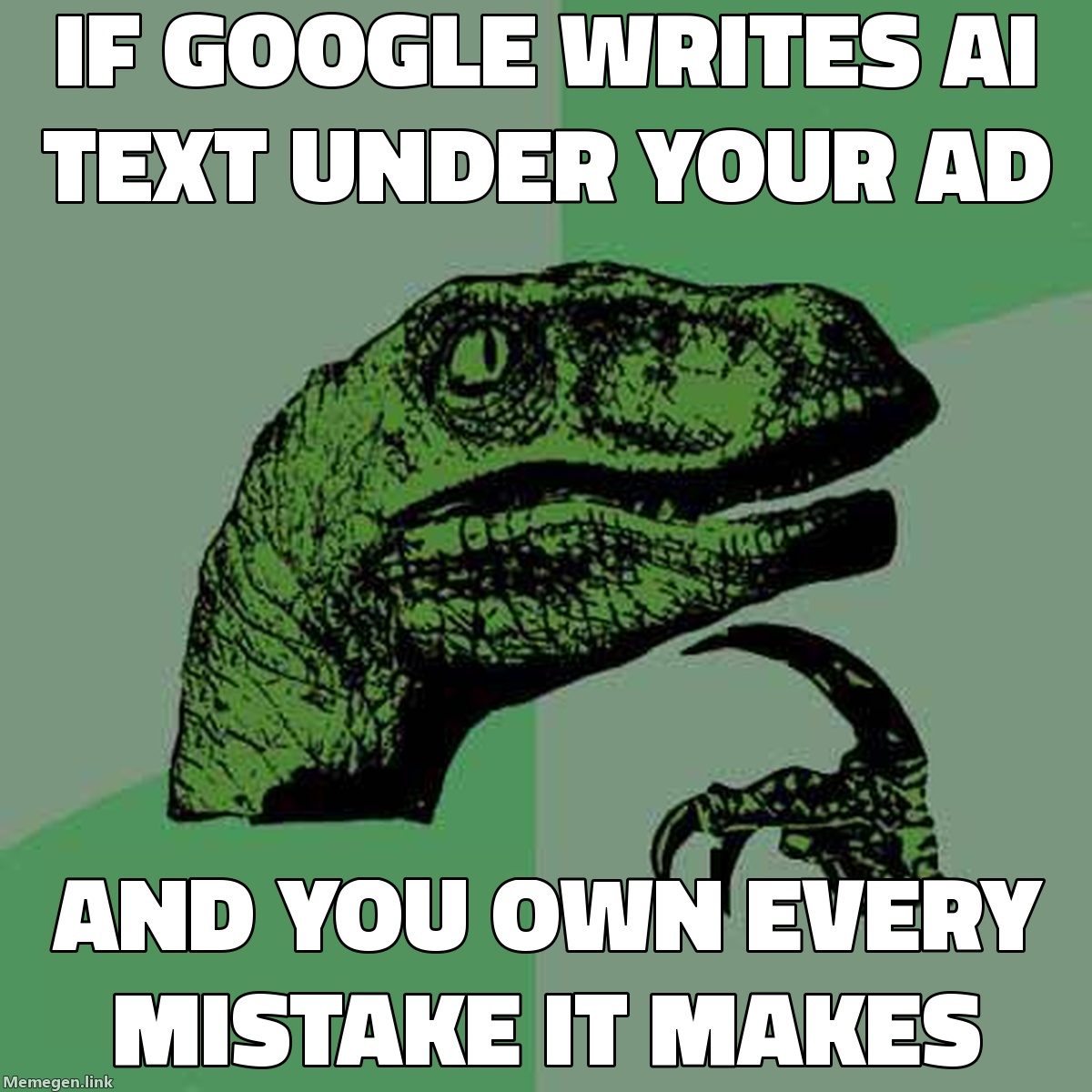
That's a reasonable disclaimer. The problem is it tells the searcher to double-check — but it doesn't change who's responsible for what appears under your brand name in a paid placement.
What the summary actually does
The AI doesn't transcribe your ad copy. It reads your ad, the landing page behind it, and the user's query, then generates a response it thinks best answers what the searcher is looking for.
That distinction matters. You wrote your ad to say specific things in a specific way. The summary has different source material — your entire landing page — and a different objective: answering the query, not communicating your brand's message.
E-commerce product pages contain a lot of content that was never meant to appear in a search ad. Warranty terms buried in an FAQ. Shipping exceptions three paragraphs deep in a returns policy. Price ranges across SKU variants that don't apply to the base product. A model scanning your landing page for summary content will pull from any of it.
The July 1 problem
This test appeared three days after Google's updated Advertising Program Terms took effect.
That update — the first major Terms of Service rewrite in eight years — makes clear that advertisers are responsible for reviewing all AI-generated assets in their campaigns. The specific language: if a generated asset contains a policy violation, or uses content the advertiser doesn't hold rights to, the responsibility to catch it sits with the account holder.
AI summaries beneath search ads aren't "assets" in the same sense as RSA headlines or PMax creative. But the practical exposure is similar: AI-written content representing your brand appears in a paid placement, you didn't author it, and it goes live before you see it.
If the summary implies a guarantee your terms don't support, or cites a delivery window your carrier can't reliably hit, or surfaces a price point that applies to one discontinued variant — you're not the one who wrote it. But your brand name is at the top of the placement.
What you can't do
You can't opt out of this test from the advertiser side. There's no reporting column showing which of your ads generated summaries. You can't preview what a summary will say before it goes live. Google hasn't published a list of query types that trigger summaries, though they appear more likely on informational and comparison-stage searches than on high-intent branded terms.
This is the same pattern Google followed with Limited Ad Serving, Broad Match expansions, and AI Max for Search: advertiser-side controls and reporting come later, if they come at all.
What to do about it
Your landing page is now creative input in ways it wasn't six months ago.
Every claim on your product pages — shipping speed, return window, compatibility specs, price comparisons — is potential summary material. If you wouldn't want it in your ad, it shouldn't be on the page in a form an AI can cleanly extract and present.
Go through your highest-spend ad groups. For each one, look at the destination landing page through this lens: what's the most prominent claim on this page that doesn't appear in my ad copy? If the answer is something you'd be uncomfortable seeing surface in a search result under your brand name, that's where to start.
Branded queries are lower risk. "Your Brand socks" is unlikely to trigger a summary. "Best compression socks for running under $40" — where your ad competes against four others and the query is still in comparison mode — is exactly where Google would add a summary if the test scales.
Your ad descriptions themselves are also worth tightening. The more specific and accurate your existing copy, the less gap there is between what you wrote and what an AI might generate from the same source material. Vague ad copy gives the model more room to interpret.
The broader pattern
This is the third placement type in four months where Google has introduced AI-written content into paid ad placements without a pre-approval step for advertisers. Conversational Discovery Ads generate creative per query from product data. AI Max uses feed attributes as creative inputs. Now Search ads get AI summaries from landing page content.
Each one shifts more content responsibility from the advertiser to the platform. Each one extends the ToS liability framework in ways that formally protect Google while assigning advertisers accountability for outputs they didn't author.
The direction is clear. Your job is to make sure the raw material — landing pages, product data, feed attributes, ad copy — is precise enough that AI systems have limited room to misrepresent you.
If you want a clear view of where your current ads and landing pages create the most exposure, the free audit at Gromerce identifies gaps across your highest-spend campaigns in a few minutes.
You didn't write the summary. You still own what it says.
Sources: Search Engine Land, SERoundtable, SEOteric, Darcy Burk via X, July 2026