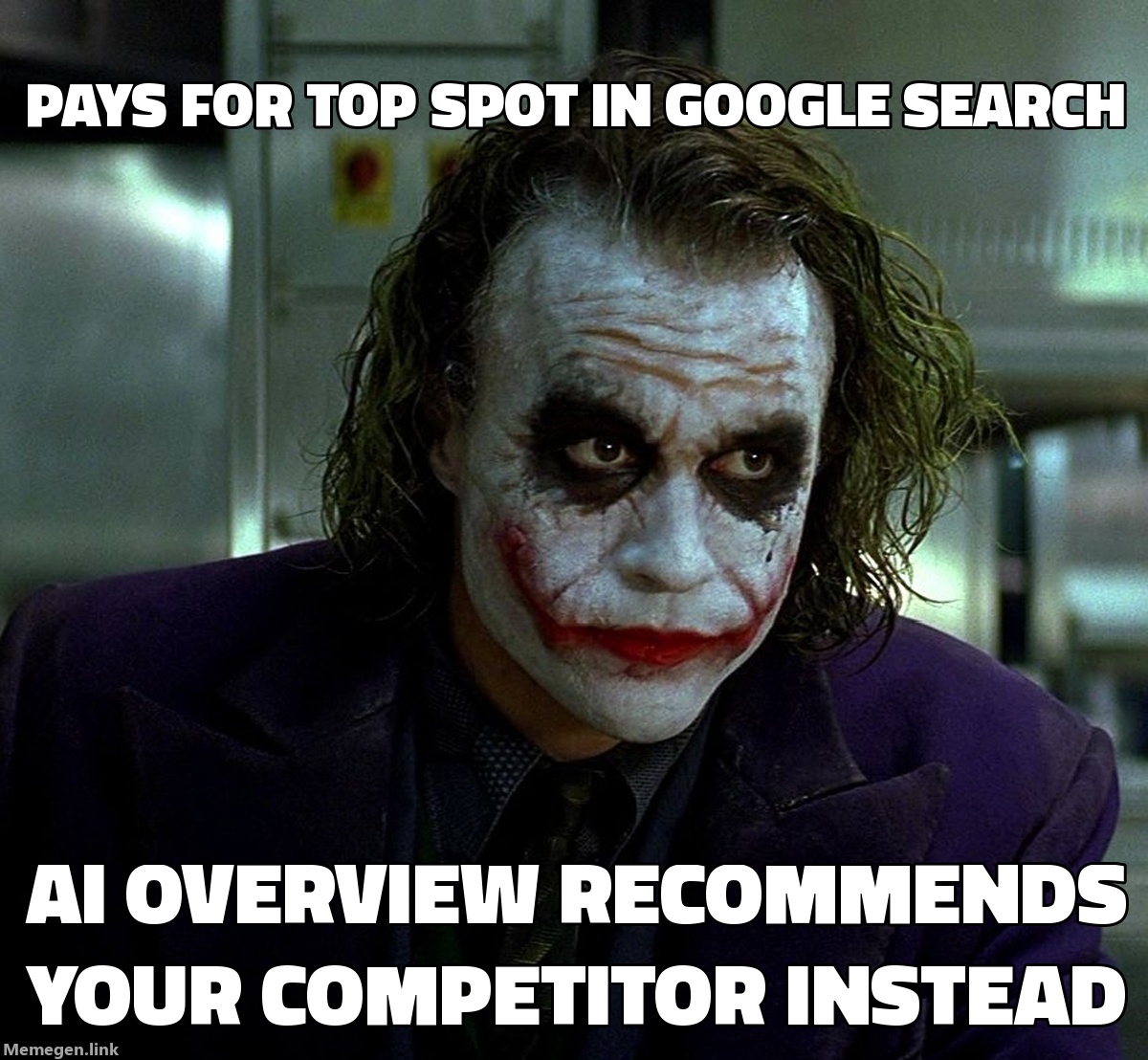
Search Engine Land documented a case recently that deserves a place in every paid media manager's reading list. Eco Plumbers ran a sponsored ad at position one with a competitive offer — $89 leak detection, 4.9-star rating across 20,000+ reviews, 24/7 availability. Everything a user needs to convert.
Below that ad, on the same results page, Google's AI Overview named different plumbers as the better options for the user's situation.
The advertiser paid for the impression. They didn't get the click. Google got paid either way.
what the CTR data shows
Search Engine Land published a paid search analysis specifically on this problem. According to that research, when an AI Overview appears on the same SERP as a paid ad, paid CTR drops to 9.87%. Without an AI Overview on the same page, Search Engine Land found CTR sits at 21.27%.
That's a meaningful drop in click probability on queries where you've already won the top position and have an ad doing everything right. You didn't do anything wrong. The AI showed up and redirected attention.
There's also a citation dynamic worth understanding. The same Search Engine Land analysis found that on informational queries where an AI Overview names a specific brand, that brand sees higher paid CTR than when the brand isn't mentioned in the Overview at all. If Google's AI is citing you, that's a lift. If it's citing a competitor on a commercial-intent query while you're paying for position one, you absorb the downside and they get the customer.
the quality score spiral
Here's where this compounds into a structural problem.
Quality Score incorporates expected CTR relative to ad position. When AI Overviews systematically suppress clicks — not because your ad is weak, but because the AI routes users toward cited competitors — your expected CTR baseline deteriorates. Lower expected CTR means a lower Quality Score. A lower Quality Score means higher CPCs to hold the same position.
The cycle: AI Overviews reduce CTR → expected CTR baseline falls → Quality Score drops → CPCs rise → more spend for the same or worse outcomes.
If you're seeing CPC creep on terms you haven't adjusted bids on, with impression volume flat or rising while clicks stagnate, that widening gap is worth investigating before assuming it's a creative problem.
this is different from the zero-click problem
Most of the AI Overview conversation focuses on zero-click behavior: users get an answer from the Overview and leave without clicking anything. That's a volume problem. Fewer buyers entering the funnel.
The contradiction scenario costs you differently. The user in the Eco Plumbers case wasn't casually browsing. They searched for emergency plumbing. They were ready to call. The AI didn't stop them from transacting — it redirected them to a named competitor while your ad absorbed the impression and your CTR signal took the hit.
There was a buyer in that session. The AI handed them to someone else.
what to check this week
There's no advertiser-controlled setting that prevents AI Overviews from appearing alongside your ads. But there are diagnostics worth running.
Pull impression-to-click ratios by query for your top-spend terms over the last 90 days. More impressions alongside flat or declining clicks on historically strong transactional terms is the signal to look for.
Cross-reference that data against the Google Search Console AI impressions report, launched June 17, 2026. That report shows which queries have significant AI Overview presence. Overlapping your paid impression data with AI impression data shows exactly where the suppression is concentrated.
For queries where you confirm AI Overview presence and competitor citation, landing page copy needs to directly address whatever question or objection the Overview is framing. If the Overview is naming competitors as better answers for a specific need, your page should address that exact scenario head-on — not in vague competitive positioning language, but in the specific terms the user is searching.
That doesn't fix the structural issue. But it changes whether a user who sees both your ad and the AI Overview still clicks yours.
The free audit at /audit maps your impression and click patterns by query category in about three minutes — faster than pulling the raw reports yourself.
On a SERP where your ad and Google's AI are both visible to the same user, they should be pointing the same direction. Right now, they sometimes aren't.
Sources: Search Engine Land, August 2026