What's happening September 1
Every Google Ads Search campaign running Automatically Created Assets (ACA) or campaign-level broad match is getting migrated to AI Max for Search between September 1 and September 30. Google emailed advertisers on August 5 to confirm the timeline. The rollout is progressive — not all accounts flip on September 1, but every affected campaign moves by the end of the month.
There is no opt-out. There is no rollback.
Google already signaled where this was heading. On August 3, it stopped allowing the creation of new Campaign-level Broad Match configurations and legacy ACA campaigns across the Google Ads UI, Ads Editor, and API. If you've tried to set either up in the past three weeks and found the option gone, that's why.
What actually changes when AI Max takes over
The migration behavior differs depending on which feature your campaigns use.
If a campaign runs ACA, it arrives in AI Max with both search term matching and text customization turned on by default. That means the campaign will expand beyond your keyword list based on query intent, and Google's AI generates additional headline and description variations from your landing page content. You can adjust these settings after migration — but you'll be making those adjustments while campaigns are already running under the new rules.
If a campaign uses campaign-level broad match (not ACA), it arrives in AI Max with search term matching on but text customization and URL expansion off. A narrower upgrade, but still a change if you built that campaign around tight keyword control.
Either way, existing brand inclusions and exclusions carry over automatically. Google won't touch your brand controls.
Why most accounts are more exposed than they think
ACA is on by default for new Search campaigns. Many accounts have built campaigns for years without ever checking this setting. If you haven't specifically turned ACA off, there's a real chance it's running quietly across most of your Search inventory.
Campaign-level broad match is different — you had to set it up intentionally, so you likely know where it lives. But it's still worth a full account audit before September rather than assuming you know the scope.
Both features are visible under campaign settings. Running this audit isn't complicated. What matters is doing it while you still have a choice about what happens next.
What your actual choices are
You have two paths.
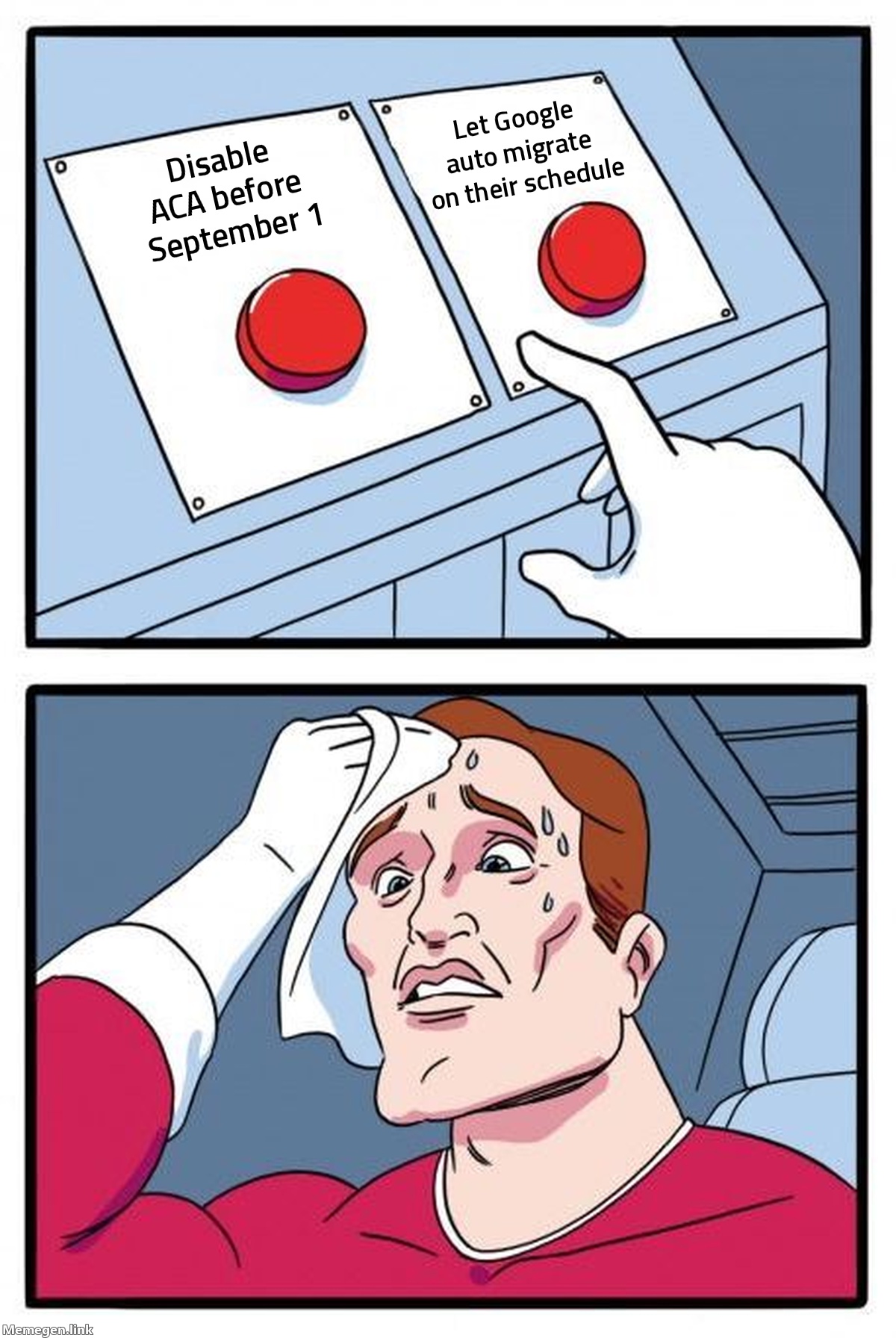
Disable ACA or campaign-level broad match before September 1 on any campaign where you want to control the migration. Once disabled, Google won't auto-migrate that campaign. You can then test and enable AI Max yourself, on your own schedule, with your own settings — rather than inheriting Google's defaults mid-flight.
Or let the migration happen automatically. This isn't necessarily wrong. AI Max has real performance upside for many accounts, and if you're already comfortable with broad match or AI-generated copy, the transition may be smoother than you expect. But you'll be reviewing settings and creative after the migration, not before.
The case for acting now is straightforward. The migration rolls progressively through September — a campaign unchanged on September 2 may still flip on September 24. If you're heading into Q4 planning in October, having your account architecture shift mid-September is a problem you can eliminate with an hour of auditing today.
The API change nobody's talking about
One thing that hasn't gotten much coverage: Google's API behavior changes along with the migration. Any Google Ads API version released after September 1 drops support for legacy ACA and Campaign-level Broad Match entities. Older API versions stay functional until their expected sunset around September 2027.
If you or your agency manage campaigns via the API, confirm your integration handles the AI Max entity format. A silent API failure is a harder problem than a campaign setting you didn't audit. Check with whoever manages your API integrations before the month ends.
Not sure which of your Search campaigns are running ACA in the background, or how exposed your account is heading into September? The free Gromerce audit surfaces these gaps without requiring full access to your account.
You can control how this transition happens, or you can let Google decide for you.
Sources: Search Engine Land, ppc.land, August 2026