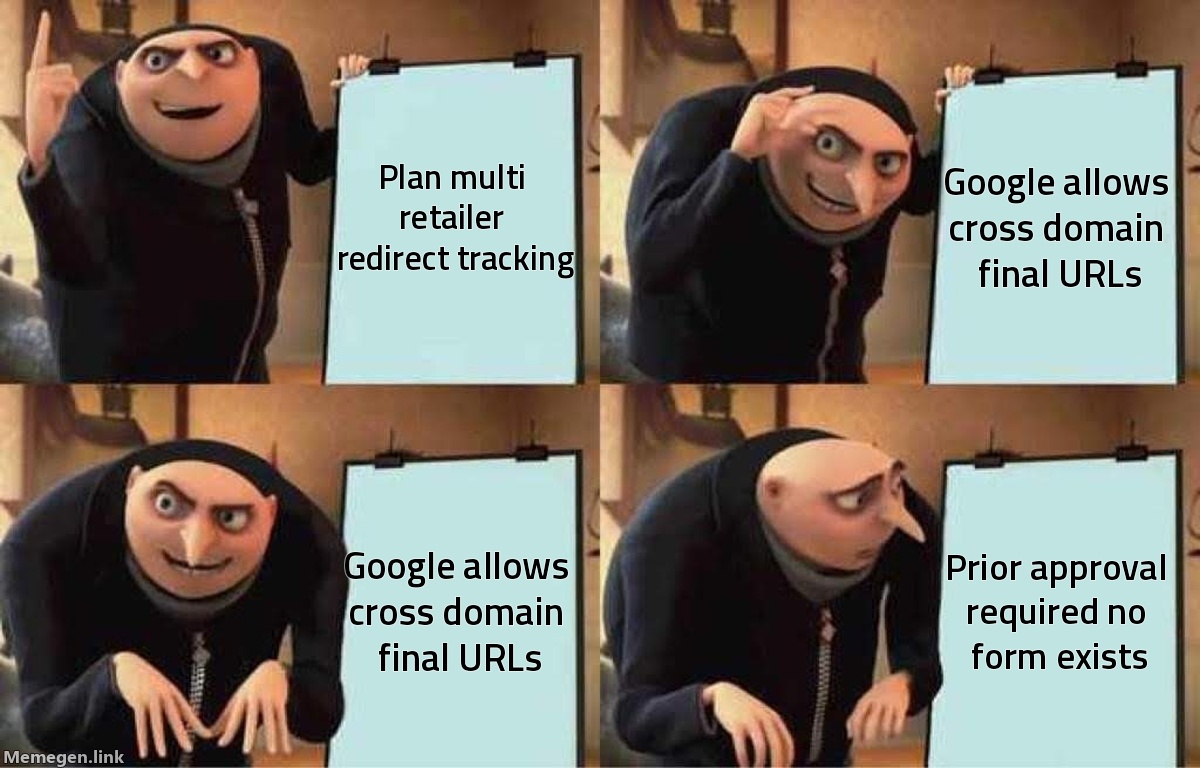
Google updated its destination requirements policy this month to allow an ad's final URL to redirect to a completely different domain. That sounds routine. It isn't. For three years, cross-domain redirects in final URLs have triggered automatic destination mismatch disapprovals — no appeal, no warning, just a rejected ad.
The catch: the new exception requires prior approval from Google. And as of today, Google hasn't published what that approval process looks like.
What the destination mismatch rule actually blocked
The old rule was strict: your final URL had to resolve to the same domain shown in the display URL. A redirect from yourbrand.com to amazon.com/product, even a clean server-side 302, violated policy.
This was a real problem for two types of advertisers.
The first is CPG brands selling through retailers. A supplement brand, a packaged food company, a household goods manufacturer — if their product lives on Amazon, Target, and Walmart but not on their own website's checkout, sending paid traffic to a retailer product page made sense. The redirect to that destination did not, under the old rules.
The second is performance marketers using redirect-based tracking. Tracking domains that collect attribution data before forwarding users to the actual landing page — the pattern used by link shorteners, third-party attribution tools, and some geo-routing setups — technically fell under the same rule, depending on implementation. Tools like Northbeam, Triple Whale, and short.io have built on this pattern.
Both groups built workarounds: forwarding pages on brand domains, intermediate landing pages that auto-forwarded immediately, manual appeal processes. These worked, but they added steps that shouldn't need to exist.
What the June 2026 update actually says
The policy update adds a carve-out. Cross-domain redirects are now explicitly allowed in certain circumstances, with prior approval. The Google Ads policy support page names one specific use case: consumer packaged goods manufacturers directing shoppers to pre-approved retailer destinations.
That's the CPG multi-retailer scenario. A brand runs a search ad with a final URL that routes to different retailer pages — Amazon, Target, Walmart — based on which retailer destinations were approved in the redirect configuration.
What the policy doesn't address:
- Whether the tracking domain pattern (track.yourbrand.com → yourbrand.com) falls inside or outside this exception
- Whether a subdomain counts as "a different domain" for policy purposes (it usually doesn't, but the policy isn't specific here)
- Whether link management tools using custom short domains qualify
If you're running a pure DTC setup where traffic goes directly to your own site with no redirect hop to another brand's domain, nothing here affects you. If you're unsure whether your setup involves a cross-domain redirect, check your final URL tracking templates.
The approval problem
This is where the update stalls for working advertisers. The policy says prior approval is required. It doesn't say:
- Who grants approval
- What form or process approval goes through
- What criteria Google uses to evaluate requests
- How long approval takes
- Whether approval is per-campaign or per-account
Barry Schwartz at SERoundtable flagged this gap when the update was published. LocalIQ noted the same: the policy change exists, the approval process does not.
Your options are contacting your Google rep directly, submitting a support ticket and asking about the process, or waiting for Google to publish formal guidance. If you have a managed account with a rep, the first path is the fastest — they can escalate internally or get you into a beta approval queue. If you're self-serve, the timeline is genuinely unclear.
What you cannot do: build a redirect campaign that bounces users to amazon.com or walmart.com and expect it to run. The policy requires approval first. Running without it still means destination mismatch disapprovals.
Who should act now
CPG brands with an established Google Ads relationship should document their use case and contact their rep now. Put together a brief: which retailer destinations you want to redirect to, the URLs involved, the campaign structure, and the business reason. That's what a rep needs to escalate a formal approval request.
DTC brands using redirect-based tracking: check whether your setup uses a truly different domain. Track.yourbrand.com routing to yourbrand.com is almost certainly not what this policy change addresses, but confirm with your tracking vendor before assuming either way.
For everyone else, nothing changes today. Cross-domain redirect campaigns still need approval through a process nobody has formally defined. The workarounds still work and are still the safer route until Google publishes the actual approval path.
When the approval process goes live, CPG advertisers will have a cleaner path to multi-retailer search campaigns that don't require an intermediate forwarding page on the brand's own domain. Until then, the door is open on paper.
If you want to see whether destination mismatch disapprovals or other policy flags are costing you impressions right now, the free audit at Gromerce surfaces ad-level disapproval reasons across your active campaigns.
The policy opened the door. The key still isn't cut.
Sources: Google Ads Policy (Update to destination requirements policy, June 2026), SERoundtable, LocalIQ, DigitalPhablet, June 2026