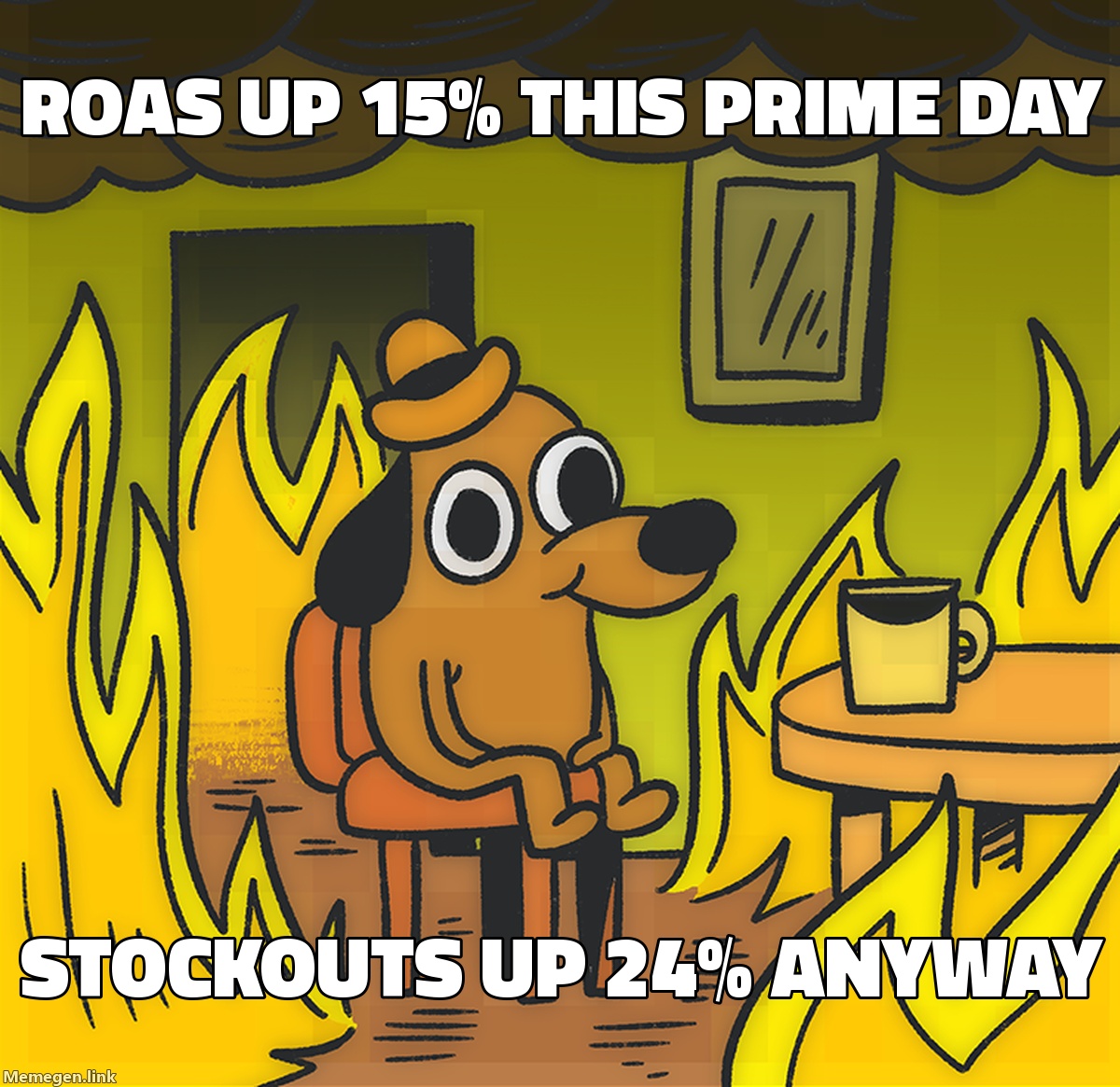
Two days in, and the numbers from Amazon Prime Day 2026 are telling two different stories at once.
According to CommerceIQ's live tracker, platform ROAS is sitting at $5.80 — up 15% from the same window in 2025 and the strongest reading in roughly 24 months. Ad spend is up 10% year over year. CPC has barely moved. On pure performance metrics, this is a good Prime Day.
Out-of-stock revenue losses are up 24% year over year. Brands entered this event with 12% more inventory than they had in 2025, and they're still losing more revenue to stockouts than they did then. Both things are true at the same time.
Where the gap actually is
The 24% stockout loss figure isn't spread evenly across catalogs. CommerceIQ's data points to inventory gaps concentrated in high-revenue ASINs specifically — the items that generate disproportionate sales when traffic spikes. Broad catalog coverage is mostly fine. The top-volume SKUs are where brands are running dry.
Average order value is down 17% this year ($48.36 versus $58.37 in 2025). That sounds bad, but it reflects how shoppers are using Prime Day in 2026: 59% of households have already placed two or more separate orders. People aren't building large carts in one session. They're making fast, specific decisions spread across multiple visits over four days.
That shopping pattern makes inventory gaps more costly. Each session is a focused intent event. If your ASIN is the item someone came for and it's out of stock, the session exits. They don't scroll to the next result the way they might with 30 browser tabs open.
The AI discovery problem
Alexa for Shopping (renamed from Rufus in May) now influences 25–35% of all Amazon searches. When a shopper asks Alexa for Shopping for a recommendation and it surfaces your product, that's a high-intent, zero-browse conversion path. The shopper hasn't considered alternatives. They've been handed one answer.
If that ASIN is out of stock, the conversation ends. Alexa doesn't browse your catalog for a comparable SKU the way a patient shopper might. The conversion dies, and the signal that fed that recommendation gets weaker the longer the ASIN stays unavailable.
This differs from 2022-era Prime Day dynamics. The purchase path was messier then: search results, competitor listings, and sponsored placements all competing in the same scroll. A stockout sent shoppers to competitors, but they at least had to make another active decision. In 2026, the AI layer removes that friction in both directions — toward conversion when you're in stock, toward a dead end when you're not.
The ranking math doesn't wait
Every sale during Prime Day carries extra weight in BSR (Best Seller Rank) compared to a normal day. Stockouts during peak velocity stop that momentum at exactly the moment when momentum matters most. The ranking position you built coming into Prime Day freezes, then decays once sales halt.
Recovery after a Prime Day stockout typically runs two to four weeks. You're not just losing today's revenue — you're losing the BSR lift that would have kept your ASIN competitive through the rest of summer.
Paying Sponsored Products CPC to send traffic to an OOS product page makes it worse: you spend on clicks that can't convert, the algorithm registers failed sessions, and your ranking still drops. It's the most expensive way to not sell anything.
Four things to do before Day 3
Pull your Placement Report and Inventory Health Report today. If any of your top five revenue-generating ASINs shows stock below two to three weeks of forward supply, act before tomorrow morning:
- Pause or reduce Sponsored Products bids on the OOS ASIN immediately — stop paying for unconvertible traffic
- Find the nearest in-stock substitute in your catalog and push incremental budget there
- If FBA inventory is in transit, the ASIN may recover mid-event; keep Sponsored Brands running for brand visibility but pull product-level performance spend
- Shift any freed budget toward multi-format campaigns with stock behind them — brands running SP, SB, and Sponsored Display together are generating 139% higher sales growth than the category baseline right now
What the data is saying
The ROAS number is real and it's positive. The algorithms are delivering. Conversion rates are there. The event demand is genuine. There's no structural problem with Amazon advertising in 2026.
The inventory problem is a planning problem wearing a campaign problem's clothing. Brands that use this event's data to set Q1 2027 inventory targets alongside their ad budgets — not just the ad budgets alone — will close the gap between a 15% ROAS improvement and the 24% in losses currently eating it.
If you want to see how your account is performing across this window, the free Gromerce audit surfaces spend efficiency and ROAS gaps in a few minutes — useful both mid-event and for the post-mortem once Prime Day closes on Thursday.
The ads are working. The inventory isn't. That's the only problem you can still fix before tomorrow.
Sources: CommerceIQ Prime Day 2026 Pulse Report, Numerator, ppc.land, Amazon Advertising, June 2026