A 393% traffic source you haven't planned for
Open GA4 and look at your referral sources. There's a category gaining ground quietly — not organic search, not paid, not social. It's the AI assistants your customers are using to decide what to buy.
Adobe Analytics tracked Q1 2026 data across major U.S. retail sites and found that traffic referred from AI platforms — ChatGPT, Gemini, Perplexity, Claude — grew 393% year-over-year. Not 39%. Not 93%. Nearly four times the volume compared to Q1 2025.
This isn't a forward-looking trend. It's already in your data.
What the numbers actually show
The growth figure gets attention, but the behavioral data is what should drive your decisions.
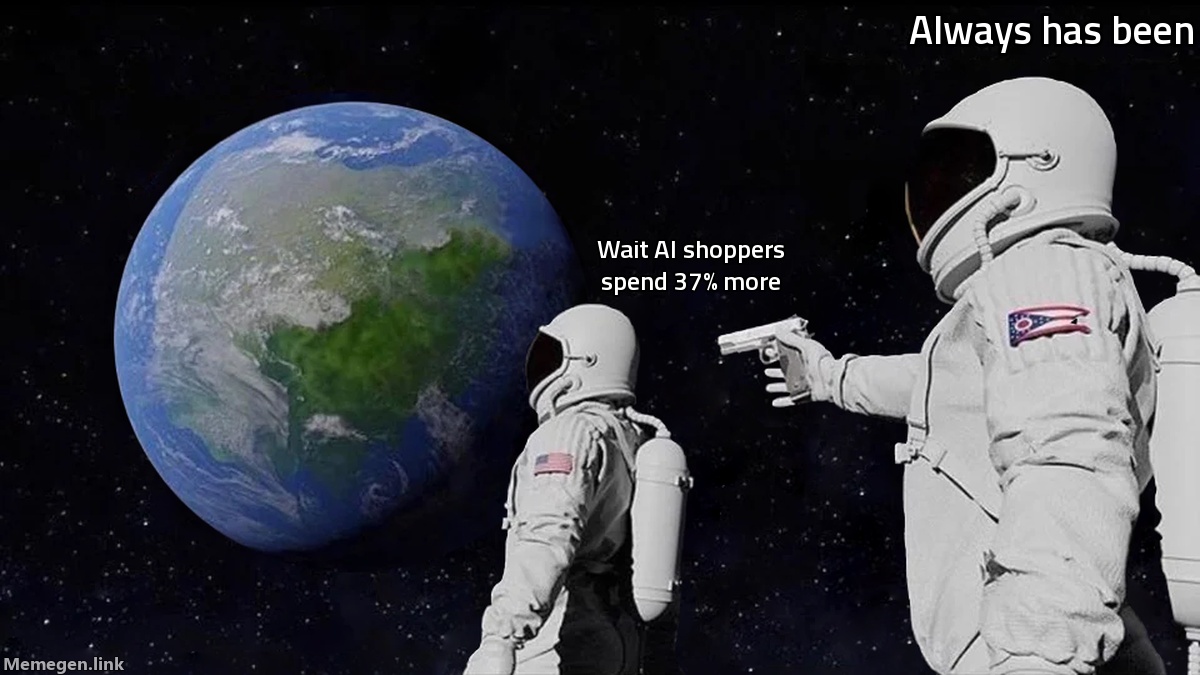
Adobe found that AI-referred shoppers spend 48% longer on site than visitors from other channels. They browse 13% more pages per session. And they generate 37% more revenue per visit.
That's not a marginal lift. A 37% revenue difference per visit means if you're treating this traffic the same as organic search in your bidding and budget models, you're consistently mis-weighting it. Every allocation decision — which pages to push, where to invest in content, how to structure landing page tests — should account for that variance.
The behavior makes sense once you understand the intent behind it. These visitors aren't browsing. They arrived at your site after explaining a specific problem to an AI assistant, receiving a recommendation, and deciding to investigate further. That's a fundamentally different mental state than someone clicking a search ad while skimming results. They've already done the comparison shopping. They're here to verify.
Why your product pages fail this visitor
Your product pages were optimized for a different buyer: someone who scans the headline, checks the price, looks at the photos, and bounces if the imagery isn't compelling.
AI-referred shoppers read. They look for specifications. They want to understand precisely why this product solves the problem they described. They arrived with context — and they want your content to match it.
A product page with a 30-word description, five bullet points, and a photo carousel does nothing for someone who told Gemini they needed a 12-inch cast iron skillet that works on induction and fits a standard dishwasher. If your page doesn't answer those questions in text, they go back to the AI and ask for a different recommendation.
The structural problem runs deeper than copy length. AI models pull recommendations from well-organized content. Product pages with thorough descriptions, technical specifications written as actual data rather than marketing language, and Product schema markup with all recommended fields filled — those score better in AI recommendation surfaces. Thin pages don't just fail to convert; many of them never get surfaced in the first place.
The paid media angle
This traffic is free today. That window is closing.
OpenAI has launched CPC advertising inside ChatGPT. Google is testing Direct Offers inside AI Mode, where advertisers can embed discounts directly into AI-generated responses. Within 12 months, paid placements in AI-native surfaces will appear on every serious e-commerce media plan alongside Meta and Search.
The brands that benefit most from those placements will be the ones with product content already structured correctly. Paid placement in an AI surface doesn't override weak structured data — it just drives more people to a page that can't answer their questions. Getting the organic foundation right now costs nothing and builds the base for what comes next.
What to fix before this traffic scales
Start with your top 20 highest-revenue product pages and check four things:
- Can a first-time visitor fully understand the product from the text alone, with no images?
- Are dimensions, materials, compatibility, and common edge cases explicitly stated in the copy?
- Are you running Product schema with all recommended fields populated?
- Are the most common customer questions answered on the page itself — not buried in reviews?
You don't need to rebuild your entire catalog. The pages with the highest revenue at stake are also the most likely to already be appearing in AI recommendations. Fix those first.
If you want a read on how your current account and landing page structure holds up as this traffic scales, a free audit gives you a clear picture in about three minutes.
The Q1 data is already written. The only question is whether your product content is positioned to benefit from what Q2 and beyond will bring.
Related articles: chatgpt-product-feed-ads-ecommerce-2026 · pmax-hybrid-strategy-ecommerce-2026
Sources: Adobe Analytics, BigFlare, Boot Camp Digital, May 2026